
Your cart (0)
Your cart is empty
Tax included and shipping calculated at checkout
Your cart is empty
Tax included and shipping calculated at checkout

Getting your RV solar system sizing wrong can leave you stranded without power in remote locations or waste thousands on oversized equipment. Whether you’re planning weekend adventures in a lightweight 16 ft camper or extended boondocking trips in a 30-foot RV, proper solar calculations ensure reliable off-grid independence while maximizing your investment.
This guide covers everything from basic load analysis to advanced system optimization, helping you design the perfect solar setup for your specific RV weight class and adventure style.
Before diving into calculations, understanding these fundamental concepts prevents costly mistakes:
Watts vs. Watt-Hours: Watts measure instantaneous power draw (like a speedometer), while watt-hours represent total energy consumption over time (like an odometer). Your 50W refrigerator running 24 hours consumes 1,200 Wh daily.
Rated vs. Real Output: Panel specifications assume perfect conditions. Real-world output averages 75-80% of rated capacity due to temperature, dust, and angle variations.
Amp-Hours (Ah): Battery capacity measurement. A 100Ah battery theoretically provides 100 amps for one hour or 10 amps for ten hours.
Peak Sun Hours: Not daylight hours, but equivalent full-sun intensity time. California averages 6 peak hours, while northern states average 4-5 hours seasonally.
System Efficiency: Account for 20-25% losses from wiring resistance, inverter conversion, and environmental factors. Never calculate at 100% efficiency.
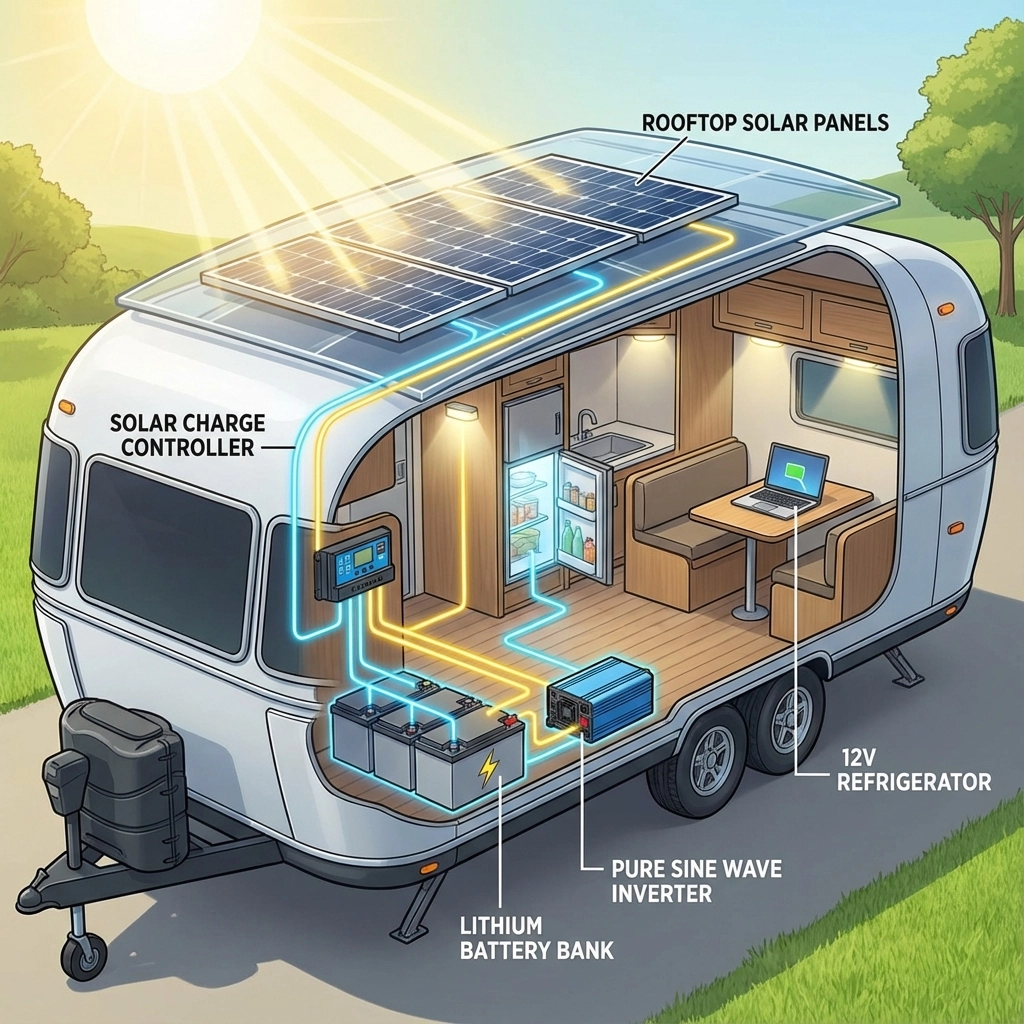
Accurate power assessment forms your system’s foundation. List every electrical device and calculate daily consumption using this formula:
Daily Consumption (Wh) = Device Wattage × Hours Used Per Day
Here’s a comprehensive load table for different RV sizes:
Example Calculation: A typical off-road travel trailer setup consuming 1,800 Wh daily needs: LED lights (120 Wh) + 12V fridge (1,200 Wh) + water pump (90 Wh) + electronics (390 Wh) = 1,800 Wh total.
Monocrystalline: Highest efficiency (18-22%), best for space-limited roofs on compact 18 ft campers. More expensive but maximizes power per square foot.
Polycrystalline: Good efficiency (15-18%) at lower cost. Suitable for larger RVs with ample roof space.
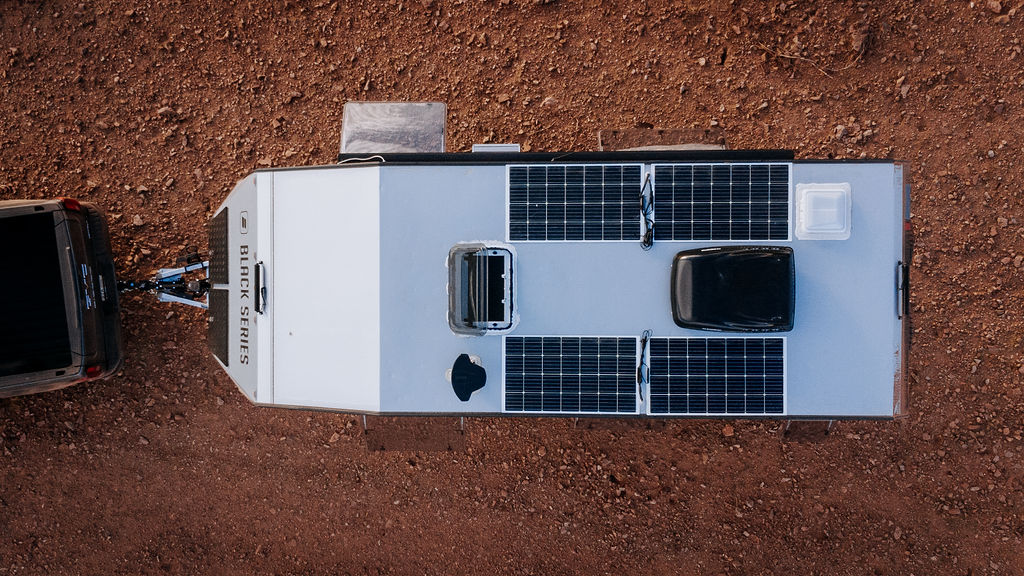
Flexible Panels: Lightweight and curved-surface compatible, ideal for aerodynamic builds but less durable long-term.
Use this industry-standard formula accounting for real-world conditions:
Required Panel Watts = Daily Consumption (Wh) ÷ Peak Sun Hours ÷ System Efficiency
Example: 1,800 Wh daily consumption ÷ 5 peak sun hours ÷ 0.77 efficiency = 468W minimum capacity
Roof space varies dramatically by RV size. A compact 16 ft camper might accommodate 200-400W, while a spacious 30 ft RV can handle 800-1,200W installations. Consider existing roof penetrations, air conditioning units, and weight distribution when planning your 2025 off-road travel trailer solar setup.
Lead-Acid Deep Cycle: Lower upfront cost but heavier, shorter lifespan (3-5 years), and 50% usable capacity due to depth-of-discharge limitations.
Lithium Iron Phosphate (LiFePO4): Higher initial investment but 80-90% usable capacity, 10+ year lifespan, and significantly lighter weight: crucial for 24 ft camper weight management.
Required Capacity (Ah) = Daily Consumption (Wh) ÷ System Voltage ÷ Depth of Discharge
Example: 1,800 Wh ÷ 12V ÷ 0.80 (LiFePO4) = 188Ah minimum
Storage Planning: Size for 1-2 days of autonomy without solar input. Include 20% buffer for battery longevity and unexpected weather.
Battery weight significantly impacts your RV’s carrying capacity:
Size inverters for simultaneous peak loads, not daily consumption totals. Add all AC devices you’ll run concurrently:
Example Peak Load: Microwave (1,500W) + Coffee maker (700W) + Laptop charger (65W) = 2,265W simultaneous demand
Select a 2,500W+ pure sine wave inverter for this scenario. Our comprehensive travel trailer inverter guide covers selection criteria in detail.
Modern systems include:

Charge Controllers: Victron SmartSolar MPPT series offers Bluetooth monitoring and maximum power harvesting efficiency.
Batteries: Battle Born or Renogy LiFePO4 provide proven reliability for demanding off-road applications.
Monitoring: Victron BMV-712 or Lynx system provides precise state-of-charge readings and historical data.
Panel Cleaning: Monthly cleaning maintains 95%+ output efficiency. Use soft brushes and deionized water.
Connection Inspection: Check MC4 connectors and terminal tightness seasonally. Corrosion reduces power transmission.
Battery Health Monitoring: LiFePO4 batteries need periodic cell balancing. Monitor individual cell voltages monthly.
Sealant Inspection: Roof penetrations require annual sealant inspection to prevent water damage.
Q: How do I quickly estimate my solar needs?
A: Divide your daily watt-hour consumption by your location’s average peak sun hours, then multiply by 1.3 for system losses. This gives you minimum panel wattage requirements.
Q: Can solar power run my RV air conditioner?
A: Yes, but it requires substantial investment. A 15,000 BTU RV AC needs 1,200-1,500W continuous power, requiring 800W+ solar panels and 400Ah+ battery bank. Soft-start devices reduce initial surge requirements.
Q: Why does my system produce less power than rated?
A: Real-world conditions differ from laboratory testing. Temperature, shading, dust, and installation angles reduce output by 20-30%. Quality MPPT charge controllers help maximize available power.
Q: Should I choose lithium or lead-acid batteries?
A: Lithium offers superior performance for serious RVers: 2x usable capacity, 3x lifespan, and 50% weight reduction. The higher upfront cost pays back through longevity and performance, especially critical for off-road travel trailer applications.
Q: How much roof space do I need for adequate solar?
A: Plan 100W per 7-10 square feet of unshaded roof space. A typical 30-foot RV has 200-300 square feet of usable roof area, supporting 800-1,200W installations comfortably.
Ready to upgrade your RV’s power independence? Explore our best 2025 recreational vehicles featuring factory solar-ready designs optimized for off-grid adventures. Contact BlackSeries RV to discuss custom solar solutions for your specific travel style and power requirements.