
Your cart (0)
Your cart is empty
Tax included and shipping calculated at checkout
Your cart is empty
Tax included and shipping calculated at checkout

When you're deep in the wilderness with your off-road travel trailer, reliable power becomes essential for comfort and safety. While solar panels provide excellent sustainable energy, they can't always meet your needs during extended cloudy periods or high-demand situations. That's where a portable generator becomes your power lifeline, ensuring your RV batteries stay charged regardless of weather conditions.
This comprehensive guide will walk you through everything you need to know about safely and efficiently using a generator to charge your RV battery system in 2026, from equipment selection to step-by-step procedures and maintenance best practices.
Before diving into generator charging, it's crucial to understand your battery system. Lead-acid batteries remain the most common and affordable option, typically requiring 6-8 hours for a full charge from 20-30% capacity. AGM (Absorbed Glass Mat) batteries offer better performance and faster charging than traditional lead-acid, while LiFePO4 (lithium iron phosphate) batteries charge approximately four times faster and can handle deeper discharges.
Generator capacity is measured in watts, which determines how much power your unit can deliver simultaneously. Amps (amperage) indicate the charging current flowing to your batteries, while volts (voltage) represent the electrical pressure. For RV applications, you'll work primarily with 12V DC battery systems powered through 120V AC generator output.
Your RV's built-in converter/inverter transforms AC power from the generator into DC power for battery charging. Many modern RVs include smart chargers that automatically adjust charging phases (bulk, absorption, and float) for optimal battery health. MPPT charge controllers and dedicated battery chargers can provide more precise charging control than basic converters.
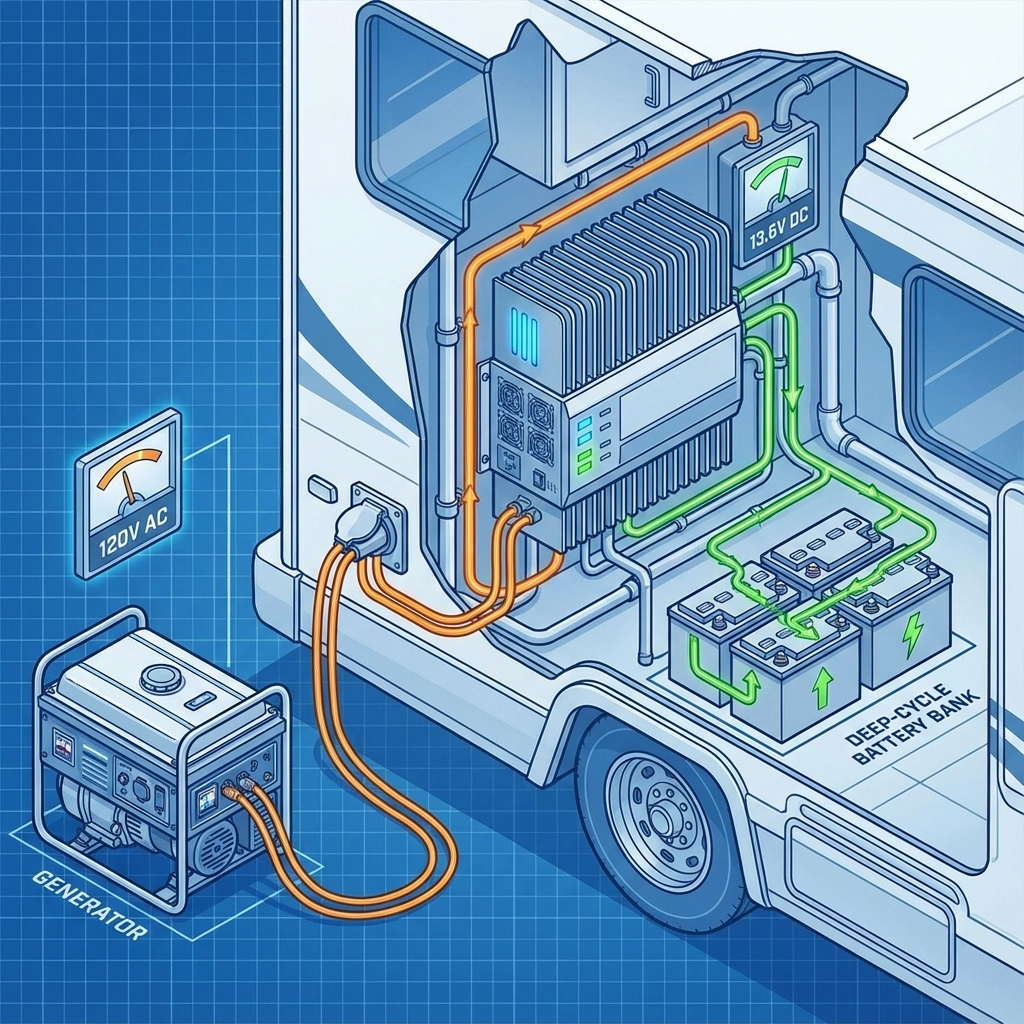
Start by checking your battery's current state of charge using a multimeter or battery monitor. A healthy 12V battery should read around 12.6 volts when fully charged, while 12.0 volts indicates approximately 50% charge. Inspect terminals for corrosion, loose connections, or physical damage before proceeding.
Different battery types have specific charging requirements. Lead-acid batteries should never discharge below 50% capacity, while lithium batteries can safely discharge to 20% or lower without damage.
For most RV battery charging applications, a 2000-4000 watt generator provides adequate power. A 2000W unit handles basic battery charging and essential systems, while 4000-5500W generators can simultaneously power your air conditioning, charge batteries, and run other appliances.
Consider your total power needs: battery charging typically requires 10-50 amps depending on your system size, which translates to roughly 120-600 watts of actual charging power. However, larger generators provide faster charging and system flexibility.
Always wear safety equipment including gloves and eye protection. Position your generator at least 20 feet from your RV and ensure adequate ventilation to prevent carbon monoxide buildup. Never operate a generator inside your RV or in enclosed spaces.
Connect your RV's standard 30A or 50A shore power cord to the generator's matching outlet. Your RV's built-in converter will automatically begin charging the batteries once connected. For faster charging, consider using a dedicated smart battery charger connected directly to your battery bank.
Modern smart chargers automatically cycle through three charging phases:
Start your generator and allow it to warm up for 5-10 minutes before connecting your RV. Monitor battery voltage and charging current using your RV's display panel or a dedicated battery monitor. Charging times typically range from 2-8 hours depending on battery type, capacity, and discharge level.
Turn off non-essential systems to maximize power flow to your batteries. Many RVers find that shutting off lights, water pumps, and entertainment systems can reduce charging time by 20-30%.
For basic battery maintenance and small RV systems, compact generators in this range offer portability and fuel efficiency. These units work well for maintaining battery charge during extended stays or charging smaller battery banks overnight.
Pros: Lightweight, quiet operation, lower fuel consumption
Cons: Cannot power high-demand appliances simultaneously with charging
This category represents the sweet spot for most RV applications. These generators can handle battery charging while simultaneously powering air conditioning, refrigeration, and other essential systems. Popular among owners of off-road travel trailers who need reliable power in remote locations.
Commercial-grade units suitable for large RV systems with multiple battery banks, high-capacity inverters, and energy-intensive appliances. These generators excel in luxury RV applications or extended off-grid living situations.
Look for generators with Automatic Voltage Regulation (AVR) to protect sensitive electronics. Low CO emission technology enhances safety during operation. 50A RV outlets eliminate the need for adapters, while quiet operation (under 65 decibels) maintains campground courtesy.

Many experienced RVers combine both systems for maximum reliability. Solar handles daily power needs during sunny conditions, while generators provide backup power during storms, winter months, or high-demand periods. This hybrid approach optimizes both cost and convenience for serious off-grid adventures.
When paired with a quality travel trailer inverter, generators become even more versatile, providing clean AC power for sensitive electronics while maintaining efficient battery charging.
Never allow lead-acid batteries to discharge below 50% capacity, as deep discharges significantly reduce battery lifespan. Lithium batteries tolerate deeper discharges but perform best when maintained above 20% capacity. Use a battery monitor to track real-time capacity and set low-voltage alarms.
Invest in a quality smart charger or converter that provides multi-stage charging. These units automatically adjust charging current and voltage throughout the charging cycle, maximizing battery life and performance. Progressive Dynamics and Victron offer excellent converter options specifically designed for RV applications.
Inspect battery terminals monthly for corrosion or loose connections. Clean terminals with a baking soda solution and apply terminal protector spray to prevent future corrosion. Check electrolyte levels in flooded lead-acid batteries, adding distilled water as needed.
Store batteries in temperature-controlled environments when possible. Extreme temperatures significantly impact charging efficiency and battery longevity. Cold weather can extend charging times by 50% or more, while excessive heat accelerates battery degradation.

Yes, but always use your RV's built-in converter or a dedicated smart charger rather than direct connection. Direct DC charging from a generator requires specialized equipment and can damage batteries if not properly regulated. Your RV's converter safely transforms generator AC output into appropriate DC charging current.
Charging time depends on battery type, capacity, and discharge level. Lead-acid batteries typically require 6-8 hours for full charging from 50% capacity, while lithium batteries can reach full charge in 2-4 hours. A 100Ah lithium battery with a 50-amp converter charges from 50% to full in approximately 1 hour.
Absolutely, but ensure your charging system supports lithium battery profiles. Lithium batteries require different charging voltages than lead-acid batteries. Many newer RV converters include selectable battery types, while older units may need replacement or adjustment for optimal lithium charging.
Yes, modern charge controllers and converters can accept multiple power sources simultaneously. The system automatically prioritizes the strongest power source while preventing conflicts. This setup maximizes charging speed and provides redundant power sources for enhanced reliability.
Generator operation is subject to local noise ordinances and campground regulations. Most campgrounds restrict generator use to specific hours, typically 8 AM to 8 PM. Some wilderness areas prohibit generators entirely, making solar power essential for these locations. Always check local regulations and respect quiet hours to maintain positive relationships with fellow campers.
Generator charging remains an essential skill for serious RV adventurers, providing reliable power independence regardless of weather conditions. When combined with proper safety procedures and quality equipment, generators offer unmatched flexibility for extended off-grid adventures. Whether you're exploring remote locations with a rugged off-road trailer or simply need backup power for weekend getaways, understanding generator charging techniques ensures you're never left without power when you need it most.
Explore the Black Series lineup
Ready for the trail? See the Black Series HQ19 Luxury Off-Road Travel Trailer — built for long, off-grid expeditions.
Related reading:
Keep going: How long can you stay off-grid? Solar & battery calculator · Black Series guides hub