
Your cart (0)
Your cart is empty
Tax included and shipping calculated at checkout
Your cart is empty
Tax included and shipping calculated at checkout

Limited time RV offers 2026 refer to short-term promotions, trade-in incentives, and special pricing available for select RV models during specific periods in 2026. These deals range from factory-direct discounts to inventory clearances, and they’re designed to move specific units during strategic windows throughout the year.
If you’ve been eyeing an off-road travel trailer or considering an upgrade, 2026’s promotional landscape is shaping up differently than previous years. Promotions are shorter, more targeted, and often focused on configuration upgrades rather than pure price cuts. Here’s how to navigate them without getting burned.
Not all “deals” are created equal. Limited time RV offers typically fall into four main categories:
Seasonal Promotions: These hit during predictable windows, early spring before the camping rush, late fall when dealers want to clear inventory before winter, and model-year transitions. Right now, early 2026 is seeing aggressive pre-order discounts, with some dealers offering factory-direct savings ranging from $4,600 to over $24,000 depending on the model.
Inventory Clearance: When a dealer has too many units of a specific floorplan or an outgoing model year sitting on the lot, they’ll slash prices to move metal. These offers can be gold mines if the unit you want happens to be the one they need gone.
Trade-In/Upgrade Incentives: Manufacturers and dealers periodically boost trade-in valuations to pull owners out of older rigs and into newer inventory. Off-road RV trade-in programs are especially hot in 2026 as more buyers realize their standard travel trailer can’t handle the BLM routes they’re chasing.
Model-Year Transition Incentives: When 2027 models start rolling in, 2026 inventory gets pushed out with special pricing. But here’s the thing, for off-road trailers with rugged builds and galvanized chassis, last year’s model often performs identically to the newest release.
The urgency factor matters because RV pricing isn’t static. Unlike cars, RVs don’t follow a fixed depreciation curve. A unit sitting on a lot for six months might cost more than one pre-ordered through a factory-direct channel, simply because the dealer needs to recoup storage and interest costs.
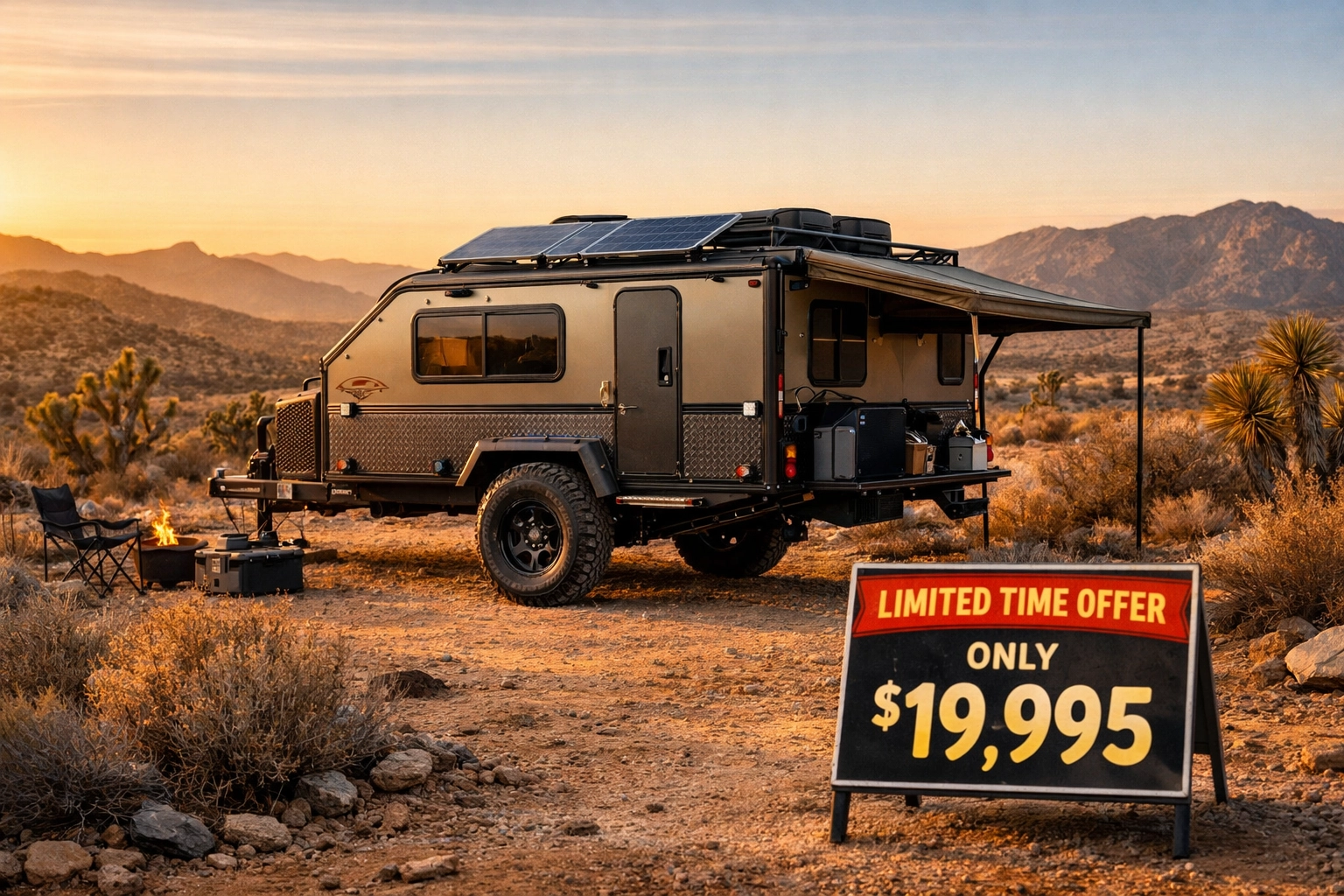
Here’s where people mess up: they see “$10,000 OFF!” and assume they’re winning. But what are you actually getting?
Discount vs. Upgrade Value: A $10,000 cash discount on a base-model travel trailer might sound better than a $6,000 credit toward upgraded features, until you realize those features include a lithium power upgrade that would’ve cost you $8,000 aftermarket. Run the math on actual value, not sticker shock.
Cash Incentives vs. Configuration Upgrades: Some of the best RV upgrade deals in 2026 are built around throwing in premium gear, solar arrays, upgraded suspension, reinforced axles, rather than cutting the base price. For off-road builds, this is huge. You’re getting factory-installed components with warranty coverage instead of paying a shop to retrofit them later.
Period Limits vs. Inventory Limits: “Offer ends March 15” doesn’t mean much if they only have three units that qualify and they sell out March 2. Always ask: “Is this time-limited or inventory-limited?” The answer changes your negotiating position.
One more thing: beware of deals tied to financing. “Zero percent APR for 60 months” often means you forfeit other rebates. For cash buyers or those with third-party financing locked in, that “deal” might actually cost you more.
Off-road promotions in 2026 are leaning heavy into equipment packages instead of pure price drops. Why? Because the buyers shopping for off-road camper trailers aren’t price shopping, they’re capability shopping.
Off-Road Kits: Free or discounted upgrades often include all-terrain tires, reinforced hitch assemblies, protective rock guards, and skid plates. These components can add $3,000–$5,000 to a build if purchased separately.
Power/Off-Grid Upgrades: Dealers are bundling off-grid power systems, lithium battery banks, solar panel arrays, upgraded inverters, into promotional packages. This makes sense: if you’re buying a trailer to hit Forest Service roads, you need power autonomy. Offering a 400-watt solar setup as part of the deal moves units faster than a $2,000 price cut.
Structural & Chassis Configurations: Independent suspension, galvanized frames, and increased ground clearance are the real game-changers for off-road use. Some 2026 promotions are waiving upgrade fees for these features on specific models. That’s a big deal, because retrofitting suspension geometry after purchase is a nightmare.
Why do off-road offers focus on configuration? Because the average weight of camper units in the off-road category, especially compact builds like an 18 ft camper weight model, allows for heavier-duty components without exceeding most mid-size truck tow ratings. Dealers know their buyers understand the value of a lighter, tougher build with premium gear.

Trade-in promotions in 2026 are structured differently than straight sales. Here’s how they break down:
Trade-In Credit Forms: Most dealers offer a guaranteed minimum trade-in value during promotional windows. For example, you might get $15,000 credit toward a new unit even if your current rig only books at $12,000. The catch? That extra $3,000 is typically a “trade-assist bonus” that only applies if you’re buying during the promo period.
Upgrade-Based Trade-Ins: These are specifically designed for owners of standard travel trailers who want to move into off-road trailer RVs. The dealer evaluates your current unit, then applies an enhanced credit if you’re upgrading to a higher-capability model. It’s a way to pull buyers into premium inventory without cutting prices across the board.
Time Windows & Condition Restrictions: Trade-in bonuses are almost always short-cycle. You might have 30 days to act, and the vehicle you’re trading must meet condition standards. Structural damage, significant wear, or missing components can disqualify you from the enhanced valuation.
Here’s a pro move: if you’re planning to trade in, get your rig independently appraised before walking into a dealership. You’ll know exactly where the market sits, and you’ll spot inflated “bonus” offers that are really just bringing you up to fair market value with better marketing.
Timing is everything. Based on current 2026 market trends and historical patterns, here are the windows to watch:
Year-Start (January–March): Early 2026 is seeing aggressive pre-order discounts, particularly on factory-direct builds. Dealers want commitments before spring inventory arrives. Right now, some programs are offering discounts ranging from $4,600 on compact travel trailers up to $24,000 on larger models. Winter and early spring also deliver better negotiating power because demand is lower.
Summer (June–August): This is actually the worst time to buy if you’re price-sensitive. Demand peaks, inventory moves fast, and dealers have zero incentive to negotiate. However, if you’re looking at a specific model and it’s in stock, you might find clearance deals on units that didn’t sell during spring. Just don’t expect deep discounts.
Model-Year Transition (September–November): When 2027 models hit the lot, 2026 inventory gets pushed out. This is prime time for closeout specials. The catch? Selection narrows. If you need a specific floorplan or configuration, you might miss out by waiting.
Why are 2026 promotions shorter and more targeted? Manufacturers learned that long-running, broad-spectrum deals just train buyers to wait. Now, they’re using scarcity and urgency to move specific inventory. The February 2026 Dallas RV SuperSale, marketed as the largest RV show in the Southwest, is a perfect example. Limited window, concentrated inventory, aggressive pricing.
One more factor: promotional cycles now account for trailer size and capability. A deal on a 30 foot rv weight model (typically 7,000–9,000 lbs) might emphasize luxury upgrades and interior features, because buyers towing that size usually have heavy-duty trucks and aren’t as concerned about payload. Meanwhile, promotions on an 18 ft camper weight or 24 ft camper weight model might focus on off-grid battery capacity and reduced GVWR, appealing to buyers with mid-size tow vehicles who need efficiency and range.

You’d be shocked how many people blow a good deal through simple errors. Here are the big ones:
Confusing “Off-Road Look” With “Off-Road Structure”: Dealers love slapping aggressive tires and black cladding on standard travel trailers and calling them “adventure-ready.” Then they put them on sale. Don’t fall for it. Check the suspension type (independent vs. leaf spring), ground clearance, chassis material (galvanized vs. standard), and frame reinforcement. If it’s just cosmetic, it’s not built for rough roads.
Ignoring Weight Distribution: You see a killer deal on a 30-foot camper and think, “My truck can tow 9,000 lbs, we’re good.” But the average travel trailer weights for a unit that size might hit 8,500 lbs loaded, leaving you zero margin for gear, water, and passengers. Worse, tongue weight might exceed your truck’s payload capacity. A deal isn’t a deal if you can’t safely tow it. Always verify GVWR, dry weight, and payload capacity before committing.
Underestimating Off-Grid Consumption: You snag a promo on an off-road trailer with a “free solar upgrade.” Great, except it’s a 200-watt panel and you’re planning week-long trips with no hookups. Running a fridge, water pump, lights, and device charging will drain a standard battery bank in two days. Factor real-world power consumption into the equation, or you’ll be buying more upgrades immediately.
Mixing Up “Promotion End Time” and “Stock End Time”: The dealer says the sale ends March 31. You assume units will be available until then. But if they only allocated five trailers to the promo and four sell by March 10, you’re out of luck. Always ask how many units qualify and how fast they’re moving.
Skipping Delivery Timelines: Pre-order deals save you money, but they also mean waiting. If you need the trailer for a June trip and the build timeline is 12–16 weeks, a February pre-order cuts it close. Factory delays happen. Plan for them.
Are limited time RV offers really time-sensitive?
Yes, but not always in the way dealers advertise. Some offers genuinely expire on a specific date. Others expire when inventory runs out, which might be sooner than the posted deadline. Always confirm whether the limitation is calendar-based or stock-based, and ask how many units are left at the promotional price.
Do limited time RV offers apply nationwide?
Not always. Some promotions are manufacturer-driven and apply across all dealers. Others are dealer-specific or regional. If you’re willing to travel or arrange long-distance delivery, you can sometimes find better deals outside your local market. Just factor in transport costs: they can eat into your savings fast.
Can trade-in offers be combined with limited time deals?
It depends on the dealer and the specific promotion. Some programs allow stacking: you get the promotional price and an enhanced trade-in credit. Others make you choose one or the other. Read the fine print and ask explicitly: “Can I apply my trade-in bonus on top of this sale price, or is it one or the other?”
How often do RV offers change in 2026?
More frequently than in previous years. Instead of quarterly or seasonal promotions, manufacturers are running shorter, 30–60 day campaigns tied to specific inventory or regional events. This creates urgency but also means you need to stay actively engaged if you’re shopping. Sign up for dealer alerts, follow manufacturer announcements, and check in monthly if you’re serious about buying.
The smartest buyers in 2026 aren’t chasing the biggest discount: they’re chasing the right configuration at the right time. Whether that’s a pre-order deal with factory-direct savings, a clearance special on last year’s inventory, or a trade-in bonus that pulls you into a legitimate off-road travel trailer, the key is knowing what you actually need before the clock starts ticking.
Because in 2026, the best deals won’t wait around.