An Overland Basecamp is a strategic, semi-permanent setup designed for deep-country exploration. Unlike traditional overlanding where you move every day, a basecamp allows you to set up a “mother ship” and explore the surrounding terrain in your unburdened vehicle. In 2026, as BLM lands become the primary destination for adventure seekers, mastering the basecamp setup is essential for long-term self-sufficiency.
What Is an Overland Basecamp?
In the world of modern exploration, we need to distinguish the “Basecamp” from other camping styles. It’s not just about parking somewhere remote, it’s a deliberate strategy.
Vs. Dispersed Camping: While both happen on public land, a basecamp is designed for multi-day residency. You’re not just stopping for the night; you’re establishing a temporary home base.
Vs. Overland Route Travel: Instead of packing up every morning and moving to the next destination, you keep your camp stationary. Your tow vehicle becomes a day-trip exploration tool, not a moving hotel.
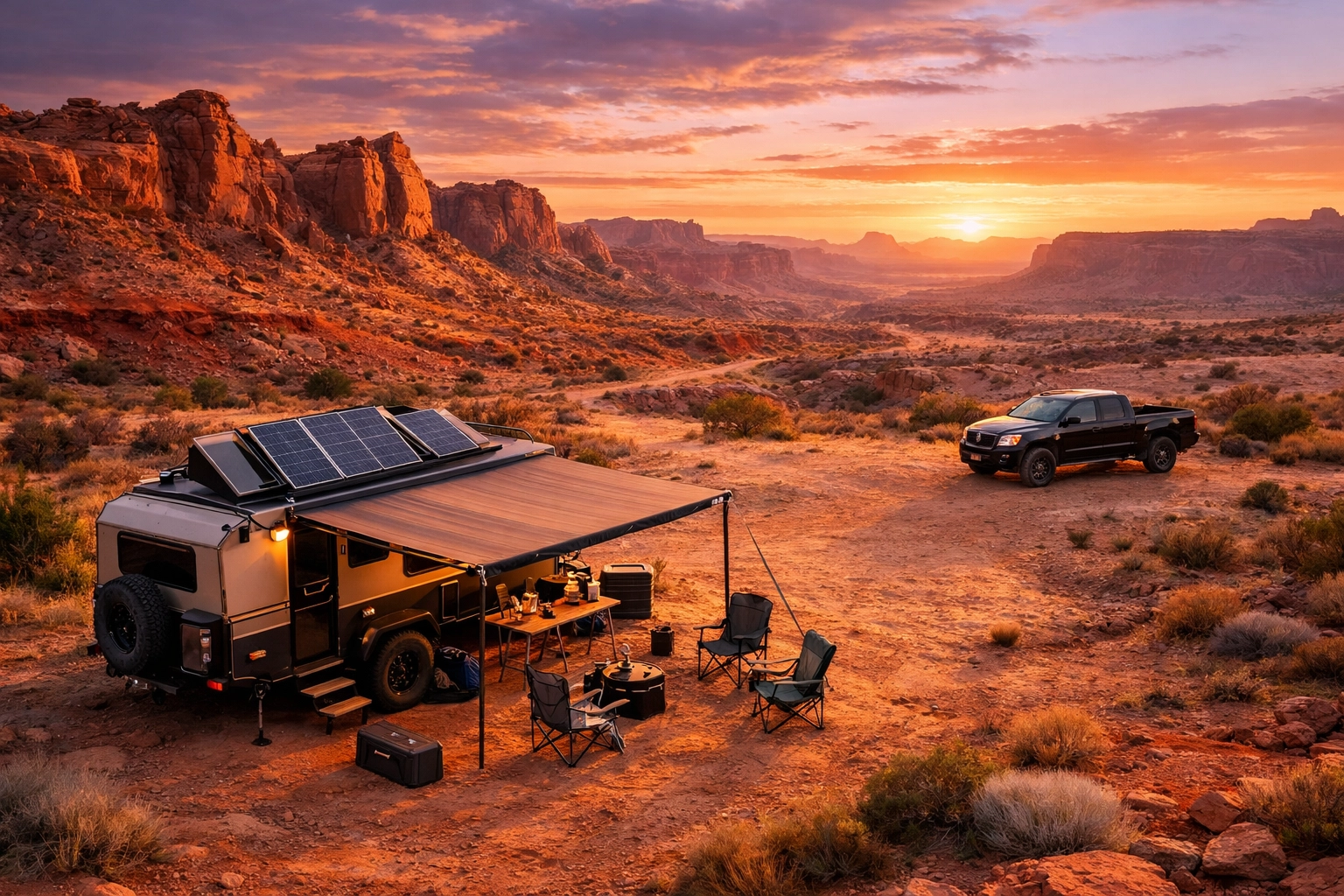
Radial Exploration: The core role of a basecamp is to serve as a hub. You unhitch your off-road travel trailer, level it once, and use your truck for “radial” day trips into more technical terrain. Think of it as your forward operating base, you can tackle challenging trails without hauling your entire living quarters.
This approach is particularly valuable in the American West, where a single region like Utah’s San Rafael Swell or Colorado’s Alpine Loop can offer weeks of exploration within a 50-mile radius.
Why Build an Overland Basecamp?
The basecamp strategy has become the go-to method for serious adventurers in 2026. Here’s why:
The Modern Adventurer Profile: Basecamping is ideal for digital nomads who need reliable power and connectivity, families who want a stable home base while exploring, and small groups who prefer depth over breadth in their travels.
U.S. Public Land Opportunities: America’s public lands are perfectly suited for basecamping:
- BLM Land: High-desert flats in Nevada, Arizona, and Utah where a stationary base provides a windbreak and energy hub. The 14-day limit gives you ample time to explore surrounding slot canyons, ghost towns, and trail systems.
- National Forests: Hidden alpine meadows in Colorado, Montana, and Wyoming where a basecamp allows for multi-day hiking, mountain biking, or fishing expeditions without breaking camp daily.
Practical Advantages: Once you’ve dialed in your basecamp, you eliminate the daily ritual of leveling, re-connecting utilities, and packing. Your solar panels stay optimally angled. Your outdoor kitchen stays deployed. Your gray water system stays configured. This efficiency means more time exploring and less time managing logistics.
How-to: Overland Basecamp Setup
Setting up an effective basecamp requires more than just parking and dropping stabilizers. Here’s the systematic approach:
Step 1: Site Selection
Prioritize flat terrain with natural drainage. In the Southwest, orient your kitchen to the leeward side of prevailing winds. Scout for morning sun exposure, your solar panels will thank you.
Look for these indicators:
- Existing fire rings (previous campers found this spot for a reason)
- Natural windbreaks (rock formations, tree lines)
- Distance from water sources (at least 200 feet per LNT principles)
- Emergency exit routes (always have a backup path out)
Step 2: Vehicle and Camp Separation
The beauty of a trailer-based basecamp is mobility. Once level, your tow vehicle is free for recovery missions, supply runs to town, or technical trail exploration. This is where the 16 ft camper weight or 18 ft camper weight range shines, compact enough for tight forest roads but substantial enough for comfortable long-term stays.
For larger groups or extended stays, a 24 ft camper weight provides the necessary internal storage for 14-day expeditions. If you’re establishing a family basecamp with multiple people, the 30 foot rv weight (or 30 ft camper weight) setup offers unmatched living space, though you’ll need to plan for a wider footprint and more accessible terrain.
Step 3: Energy and Water Configuration
Your basecamp’s autonomy depends on proper system setup:
- Solar Arrays: Angle panels toward the winter sun (lower angle) or summer sun (higher angle) based on season
- Battery Bank: A quality off-grid power system should provide 3-5 days of autonomy without sunlight
- Water Management: Calculate 2-3 gallons per person per day for cooking, cleaning, and hygiene
Step 4: Risk Assessment
Before committing to a location, evaluate:
- Weather windows (check extended forecasts)
- Ground conditions (will rain turn your site into a mud pit?)
- Wildlife activity (bear country requires different protocols)
- Cell/satellite coverage (for emergency communications)

Basecamp Setup Checklist
Overland Basecamp Gear List
Your basecamp gear divides into four categories:
Core Camp Infrastructure:
- Heavy-duty awnings to define your outdoor living space
- Ground mats to prevent vegetation damage
- Exterior lighting for nighttime functionality
- Folding tables and camp chairs rated for long-term use
Kitchen and Life Support:
- 12V fridge/freezer (dual-zone preferred)
- High-output propane stove or induction cooktop
- Dutch ovens and cast-iron cookware for campfire cooking
- Adequate food storage for your planned duration
Energy Systems:
- Lithium batteries (the heartbeat of any extended basecamp)
- Portable solar panels for supplemental charging
- Generator backup (for extended cloudy periods)
- Power monitoring system to track consumption
Emergency and Communications:
- Satellite messenger or Starlink for remote connectivity
- First aid kit scaled to your group size and trip duration
- Recovery gear (even if your trailer stays put, your truck might need help)
- Paper maps and GPS backup
The Role of a Basecamp Trailer in Overlanding
Why choose a trailer over a rooftop tent (RTT) or truck camper for basecamp operations?
Stability: A trailer provides a rigid structure that doesn’t shake in high desert winds or mountain storms. Unlike an RTT mounted on your vehicle, a properly leveled trailer offers a stable sleeping and living platform regardless of what your tow vehicle is doing.
Efficiency: No need to “fold your house” every time you want to drive to a trailhead. This is the critical advantage, your basecamp stays intact while you explore. Morning coffee doesn’t require repacking your bedding.
Space Division: A trailer creates clear zones, sleeping inside, cooking outside, vehicle for mobility. This separation makes extended stays more livable, especially for groups or families.
Weight Considerations: While the average travel trailer weights hover around 5,000 lbs for conventional models, off-road trailers in the average weight of camper category for overlanding typically range from 3,000-4,500 lbs. This keeps them within the towing capacity of most 1/2-ton trucks while providing genuine four-season comfort.
The average travel trailer weights for standard models often include features unnecessary for off-grid use, adding bulk without function. Purpose-built basecamp trailers prioritize ground clearance, chassis durability, and self-sufficiency over suburban campground amenities.
BlackSeries Perspective: We engineer our trailers specifically for the basecamp role. The independent trailing arm suspension, reinforced chassis, and integrated off-grid systems create a platform that excels at stationary deployment in challenging terrain. It’s not about marketing, it’s about structural logic for this specific use case.
Real-World Scenarios and Experience Data
Let’s ground this in actual numbers and regional differences:
Energy Consumption Math: For a 7-day basecamp stay using Starlink for connectivity, expect to consume approximately 800-1,000Ah of battery capacity if you’re not supplementing with a generator. A 30 ft rv weight rig with full residential appliances will push toward the higher end of that range. Smaller setups in the 16-18 ft camper weight class can often manage on 400-600Ah with conservative use.
Regional Differences:
American West: Open BLM lands allow for larger 30-foot camper weight rigs without access issues. The dry climate means awnings and outdoor kitchens get daily use. Solar efficiency is excellent, count on 5-6 peak sun hours even in winter.
American East: Dense National Forest roads favor the agility of the 16-18 ft class. Higher humidity means you’ll rely more on interior climate control. Tree canopy reduces solar efficiency to 3-4 peak hours, making battery capacity more critical.
Duration and Impact: The beauty of basecamp overlanding is sustainability. A well-planned setup can comfortably extend to the 14-day BLM limit. The key metrics:
- Water: 30-40 gallons for two people for 14 days (with conservation)
- Power: 200-300Ah daily consumption with Starlink and standard appliances
- Propane: 10-15 lbs for cooking and occasional heating
Leave No Trace Obligations: In 2026, staying in one spot requires strict waste management to keep public lands open. That means packing out all trash, managing gray water responsibly (no broadcast dumping), and leaving the site cleaner than you found it. The boondocking basics still apply, just amplified by your extended stay.
Frequently Asked Questions
What is an overland basecamp?
An overland basecamp is a stationary off-grid hub used for multi-day exploration of a specific region. Instead of moving camp daily, you establish a semi-permanent setup and use your unburdened vehicle for radial exploration of surrounding terrain.
How long can you stay at a basecamp?
Most BLM and USFS lands have a 14-day limit in any 28-day period. Some areas may have shorter restrictions. Always check local regulations before establishing camp.
Is a trailer better than a rooftop tent for basecamping?
For extended stays, yes. A trailer provides superior stability, doesn’t require daily setup/teardown, and frees your vehicle for exploration. RTTs excel at mobile overlanding, while trailers dominate the basecamp strategy.
Where is overland basecamping legal in the USA?
Throughout most BLM land and National Forests, provided you follow dispersed camping regulations. State Trust Lands require permits in many states. National Parks typically restrict backcountry camping to designated sites. Always verify current regulations for your target area.
What size trailer is best for a basecamp?
It depends on group size and access terrain. A 16 ft camper weight or 18 ft camper weight offers maximum maneuverability for tight forest roads. A 24 ft camper weight balances space with accessibility. Anything in the 30 ft camper weight category provides maximum comfort but requires wider, more maintained access roads.
Start Your Basecamp Journey
The basecamp strategy transforms how you experience America’s wild spaces. Instead of rushing through a checklist of destinations, you dive deep into a single region: understanding its geology, weather patterns, hidden trails, and seasonal changes.
Ready to build your ultimate exploration hub? Check out our range of off-road travel trailers engineered specifically for extended off-grid deployment. From the compact HQ17 to the spacious HQ21, each model is built with the basecamp mission in mind: reliable systems, durable construction, and the ground clearance to access the places worth staying.
Your next 14-day expedition starts with the right basecamp strategy. Choose your terrain, plan your radial routes, and let your trailer do what it does best: provide a stable home while you explore everything within reach.

