Let’s be honest: most RVs are built for campgrounds with full hookups and flat, paved roads. But what if you want to chase sunsets deep in the Mojave Desert, camp beside alpine lakes in the Rockies, or disappear for weeks on BLM land where the nearest cell tower is a hundred miles away? That’s when you need an RV that can truly go anywhere.
In 2026, the gap between “pavement queens” and genuine off-road rigs has never been wider. With advancements in independent suspension systems, lithium power redundancy, and all-terrain chassis design, the best adventure RVs are now capable of reaching places that would’ve been unthinkable a decade ago. Whether you’re considering a 4×4 motorhome or a reinforced off-road travel trailer, this guide will help you understand what separates the pretenders from the real deal.
What Defines an “RV That Can Go Anywhere”?
A true “go-anywhere” RV isn’t just about slapping bigger tires on a standard travel trailer and calling it a day. The difference lies in three core engineering elements: ground clearance, independent suspension systems, and reinforced chassis construction.
Ground clearance is your first line of defense against rocks, ruts, and uneven terrain. While a typical travel trailer sits around 8–10 inches off the ground, a legitimate off-road RV needs at least 12–16 inches to handle washed-out forest service roads, desert washes, and boulder fields. This extra height prevents your undercarriage from bottoming out on obstacles that would leave a standard rig stranded or damaged.
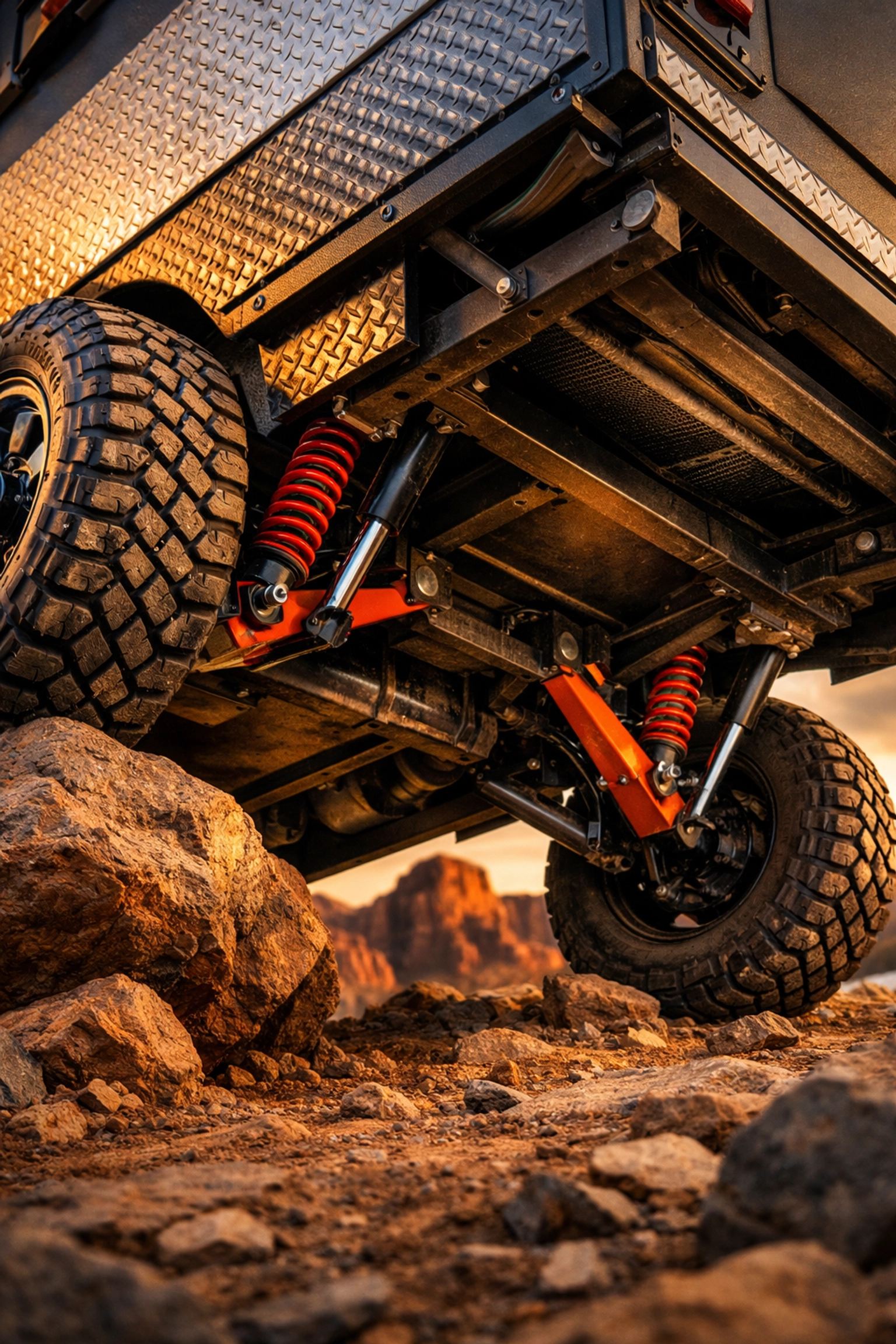
Independent suspension is where the magic happens. Unlike traditional leaf-spring or torsion axle setups that treat both wheels as a single unit, independent suspension allows each wheel to react independently to terrain changes. This means better traction, improved handling, and dramatically less stress on your trailer’s frame when one wheel hits a rock while the other drops into a rut. BlackSeries pioneered this approach in the off-road trailer market, and it’s become the benchmark for serious adventure rigs.
Reinforced chassis construction ties it all together. A go-anywhere RV needs a fully welded steel frame (not just aluminum or wood framing), diamond-plate armor on vulnerable areas, and a chassis designed to flex and absorb impacts without cracking or separating. This is where you’ll see the biggest difference between a “rugged-looking” RV and one that’s actually engineered for punishment.
The common misconception? That width and length automatically disqualify an RV from off-road use. While a compact 16-footer is certainly more nimble on tight switchbacks, a well-designed 21-foot or even 24-foot off-road trailer can handle the same terrain if it has proper articulation and approach/departure angles. It’s not about size: it’s about engineering.
Another myth: “High ground clearance equals all-terrain capability.” Not true. Ground clearance is useless without the suspension to keep your wheels planted and the structural integrity to handle side-loading forces on steep off-camber trails.
Best Off-Road RVs That Can Go Anywhere (2026 Top Picks)
The 2026 market offers two primary paths to boundless adventure: 4×4 motorhomes and off-road capable travel trailers. Each has distinct advantages depending on your adventure style.
4×4 Motorhome Platforms
The Sprinter 2500 AWD and Ford Transit AWD chassis have dominated the Class B and compact Class C segments in 2026. Models like the Jayco Terrain (starting at $221,993) and Entegra Coach Launch deliver Mercedes-Benz all-wheel-drive traction with turbocharged 2.0L twin-turbo diesel engines producing 211 horsepower. The 144-inch wheelbase provides surprising maneuverability for tight backcountry access roads.
For 2026, these platforms now include 360-degree camera systems, MBUX infotainment with real-time terrain mapping, and Koni shocks with heavy-duty stabilizer bars for smoother handling on washboard roads. The Winnebago Revel has been redesigned with upgraded technology and interior layouts specifically engineered for adventures beyond pavement.
Off-Road Capable Travel Trailers: The Smarter Choice?
Here’s the advantage most people overlook: a travel trailer lets you unhook and use your 4×4 truck for even deeper exploration. Once you’ve set up base camp, you can tackle Class 4 trails, scout fishing spots, or make supply runs without breaking camp. You’re essentially getting two vehicles in one setup.
This is where BlackSeries off-road trailers have changed the game. With fully independent suspension, military-grade construction, and chassis flex built into the design, these rigs can handle terrain that would destroy a conventional travel trailer. The outdoor kitchen, 200+ amp-hour lithium systems, and integrated solar make them self-sufficient for weeks at a time.
The HQ17 and HQ19 models strike the perfect balance between livable space and tight-trail accessibility, while the HQ21 offers full luxury for extended off-grid living. Unlike motorhomes, if your tow vehicle breaks down, you haven’t lost your entire mobile home: just your transportation.

How to Choose an RV That Can Travel Anywhere
Choosing the right go-anywhere RV comes down to matching your terrain, budget, and lifestyle needs. Here’s the framework that actually works in 2026:
Define Your Primary Terrain
Desert environments (Arizona, Utah, Nevada) demand excellent insulation for temperature extremes, robust water storage (60+ gallons), and dust-sealed entry points. Ground clearance is critical for washes and embedded rocks.
Rocky mountain trails (Colorado, Montana, Wyoming) require maximum suspension articulation, aggressive all-terrain tires, and strong braking systems for steep descents. Look for approach angles of 30+ degrees.
Muddy forest roads (Pacific Northwest, Upper Midwest) need wider tires with deep lugs, sealed electrical systems, and chassis protection against corrosive mud buildup.
The Weight Question: Size vs. Access
This is where those technical specs matter. Understanding average travel trailer weights helps you balance capability with comfort.
A 16 ft camper weight typically ranges from 2,800–3,500 lbs dry. This gives you exceptional access to narrow trails and tight switchbacks, but you’ll sacrifice interior living space and freshwater capacity.
An 18 ft camper weight usually sits between 3,200–4,000 lbs, offering a sweet spot for couples who want a real bed, bathroom, and kitchen without the bulk of larger units.
Jump to a 24 ft camper weight (4,500–5,500 lbs) and you gain slide-outs, separate sleeping areas, and bigger tanks: but you’ll need a ¾-ton truck and you’ll be limited on the tightest backcountry roads.
The 30 foot rv weight (or 30 ft rv weight / 30-foot camper weight) enters the 7,000–9,000 lb range. These are luxurious, but unless you’re sticking to well-maintained forest service roads and large BLM dispersed sites, the size becomes a liability on technical terrain.
When comparing options, always check the average weight of camper in your target category against your tow vehicle’s capacity. A reinforced off-road chassis adds 300–600 lbs over standard construction, so factor that into your calculations.
Performance Checklist
Before signing anything, verify:
- Ground clearance: Minimum 12 inches at the lowest point
- Suspension travel: At least 6 inches of wheel articulation
- Towing capacity match: Your truck’s tow rating should exceed loaded trailer weight by 20%
- Water capacity: 40+ gallons for extended boondocking
- Electrical system: Minimum 200Ah lithium for off-grid comfort
- Solar capability: 300+ watts for energy independence
Budget vs. Capability Trade-offs
A true off-road trailer starts around $35,000–$45,000 for entry-level models (think rugged teardrops or compact squaredrops). Mid-range adventure trailers with full amenities run $60,000–$90,000. Premium rigs like the BlackSeries HQ models start around $85,000 and can exceed $120,000 with full options: but you’re getting military-grade construction, Australian engineering, and components designed for Outback abuse.
4×4 motorhomes are significantly pricier, with quality Class B options starting near $180,000 and climbing past $250,000 for top-tier builds.
Remember: cheaper upfront often means expensive repairs later. A $40,000 “off-road” trailer with standard construction will need costly upgrades (suspension, tires, frame reinforcement) to handle serious terrain.
Preparing Your RV for Remote Terrain
Even the best RV needs proper preparation before tackling remote destinations. Here’s the pre-departure checklist that prevents expensive mistakes:
Vehicle Systems Check
Suspension and Tires are your lifeline. Inspect shock absorbers for leaks, check all bushings and bolts for tightness, and verify proper tire pressure for the terrain ahead. Most off-roaders run 35–45 PSI for highway transit, then air down to 20–28 PSI for improved traction and ride quality on dirt roads. Don’t forget to inspect your spare: it’s useless if it’s flat when you need it.
Chassis and Frame inspection should catch problems before they strand you. Look for cracks around welds, loose bolts on the hitch system, and signs of stress on the frame. Check that your weight distribution system is properly adjusted. An unbalanced trailer will fishtail on rough roads and put unnecessary stress on both your truck and trailer frames.
Brake Systems deserve extra attention for mountain descents. Verify your trailer brakes engage properly and that your brake controller is calibrated correctly. Test on a safe road before heading into remote areas.
Energy and Water Redundancy
In 2026, energy independence isn’t optional: it’s essential. A robust solar power system (300+ watts) paired with lithium batteries (200–400 Ah capacity) lets you run refrigeration, lights, fans, and even air conditioning without generator noise or fuel dependency.
Water system preparation means more than just filling your tank. Inspect all connections for leaks, sanitize your fresh water system, and verify your water pump functions properly. Carry collapsible jerry cans for an extra 10–20 gallons when you find a reliable source. Install a quality water filter: backcountry sources aren’t always clean.
Add a backup power option like a portable generator or vehicle alternator charging system. When clouds roll in for three days straight, solar won’t cut it.
Recovery and Emergency Equipment
Never venture into remote terrain without proper recovery gear:
- Heavy-duty recovery straps (rated for 2x your trailer weight)
- D-ring shackles (3/4″ minimum)
- Traction boards for sand and mud
- Portable air compressor (for airing down/up tires)
- Basic toolkit with trailer-specific sockets and wrenches
- Tire repair kit and 12V tire inflator
- First aid kit and emergency communication device (satellite messenger)
For serious backcountry exploration, consider adding a vehicle-mounted winch to your tow rig. A 10,000-lb capacity winch can pull your trailer out of situations where a recovery strap won’t reach another vehicle.
Where to Take an RV That Can Go Anywhere
The real question isn’t “Can your RV handle it?”: it’s “Where will you go first?” Here are the premier destinations that separate true adventure rigs from glorified hotel rooms on wheels:
Southwest Desert Adventures
Arizona’s BLM Land offers unlimited dispersed camping across millions of acres. Popular zones near Quartzsite see winter snowbird gatherings, but venture 20 miles off the beaten path and you’ll have entire valleys to yourself. The terrain varies from sandy washes to rocky plateaus, demanding good ground clearance and heat management.
Utah’s Canyon Country around Moab provides everything from maintained dirt roads to technical 4×4 trails. White Rim Road (Class 3) offers 100 miles of stunning scenery with camping pullouts, while Shafer Trail tests your truck’s gearing and your nerves with steep switchbacks and cliff-edge exposure.
Nevada’s Great Basin gives you true solitude. The Black Rock Desert and surrounding ranges offer endless exploration, but water sources are scarce: plan for full self-sufficiency.
Mountain and Forest Routes
Colorado’s USFS Roads provide access to high-altitude camping at 9,000–11,000 feet. Engineer Pass and Corkscrew Gulch challenge your ground clearance and breakover angles, while gentler routes around Crested Butte offer stunning alpine meadows with easier access.
Montana’s Bob Marshall Wilderness perimeter roads let you camp within hiking distance of true wilderness. These Class 2–3 routes feature stream crossings, muddy sections, and fallen timber obstacles: perfect for testing your rig’s capability without requiring extreme technical skills.
Oregon and Washington National Forests offer dense tree cover and frequent precipitation. Routes here test your sealing systems and mud-handling capability, with rewards of moss-covered old growth and cascading waterfalls.
California’s BLM and State Lands
Anza-Borrego Desert State Park allows dispersed camping in designated zones, offering everything from easy sandy washes to challenging rocky canyons. The park’s 600,000 acres provide endless variety.
Modoc National Forest in California’s northeast corner remains one of the state’s best-kept secrets. Lava beds, high desert, and ponderosa pine forests offer excellent camping with minimal crowds even during peak summer months.
Difficulty Grading System
Understanding trail ratings helps you choose appropriate routes:
Easy (Class 1-2): Maintained gravel or dirt roads, passable by high-clearance 2WD vehicles. Suitable for first-time off-road trailer users. Examples: Most BLM access roads, designated National Forest campgrounds.
Moderate (Class 3): Requires 4WD, features embedded rocks, mild water crossings, moderate grades. Off-road suspension recommended. Examples: White Rim Road (Utah), Schnebly Hill Road (Arizona).
Hard (Class 4-5): Demands serious 4WD capability, off-road suspension, experienced driving. Features deep ruts, large embedded rocks, steep grades, significant water crossings. Examples: Black Bear Pass (Colorado), Corkscrew Gulch (Colorado).
For detailed route planning and more destination ideas, check out our comprehensive guide on luxury off-road trailer features that enhance your backcountry experience.
FAQ
What makes an RV truly capable of going anywhere?
A genuine “go-anywhere” RV combines three critical elements: high ground clearance (12+ inches), independent suspension that allows each wheel to articulate separately over obstacles, and a reinforced chassis with full welded steel construction. All-terrain tires, protective skid plates, and off-grid power/water systems complete the package. Most standard RVs lack the suspension travel and chassis strength to handle severe washboard roads, embedded rocks, or steep off-camber situations without damage.
Are 4×4 motorhomes better than off-road trailers for remote terrain?
It depends on your adventure style. 4×4 motorhomes offer convenience: everything’s in one unit: and they handle tight trails well due to their compact size. However, off-road trailers provide a huge advantage: you can unhook at base camp and use your 4×4 truck to explore even more challenging terrain, scout fishing spots, or make supply runs. Trailers also cost less to maintain and repair, and if your tow vehicle breaks down, you haven’t lost your home. For serious long-term adventuring, the trailer approach offers more flexibility and redundancy.
Can a travel trailer really go anywhere a motorhome can?
A properly engineered off-road travel trailer with independent suspension, adequate ground clearance, and a reinforced chassis can absolutely handle the same terrain as a 4×4 motorhome: and often more, because you can approach obstacles with just your truck first. The key is matching the trailer’s specifications to the terrain. A 16-18 foot off-road trailer will navigate tighter switchbacks than a 24-foot Class C motorhome, while offering similar living amenities. However, standard “RV park” trailers with leaf springs and low clearance cannot: don’t confuse the two categories.
What preparations are essential for off-grid RV travel?
Start with reliable power: 300+ watts of solar panels and 200+ amp-hours of lithium batteries minimum. Verify your water capacity (40+ gallons fresh) and add filtration for refilling from natural sources. Pack recovery equipment (straps, shackles, traction boards), a comprehensive tool kit, spare tire, and emergency communication device (satellite messenger). Inspect all suspension components, check tire condition and pressure, and test your trailer brakes. Always carry extra water, fuel, and food beyond your planned duration: remote breakdowns can extend trips by days.
Your Adventure Starts Now
The difference between dreaming about remote destinations and actually reaching them comes down to one decision: choosing an RV that’s genuinely engineered for the challenge. In 2026, you don’t have to compromise between comfort and capability: the best adventure rigs deliver both.
Whether you’re eyeing a nimble 16-footer for tight mountain passes or a fully-equipped 21-foot luxury trailer for extended desert stays, focus on the fundamentals: independent suspension, proper ground clearance, reinforced construction, and legitimate off-grid systems.
The trails are waiting. The only question is( are you ready to truly go anywhere?)

