RV trade-in value is the amount a dealer offers you when you swap your current RV for a newer model. It’s influenced by your RV’s age, mileage, maintenance history, features, and even the season you’re trading. Want to maximize your return? Focus on three strategies: document every upgrade and repair, clean and address visible damage before the appraisal, and compare multiple dealer quotes. Ready to see what your rig is worth?
What Is RV Trade-In Value?
RV trade-in value is the cash or credit amount a dealership will give you toward the purchase of a new or used RV when you trade in your current one. It’s different from private sale value: what you’d get selling directly to another buyer: and typically lower, because dealers factor in reconditioning costs, overhead, and resale risk.
In the U.S. RV market, trade-ins are common for buyers who want a hassle-free process. You skip the effort of listing your rig online, dealing with tire-kickers, or worrying about financing complications. Instead, you drive in with your old RV and leave with a new adventure-ready trailer or motorhome. Dealers handle the paperwork, payoff (if you still owe money), and logistics.
Trade-in value is especially useful if you’re upgrading to something like an off-road travel trailer or want to take advantage of best RV upgrade deals in 2026. The convenience and speed of trade-ins often outweigh the slightly lower payout compared to private sales.
How RV Trade-In Value Is Calculated
Understanding how dealers determine your RV’s worth helps you negotiate better and set realistic expectations. Here’s what matters most:
Valuation Tools and Methods
Most dealers use J.D. Power RV Value Guide (formerly NADA RV Guide), BlackBook, or proprietary databases that track regional market trends. These tools factor in your exact make, model, year, mileage, and options to generate a baseline estimate.
Dealer valuation often starts with these tools but adjusts based on:
- Physical inspection (exterior, chassis, appliances, tires)
- Local supply and demand
- Reconditioning costs (detailing, repairs, safety checks)
Online valuation tools (like J.D. Power’s public-facing calculator) give you a ballpark figure but lack dealer-specific data like auction trends or wholesale pricing. Use them as a starting point, but expect the actual trade-in offer to vary by 10–20% depending on your RV’s real-world condition.
Best RV Trade-In Value Tips (Step-by-Step)
Maximizing your trade-in value takes preparation. Here’s how to get the best possible offer:
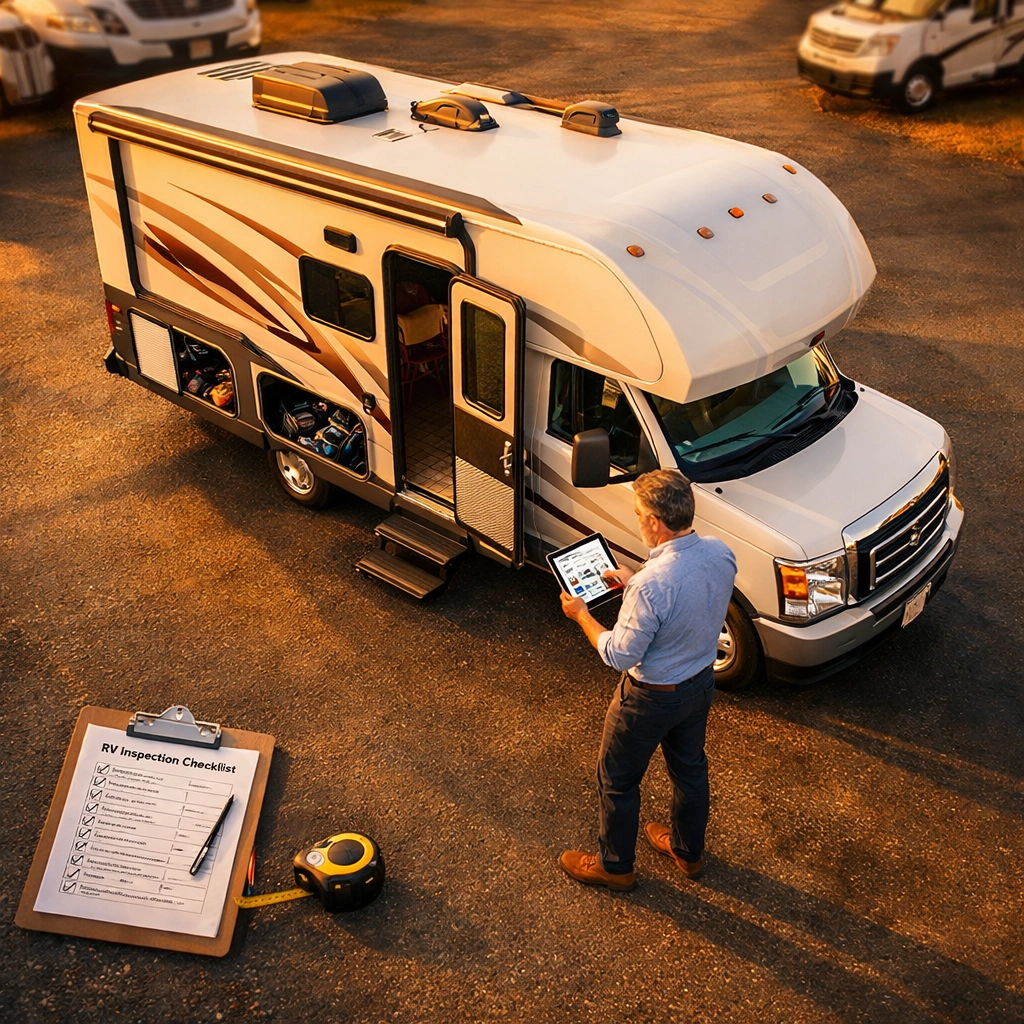
1. Pre-Trade Inspection Checklist
Walk through your RV and document:
- Exterior: Check for dents, scratches, fading, or delamination
- Roof: Look for cracks, sealant issues, or ponding water
- Chassis: Inspect frame, axles, and suspension for rust or damage
- Appliances: Test fridge, stove, AC, furnace, water heater
- Plumbing: Check for leaks, water pressure, and holding tank function
- Electrical: Ensure all outlets, lights, and 12V systems work
Take photos of anything that might be questioned during appraisal.
2. Cleaning vs. Repairs: What’s Worth It?
Worth doing:
- Deep clean interior and exterior
- Buff out minor scratches or scuffs
- Replace broken cabinet handles or light fixtures
- Fix leaky faucets or loose trim
- Wash and condition tires
Not worth it:
- Major engine or transmission overhauls (cost exceeds value gain)
- Full paint jobs or body panel replacements
- Replacing perfectly functional appliances for cosmetic reasons
Dealers expect some wear, but a clean, well-maintained RV signals you’ve taken care of the big stuff.
3. Gather and Organize Documents
Bring:
- Title and registration
- Service and maintenance records (oil changes, generator hours, tire rotations)
- Upgrade receipts (solar panels, lithium batteries, awnings, suspension mods)
- Warranty information (if transferable)
- Owner’s manual and appliance manuals
If you’ve upgraded to systems like an RV lithium power upgrade or added off-grid power systems, documentation proves value and can boost your appraisal by hundreds or even thousands of dollars.
4. Compare Multiple Quotes
Don’t settle for the first offer. Get appraisals from:
- At least 3 dealerships
- Online buyers (like Camping World’s trade-in program)
- RV consignment services if applicable
Leverage competing offers to negotiate. If Dealer A offers $25,000 and Dealer B offers $27,000, use that gap to push for a better deal.
5. Negotiation Strategy
- Start by asking what they’ll offer before discussing the new RV you want to buy. This keeps the trade-in value separate from the purchase price.
- Be realistic. If your RV has water damage or frame issues, don’t expect top dollar.
- If the dealer won’t budge on trade-in value, negotiate the purchase price of the new RV instead.
RV Trade-In vs Private Sale: Which Nets Higher Value?
Both options have pros and cons. Here’s how they stack up:
When to trade in:
- You value time and convenience over maximum profit
- Your RV still has a loan (dealer handles payoff)
- You’re upgrading at the same dealership
- You don’t want to deal with strangers or marketing hassles
When to sell privately:
- You have time to market and show your RV
- Your RV is in excellent condition and has desirable features
- You’re comfortable negotiating and handling title transfers
- You want to maximize profit (expect 10–20% more than trade-in)
Common RV Types & Their Typical Trade-In Value Ranges
Trade-in values vary widely by RV type, size, and features. Here’s what impacts each category: and how weight plays a role in market demand and pricing.
Class A Motorhomes
These are the heavyweights of the RV world, both literally and financially. Trade-in values range from $40,000 to $300,000+ depending on age, brand (think Newmar, Tiffin, or Entegra), and luxury features. Buyers care about mileage, slide-out condition, and engine hours. Heavier Class A rigs (often 30,000–40,000 lbs) require substantial tow vehicles or aren’t towable at all, which can limit buyer pools.
Class B Camper Vans
Class B vans (like Sprinter or Transit conversions) hold value well due to their versatility and fuel efficiency. Trade-in values typically run $50,000–$150,000. These rigs are lighter (8,000–12,000 lbs) and easier to drive than Class A or C models, making them popular for buyers who want RV amenities without the bulk.
Class C Motorhomes
Mid-sized motorhomes built on truck or van chassis. Trade-in values range from $30,000 to $120,000. The average weight of camper units in this class is 10,000–15,000 lbs, so buyers often prioritize fuel economy and drivability over sheer size. Maintenance records and appliance condition matter here more than cosmetic upgrades.

Travel Trailers
Travel trailers are the most diverse category, and weight is a major factor in trade-in value. A compact 16 ft camper weight (around 2,000–3,000 lbs) appeals to buyers with smaller tow vehicles like crossovers or mid-size SUVs. An 18 ft camper weight (roughly 3,000–4,000 lbs) sits in the sweet spot for first-time buyers.
As you scale up, a 24 ft camper weight (4,500–6,000 lbs) requires a half-ton truck, while a 30 ft camper weight or 30 ft rv weight (7,000–9,000 lbs) demands a heavy-duty truck with serious payload capacity. Heavier units often have lower demand due to towing limitations, which can slightly reduce trade-in values unless they’re packed with premium features.
For example, if you’re upgrading to an off-road camper trailer built for extreme terrain, dealers will factor in the average travel trailer weights for comparable units and adjust based on off-road features like independent suspension, reinforced chassis, and all-terrain tires.
Fifth Wheels
Fifth wheels offer the most living space and tend to hold value better than travel trailers. Trade-in values range from $25,000 to $150,000+. These rigs require a truck bed-mounted hitch and often weigh 10,000–16,000 lbs, so buyers need heavy-duty trucks. The 30-foot camper weight range for fifth wheels is typically 8,000–12,000 lbs, making them more manageable than larger models. Premium brands like Grand Design or Arctic Fox command higher trade-in values due to build quality and resale demand.
If you’re considering an upgrade to an off-road trailer RV designed for adventure, understanding how weight impacts towing capacity and market appeal helps you make smarter trade-in decisions.
FAQ: RV Trade-In Value
What is a good RV trade-in value?
A “good” trade-in value is typically 70–85% of the private sale price, depending on condition, market demand, and your negotiation skills. For example, if similar RVs sell privately for $50,000, a trade-in offer of $37,500–$42,500 is reasonable.
How can I get the best trade-in value for my RV?
Clean your RV thoroughly, fix minor issues, document all upgrades and maintenance, and get quotes from at least three dealers. Highlight premium features like solar panels, lithium batteries, or off-grid systems. Timing matters too: trade in during peak buying seasons (spring and early summer) for better offers.
Does RV mileage affect trade-in value?
Absolutely. Lower mileage means less wear on the engine, transmission, and chassis components. Expect mileage to impact value more on motorhomes than towable trailers, since trailers don’t have engines. High-mileage Class A or C motorhomes (over 100,000 miles) can see trade-in values drop 20–30%.
Should I repair items before trading in my RV?
Fix cheap, visible issues (loose trim, leaky faucets, cracked caulking) but skip expensive repairs like engine work or major body damage. Dealers will factor repair costs into their offer anyway, and you’ll rarely recoup what you spend on big fixes.
Is trade-in value different in summer vs winter?
Yes. RV demand peaks in spring and early summer, so trade-in offers tend to be higher from March through June. Fall and winter see softer demand, especially for travel trailers and fifth wheels. Motorhomes hold steadier year-round demand but still dip slightly in colder months.
Can trade-in value be higher than private sale?
Rarely, but it happens if a dealer desperately needs your specific make and model for inventory, or if you negotiate a strong deal that includes credits or incentives. In most cases, private sales net 10–20% more than trade-ins.
Do dealers share how they calculate RV trade-in value?
Most dealers use industry tools like J.D. Power or BlackBook but don’t always disclose their exact formula. They’ll consider your RV’s condition, market demand, reconditioning costs, and how quickly they can resell it. Ask for a breakdown if you want transparency: it shows you’re informed and serious.
How long does an RV trade-in process take?
Typically 1–3 days. The dealer inspects your RV, runs a value report, and makes an offer (1 day). If you accept, they handle paperwork, payoff (if applicable), and transfer the title (1–2 days). Compare that to private sales, which can take weeks or months.
Ready to Upgrade?
Whether you’re trading in a compact travel trailer or a luxury Class A, understanding your RV’s true value puts you in control. Document your maintenance, clean up the details, and shop your trade-in to multiple dealers. And if you’re ready to level up your adventures, consider an off-road RV trade-in to unlock rugged capability and off-grid freedom.

