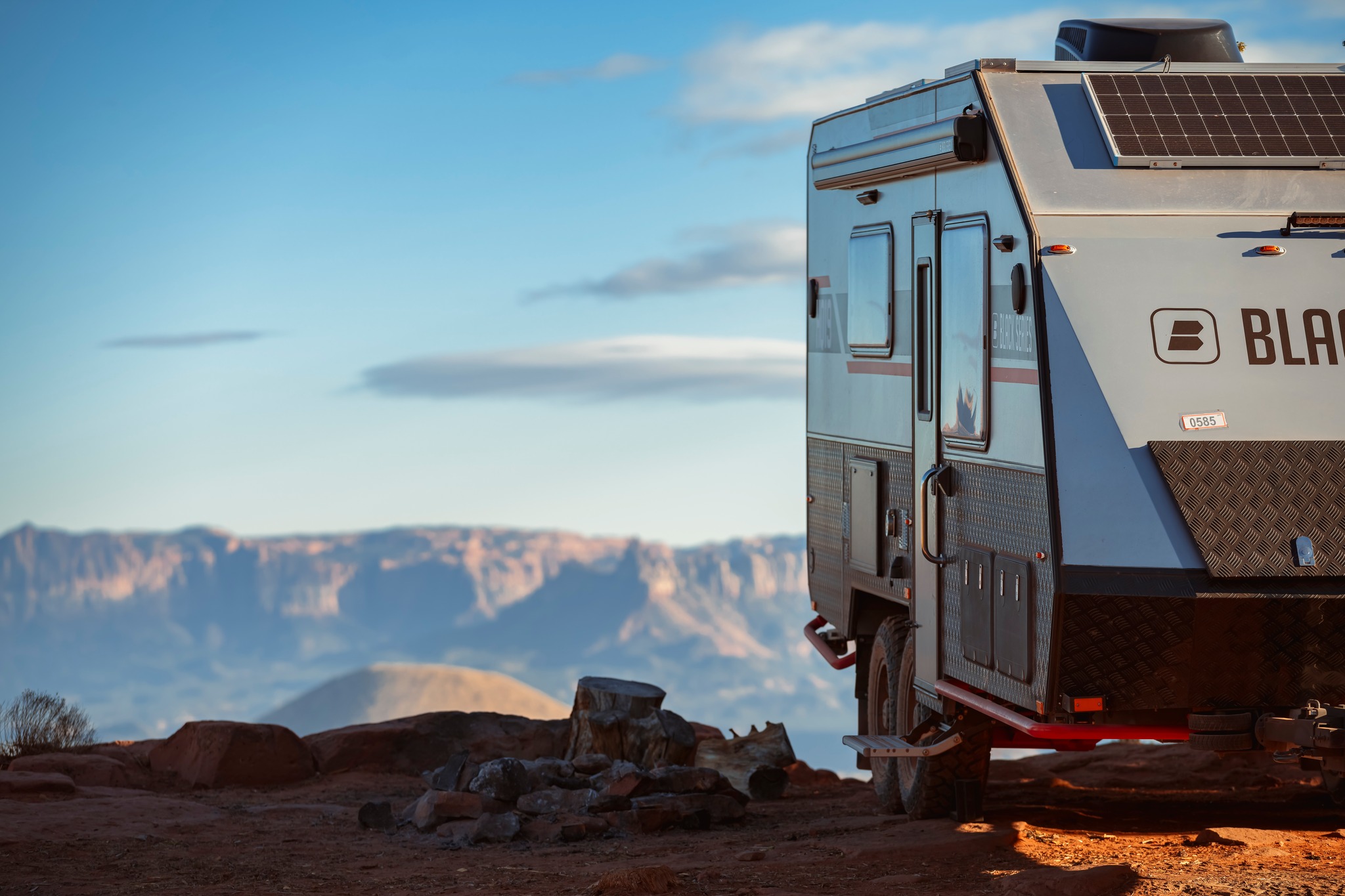
Off road trailer travel refers to traveling beyond paved roads using purpose-built trailers designed for rough terrain, remote access, and off-grid camping. Unlike traditional RV park hopping, you’re venturing into BLM land, forest service roads, and remote backcountry where conventional trailers simply can’t go. It requires a trailer with reinforced chassis, high ground clearance, independent suspension, and self-sufficient systems for water, power, and cooking, because the nearest hookup might be 100 miles away.
What Is Off Road Trailer Travel?
Off road trailer travel is the practice of towing a specialized trailer into terrain that would leave a standard travel trailer stuck, damaged, or worse. We’re talking washboard roads, rocky creek crossings, sand dunes, and unmaintained forest routes where cell service is a distant memory.
The structural differences are massive. A true off-road travel trailer isn’t just a regular camper with bigger tires. It’s built from the ground up with:
- Heavy-duty chassis made from reinforced steel or aluminum to handle constant flexing and impacts
- High ground clearance (typically 12–18 inches) to clear rocks, roots, and deep ruts
- Independent suspension systems that absorb shocks from uneven terrain without transferring stress to the frame
- All-terrain tires rated for mud, sand, and sharp rocks
- Off-grid power and water systems designed for 7–14 days without resupply
Overlanding vs. Boondocking: What’s the Difference?
People often confuse these terms. Overlanding is vehicle-based adventure travel where the journey itself is the goal, think multi-week expeditions across diverse terrain. Boondocking is simply camping without hookups, often in one spot for several days. Off road trailer travel can be both, but it’s defined by the terrain capability, not just the camping style.
Why More Travelers Are Choosing Off Road Trailer Travel
In 2026, the shift toward off-road exploration is undeniable. National parks like Yellowstone and Yosemite are implementing reservation systems and timed entry due to overcrowding. Meanwhile, the U.S. has over 245 million acres of BLM (Bureau of Land Management) land where dispersed camping is free and legal.
The appeal is simple: freedom and solitude. Traditional RV parks are crowded, expensive, and boxed in by rules. Off road trailer travel lets you wake up to sunrise over red rock canyons in Utah, camp beside alpine lakes in Colorado, or park on a coastal bluff in Oregon, all without paying a dime or seeing another soul for days.
The lifestyle contrast is stark. RV park culture is about amenities, pools, WiFi, laundry facilities. Off road trailer travel is about self-reliance, minimal impact, and accessing places most people will never see. It’s not for everyone, but for those who crave adventure and quiet, it’s transformative.
How to Travel Off Road With a Trailer (Step-by-Step)
Step 1: Choose the Right Off Road Trailer
This is where most people mess up. Your trailer needs to match both your tow vehicle’s capability and the terrain you’re targeting.
Weight matters, a lot. The average weight of a camper varies wildly. A standard 30 foot RV weight can hit 7,000–10,000 lbs loaded, which is way too heavy for most half-ton trucks on rough terrain. Compare that to a compact off-road camper trailer: an 18 ft camper weight might be just 3,500–4,500 lbs, while a 24 ft camper weight could range from 4,800–6,200 lbs depending on build quality and features.

For serious off-road use, lighter is often better. A 16 ft camper weight (typically 2,800–3,800 lbs) is far more maneuverable on tight switchbacks and less likely to bottom out on steep approaches. Average travel trailer weights hover around 5,000–6,000 lbs for mid-size units, but purpose-built off-road rigs are engineered to stay under 5,500 lbs even with full tanks and gear.
Suspension type is critical. Independent torsion axles absorb impacts without transferring shock to the frame, while traditional leaf springs can’t handle sustained off-road abuse. Single-axle trailers are more nimble; tandem-axle units are more stable but less flexible over uneven ground.
Step 2: Plan Routes Beyond Pavement
Don’t just wing it. Some overlanders venture into unknown territory and end up trespassing, stuck in dead-ends with no room to turn around, or worse, jackknifed on a narrow ridge.
Use Forest Service roads and BLM routes as your primary corridors. These are publicly accessible, legally drivable, and often lead to incredible dispersed camping sites. Download offline maps before you leave cell coverage, apps like Gaia GPS or OnX Offroad work when your phone has zero bars.
Check road conditions with local ranger stations. A route that’s easy in August might be a muddy disaster in April or snow-choked in November. Always have a backup camping location in case your primary spot is occupied or inaccessible.
Step 3: Prepare for Off-Grid Conditions
Self-sufficiency isn’t optional, it’s survival. Here’s what you need dialed in:
Water: Carry 100+ gallons of fresh water. That sounds like overkill until you’re five days into a remote trip and realize the nearest fill station is 80 miles away.
Power: Solar panels paired with lithium batteries are the gold standard in 2026. A quality off-grid power system can run your fridge, lights, water pump, and charge devices for 7+ days without hookups.
Food: Plan meals and carry extra non-perishables. Running out of propane for your stove in the backcountry is a fast way to ruin a trip.
Communication: A satellite messenger (like Garmin inReach or SPOT) isn’t just smart, it’s your lifeline if something goes wrong 40 miles from the nearest paved road.
Best Off Road Trailers for Travel: What to Look For
When you’re shopping for an off-road trailer RV, here’s what separates real capability from marketing hype:
Chassis strength: Look for reinforced steel or aluminum frames rated for continuous flex. Cheap trailers use standard RV frames that crack under off-road stress.
Suspension design: Independent torsion or coil-spring systems with shock absorbers. If it has basic leaf springs, it’s not built for serious terrain.
Power systems: At minimum, 400W solar with 200Ah lithium batteries. Anything less and you’re constantly worried about running out of juice.
Storage layout: External gear storage (roof racks, rear cargo areas) keeps dirt and wet equipment out of the living space. Internal storage should be lockable and padded to prevent damage on rough roads.
BlackSeries trailers are designed around these principles. We don’t slap off-road stickers on a standard build and call it good. Our HQ series uses fully independent suspension, oversized water tanks, and military-grade construction because we know what actually breaks when you’re 100 miles from civilization.
Off Grid Off Road Trailer Travel: What Makes It Possible
Extended off-grid capability requires serious engineering, not just extra batteries.
Electrical systems: Modern lithium setups can power a fridge, water heater, LED lights, and USB charging for 5–7 days without sun. Add solar panels and you’re essentially unlimited in good weather. Check out our guide on RV lithium power upgrades for the full breakdown.
Water management: Dual tanks (fresh and gray) let you camp longer between dumps. Efficient water heaters and low-flow fixtures make 100 gallons stretch surprisingly far.
Durability: Off-grid travel means you can’t just call a mobile RV tech. Your trailer needs to handle washboard roads, temperature swings, and constant vibration without components shaking loose or systems failing.
Reliability: Every failure point matters. Cheap plumbing fittings, poorly secured propane lines, or weak electrical connections become disasters when you’re remote. Quality builds use marine-grade components because they have to work, every time.
Common Mistakes in Off Road Trailer Travel
Overestimating your tow vehicle. Just because your truck’s manual says it can tow 8,000 lbs doesn’t mean it should on a rutted mountain road at 9,000 feet elevation. Real-world towing capacity drops significantly off-road.
Ignoring weight distribution. Tongue weight should be 10–15% of trailer weight. Too light and you get sway; too heavy and you overload your truck’s rear axle. Load your heaviest gear low and centered.
Underestimating terrain risks. That innocent-looking puddle might be 18 inches deep. That “slight incline” might have a 30% grade around the bend. Flash floods can turn dry washes into raging rivers in minutes. Slow down, scout ahead on foot, and don’t push beyond your skill level.
Skipping pre-trip inspections. Check tire pressure, lug nuts, brake controller calibration, lights, suspension, and hitch connections before every trip. A loose bolt at camp is annoying. A loose bolt at 60 mph is deadly.
FAQ
Is off road trailer travel safe for beginners?
Yes: if you start conservatively. Stick to well-maintained forest roads initially, practice recovery techniques in controlled settings, and gradually increase difficulty as your skills improve. The biggest safety risks come from overconfidence, not terrain.
Do I need a special tow vehicle?
Not necessarily, but you need the right tow vehicle for your trailer. A half-ton truck can handle lighter off-road trailers (under 5,000 lbs), but heavier rigs require ¾-ton or 1-ton capability. Four-wheel drive isn’t mandatory but makes everything easier and safer.
What’s the difference between off road and overland trailers?
They’re often used interchangeably, but “overland” typically implies expedition-length travel capability (weeks to months), while “off-road” simply means the trailer can handle rough terrain. All overland trailers are off-road capable; not all off-road trailers are set up for extended overlanding.
Can off road trailers be used for long-distance travel?
Absolutely. Modern off-road trailers are built for both durability and comfort. You’re not sacrificing amenities: you’re just accessing places traditional RVs can’t reach. Many owners use them for multi-month road trips mixing pavement, dirt, and everything in between.
Ready to explore beyond the pavement? Check out our latest RV upgrade deals for 2026 or learn about off-road RV trade-in options to get into a real adventure rig.

