
Your cart (0)
Your cart is empty
Tax included and shipping calculated at checkout
Your cart is empty
Tax included and shipping calculated at checkout

A slanted front travel trailer uses angled geometry at the front wall to improve aerodynamics, reduce drag, and enhance towing stability compared to traditional flat-front designs. This engineering approach delivers measurable fuel savings and improved highway handling for modern RV enthusiasts.
A slanted front travel trailer features an angled or tapered front wall instead of the traditional vertical, flat front design. This geometric modification typically involves a forward slope ranging from 15 to 45 degrees, depending on the manufacturer’s aerodynamic objectives and interior space requirements.
Unlike flat front trailers that present a blunt surface to oncoming airflow, slanted front designs create a more gradual transition from the tow vehicle to the trailer body. This design philosophy borrowed from automotive and aerospace engineering recognizes that even modest front-end shaping can significantly impact overall aerodynamic performance.
The slanted front approach is particularly common in modern travel trailers ranging from compact 16 ft camper configurations to larger 30-foot RV designs. Whether you’re considering an 18 ft camper weight of around 3,500 pounds or a 24 ft camper weight approaching 6,000 pounds, the aerodynamic benefits of front-end shaping scale proportionally with trailer size and highway speeds.
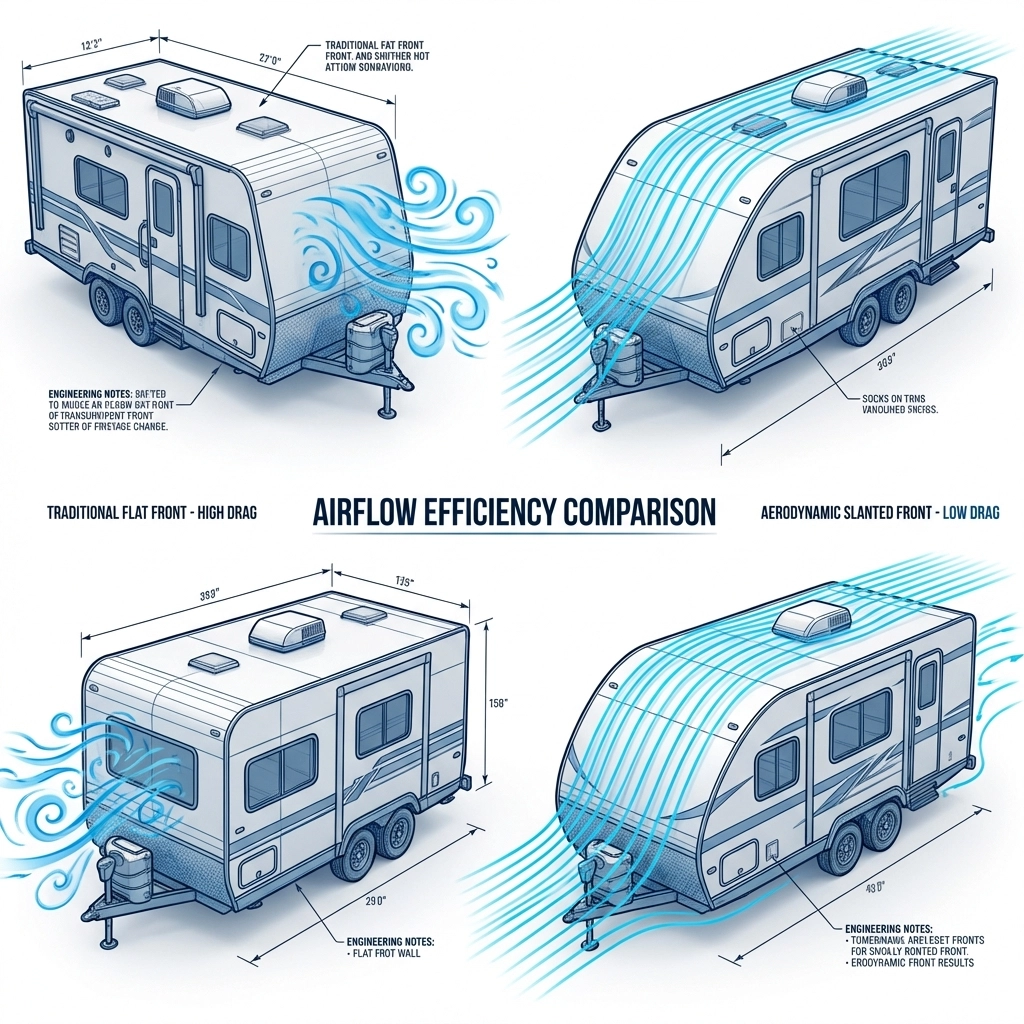
Flat front travel trailers generate substantial aerodynamic drag through several interconnected mechanisms that directly impact towing performance and fuel efficiency.
The primary culprit is stagnation pressure, which occurs when moving air encounters the flat front wall and essentially “stalls” against the surface. This creates a high-pressure zone directly in front of the trailer, forcing air to rapidly change direction and flow around the sides. The abrupt pressure spike requires significant energy to overcome, translating directly into increased drag.
Boundary layer separation compounds this problem as airflow attempts to navigate the sharp transition from the flat front to the trailer’s sides. The air cannot smoothly follow these angular corners, creating turbulent wake zones that further increase aerodynamic resistance.
Perhaps most importantly, flat front trailers create a fundamental mismatch with the tow vehicle’s airflow patterns. Modern trucks and SUVs are designed with sloped hoods, angled windshields, and tapered rooflines that guide air smoothly over and around the vehicle. When this carefully managed airflow suddenly encounters a vertical trailer wall, it creates an aerodynamic “wall” that disrupts the entire system’s efficiency.
For more detailed technical information on this phenomenon, see our article on Boundary Layer Separation in RVs.
Slanted front designs address the fundamental airflow disruption issues inherent in flat-front trailers through several key mechanisms that work together to improve overall aerodynamic efficiency.
The angled front wall allows air to accelerate gradually rather than hitting an abrupt barrier. As airflow encounters the slanted surface, it compresses smoothly and accelerates around the trailer’s profile without the dramatic pressure spike characteristic of flat fronts. This gradual pressure transition requires less energy to maintain, directly reducing drag.
Flow separation mitigation represents another critical advantage. The slanted geometry guides airflow along the trailer’s surface rather than forcing it to make sharp directional changes. This adherent flow pattern minimizes the turbulent wake zones that typically form when air separates from angular surfaces.
Most significantly, slanted fronts create better aerodynamic integration with tow vehicles. The angled surface provides a more natural transition from the truck’s tapered rear profile to the trailer’s body, creating what engineers call a “virtual streamlined shape” that encompasses both vehicles as a single aerodynamic unit.
This integration becomes particularly valuable at highway speeds where aerodynamic forces dominate. A 30 ft RV weight of 8,000-10,000 pounds benefits significantly from drag reduction, as the aerodynamic penalty of poor front-end design scales with both speed and vehicle mass.
The performance differences between slanted front and flat front travel trailers become pronounced across multiple measurable criteria that directly impact the towing experience.
Aerodynamic Drag Comparison:
Crosswind Stability:
Fuel Efficiency Impact:
Driver Fatigue Reduction:
Slanted front geometry contributes to towing stability through mechanisms that extend beyond simple drag reduction to encompass the entire vehicle dynamics equation.
Crosswind Response: When crosswinds strike a slanted front trailer, the angled surface deflects air more gradually than a flat front. This creates more predictable side forces that develop progressively rather than as sudden impacts. The result is smoother, more controllable trailer behavior during windy conditions.
Overtaking Dynamics: When large vehicles pass a travel trailer, they create complex pressure waves that can destabilize towed units. Slanted fronts help these pressure disturbances flow more smoothly around the trailer rather than creating abrupt pressure differentials that can trigger sway.
Highway Speed Stability: At interstate speeds, aerodynamic forces become the primary influence on trailer behavior. The improved pressure distribution created by slanted fronts reduces the aerodynamic moments that can initiate trailer oscillations, contributing to more stable high-speed towing.
This stability enhancement becomes increasingly critical as trailer size increases. Whether dealing with a compact 16 ft camper weight of 3,000 pounds or a substantial 30 ft camper weight approaching 10,000 pounds, aerodynamic stability scales with both size and speed.
For additional information on trailer stability dynamics, explore our comprehensive guide on Air Vortex Behind Trailer.

While both slanted fronts and nose cones aim to improve trailer aerodynamics, their implementation and effectiveness differ significantly in practical applications.
Integrated Slanted Front Advantages:
Nose Cone Limitations:
Off-Road Durability Considerations:
For off-road travel trailer applications, integrated slanted fronts offer superior durability compared to bolt-on solutions. The unified construction eliminates potential impact damage to separate components, while the integrated design can better withstand the vibration and stress of rough terrain travel.
Engineering Integration:
Slanted front designs allow engineers to optimize the entire front-end airflow pattern as a unified system, rather than attempting to retrofit aerodynamic improvements to existing flat-front designs. This holistic approach typically delivers superior performance and reliability.
Off-road travel trailers present unique aerodynamic challenges that make slanted front designs particularly valuable compared to traditional on-road applications.
Ground Clearance Impact: Off-road trailers typically feature higher ground clearance, which elevates the trailer body further from the tow vehicle’s aerodynamic wake. This separation increases the importance of the trailer’s independent aerodynamic performance, making front-end shaping more critical.
External Equipment Considerations: Off-road trailers commonly carry external equipment such as spare tires, jerry cans, recovery gear, and roof-mounted accessories. These additions create complex airflow patterns that interact with the trailer’s primary aerodynamic profile. A well-designed slanted front helps establish organized airflow that better manages these aerodynamic complications.
Multi-Condition Performance: Off-road trailers regularly transition between highway cruising and challenging terrain. During highway segments, aerodynamic efficiency directly impacts fuel consumption and stability. The slanted front design ensures optimal performance during these high-speed phases while maintaining structural integrity for off-road demands.
Speed Range Optimization: Unlike dedicated highway trailers, off-road units must perform across a wider speed range. Slanted front aerodynamics provide benefits from moderate highway speeds down to the lower speeds typical of technical terrain, where reduced air resistance still contributes to overall efficiency.
BlackSeries approaches slanted front travel trailer design through a comprehensive engineering methodology that prioritizes system-level aerodynamic performance over superficial styling modifications.
Integrated Airflow Management: Rather than treating the front profile as an isolated component, BlackSeries engineers consider the entire airflow pattern from the tow vehicle through the trailer and into the wake region. This systems approach ensures that front-end modifications complement rather than disrupt the overall aerodynamic package.
Structural-Aerodynamic Integration: The slanted front geometry integrates directly with the trailer’s structural framework, ensuring that aerodynamic improvements do not compromise durability or functionality. This unified design philosophy eliminates the compromises typically associated with retrofitted aerodynamic modifications.
Real-World Validation: BlackSeries validates aerodynamic designs through comprehensive testing that includes both computational analysis and real-world towing scenarios. This validation approach ensures that theoretical aerodynamic improvements translate into measurable benefits under actual towing conditions.
Stability-First Philosophy: While aerodynamic efficiency matters, BlackSeries prioritizes towing stability and safety above pure drag reduction. The slanted front designs incorporate features that enhance crosswind stability and reduce trailer-induced dynamics that could compromise towing safety.
Off-Road Optimization: Recognizing that off-road trailers face unique aerodynamic challenges, BlackSeries incorporates design elements that account for higher ground clearance, external equipment, and multi-terrain performance requirements that distinguish off-road applications from conventional highway trailers.

Does a slanted front really reduce trailer drag?
Yes, slanted front designs typically reduce aerodynamic drag by 8-15% compared to flat-front trailers. The improvement comes from smoother airflow transition and reduced pressure buildup at the front wall. Benefits increase with highway speed and trailer size.
Is a slanted front better than a flat front trailer?
Slanted front trailers consistently outperform flat-front designs in aerodynamic efficiency, crosswind stability, and towing fuel consumption. Even modest angling provides measurable improvements, particularly noticeable during highway cruising and windy conditions.
Does a slanted front improve towing stability?
Yes, slanted fronts contribute to towing stability by creating more predictable aerodynamic forces during crosswinds and vehicle passing situations. The improved airflow patterns reduce sudden pressure changes that can trigger trailer sway or instability.
Are slanted front trailers better for off-road use?
Slanted front designs offer particular advantages for off-road trailers due to their higher ground clearance and external equipment requirements. The aerodynamic benefits during highway transit segments, combined with integrated structural durability, make them well-suited for multi-terrain applications.
How does BlackSeries approach trailer front aerodynamics?
BlackSeries engineers slanted front designs as integrated systems rather than cosmetic modifications. The approach emphasizes structural integration, real-world validation, and stability-first philosophy while optimizing for the unique requirements of off-road travel trailers.