Table of Contents
- Main Takeaways: The Short Answer on Drafting Behind Semi Trucks with an RV
- What Is Drafting Behind Semi Trucks?
- Does Drafting Actually Save Fuel for RVs?
- Is Drafting Behind Semi Trucks Safe for RVs?
- Is Drafting Legal in the United States in 2026?
- Why BlackSeries Does NOT Recommend Drafting
- Safer Ways to Improve RV Fuel Efficiency (Recommended)
- Frequently Asked Questions
- Conclusion and Further Reading
Main Takeaways: The Short Answer on Drafting Behind Semi Trucks with an RV
> Summary Box
> – No, drafting behind semi trucks is not safe nor advisable for RVs in 2026.
> – While it could theoretically improve fuel efficiency by 5–10%, the risks far outweigh the savings.
> – Drafting is commonly subject to fines under “following too closely” laws in many US states: it’s illegal in practical terms.
> – BlackSeries firmly advises against any RV drafting practice, prioritizing safety and responsibility for all road users.
What Is Drafting Behind Semi Trucks?
> Summary Box
> – Drafting refers to following closely behind a large vehicle (usually a semi) to reduce wind resistance.
> – While small cars sometimes attempt this illegally for fuel economy, doing so with an RV is much more dangerous due to size, weight, and stability.
> – Key Phrase: “drafting behind semi trucks rv”
The Science and Appeal
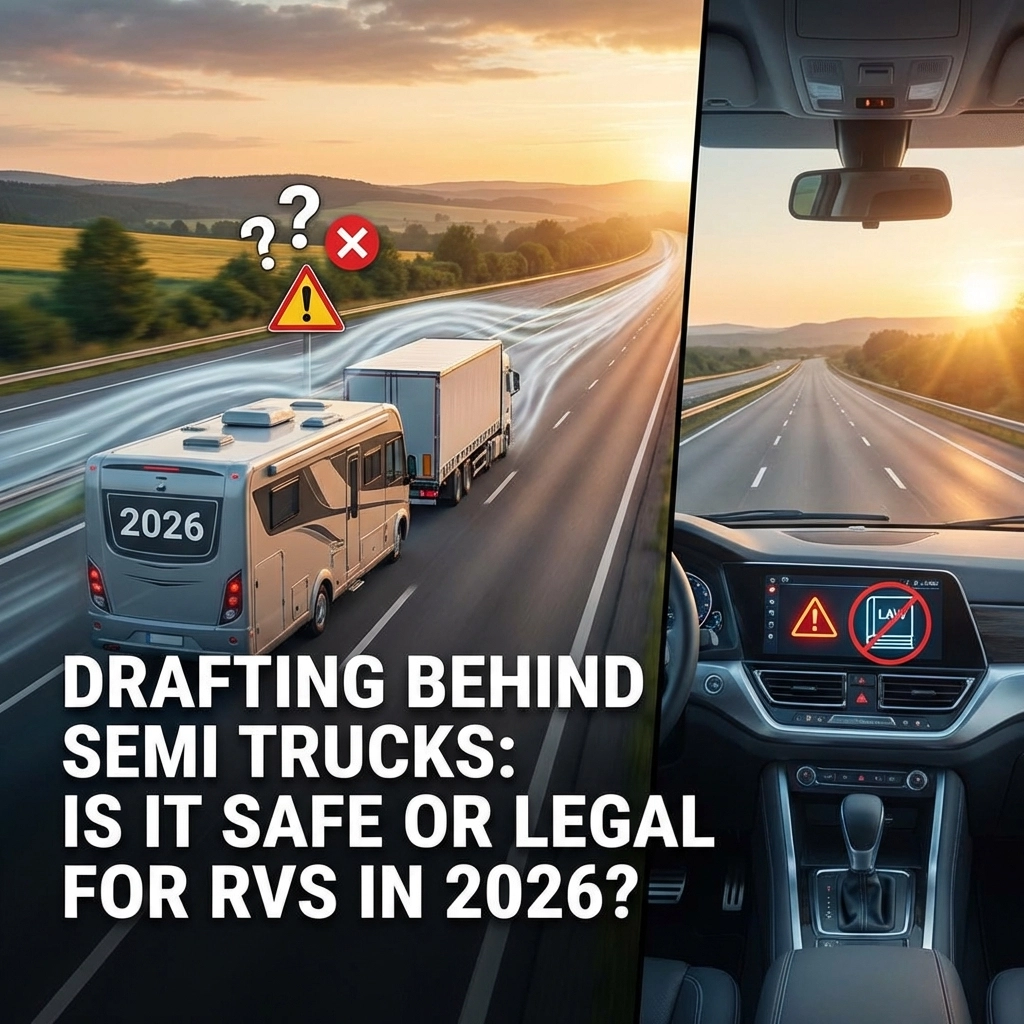
Drafting, also known as “aerodynamic tailgating,” is when a vehicle follows closely in the low-pressure slipstream behind another vehicle: most often a semi truck. The goal? To experience reduced aerodynamic drag, which may improve fuel economy. This practice has been widely discussed in motorsports and occasionally attempted by drivers of smaller vehicles seeking to squeeze out better mileage.
However, in the context of towing an RV or driving a travel trailer, the dynamics are completely different. RVs have huge frontal areas, non-aerodynamic shapes, and towing setups that make them inherently less stable than passenger cars.
Why Do Some Drivers Draft?
- Fuel Economy: It’s tempting; videos and anecdotes online claim fuel savings from a 5–10% MPG boost.
- Urban Myth: Car culture sometimes sensationalizes “hypermiling” tricks.
- Misconceptions about Safety: Many don’t grasp the compounded risks when towing something as large and heavy as an RV.
How RVs Differ Aerodynamically
Compared to a compact car, an RV is:
- Taller and broader: Massive “sails” in the wind.
- Much heavier: Takes longer to stop.
- Prone to sway and wind buffeting: Unstable in turbulent air, especially near trucks.
Further Reading: If you’re curious about aerodynamic design evolution for trailers, see our post on Slanted Front Travel Trailer: Aerodynamics & Stability.
Does Drafting Actually Save Fuel for RVs?
> Summary Box
> – Lab tests suggest theoretical savings of 5–10% on fuel economy.
> – Real-world RVs rarely achieve these numbers; the aerodynamic chaos behind a truck often causes instability.
> – User reports show inconsistent benefits, and any gain is dwarfed by the extreme risks.
> – Key Phrase: “RV fuel saving drafting”
Theoretical Savings
In strictly controlled environments, following within 20–50 feet of a semi truck does measurably reduce aerodynamic drag, and thus fuel usage. Studies focusing on automobiles have returned savings as high as 10%: but that means remaining dangerously close to the truck’s bumper at highway speeds.
Real-World RV Experience
- Drag Is a Fact: RVs and travel trailers have a high drag coefficient (for a deep dive, see Drag Coefficient Travel Trailer: What It Means for Towing). Even in a low-pressure zone, there’s significant resistance.
- Weight and Instability: Towing setups amplify instability. The turbulent wake from a truck can cause sway, requiring immediate corrections.
- Anecdotal Evidence: A few RVers have attempted this and reported that small fuel gains were offset by “white-knuckle” stress and near-misses.
Data and Risks Outweighing Rewards
Almost every expert review in 2026 agrees: with modern gas prices and safety risks, the minuscule savings from drafting are negligible compared to the real cost of repairs, fines, and potential accidents.
Related Resource: For optimizing fuel efficiency the right way, see Gas Mileage Towing Travel Trailer: What to Expect.
Is Drafting Behind Semi Trucks Safe for RVs?
> Summary Box
> – Drafting behind a semi is one of the riskiest practices for any RV owner.
> – Major safety threats include reduced stopping distance, hidden road debris, crosswinds, and severely restricted visibility.
> – No fuel savings is worth risking your life: or others’ lives: on the road.
> – Key Phrase: “is drafting safe for RVs”
Risk #1: Inadequate Stopping Distance
The “two-second rule” is widely accepted. At 65 mph, this translates to 190+ feet of following distance. Drafting cuts this to under 50 feet: giving your heavy, slow-braking RV almost no time to react if the truck ahead stops suddenly. The kinetic energy difference is exponential with load and speed, meaning a rear-end collision would be catastrophic.
Risk #2: Flying Debris and Road Shrapnel
Semi trucks regularly fling up tire tread, rocks, or chunks of metal. Following closely, your RV (or its large, expensive windshield) becomes the first target. At high speeds, these hazards can cause severe damage or even loss of control.
Risk #3: Crosswind and “Vacuum” Effects
The wake of a semi creates a pocket of violent, turbulent air. For a modern RV trailer, this can mean sudden lurches, sway, or even temporary wheel lift. Strong crosswinds compound the danger.
Related Read: Discover how to Prevent Trailer Sway While Towing.
Risk #4: Compromised Visibility
Drafting puts you squarely in the truck’s blind spot. You can’t see ahead or anticipate hazards, and the truck driver often can’t see you at all. It’s a setup for disaster, especially when traffic suddenly slows or road debris appears.
Further Information: For practical safety upgrades, visit our Use Trailer Mirrors Correctly: Towing Safety Guide.
Is Drafting Legal in the United States in 2026?
> Summary Box
> – Drafting RVs behind semi trucks is effectively illegal: most states have “following too closely” statutes with steep fines.
> – Commercial truck drivers may be held blameless; liability usually falls on the drafting RV.
> – Ticketing and traffic stops for tailgating are increasingly frequent, thanks to dash cams and telematics.
The Law: “Following Too Closely”
Every US state enforces some version of a law against “tailgating” or “following too closely.” While the wording varies, the intent is the same: if you cannot stop safely, you’re too close.
- California Vehicle Code § 21703: “The driver of a motor vehicle shall not follow another vehicle more closely than is reasonable and prudent…”
- Similar language in Texas, Florida, and nearly all states.
Violating this law is a common reason for both traffic stops and insurance denial of claims.
Enhanced Enforcement and Liability
- 2026 Trend: Highway patrols now have better dash and rear cameras, making evidence collection easy.
- In an accident, if you were drafting, the RV driver is almost always found at fault.
- Many insurance policies now specifically exclude coverage for “reckless or illegal following” behavior.
Industry Perspective: Read our RV Highway Safety Guide for a deeper dive into towing law and best practices.
Why BlackSeries Does NOT Recommend Drafting
> Summary Box
> – BlackSeries builds for stability, adventure, and safety: not for risky hypermile tactics.
> – Drafting contradicts BlackSeries’ foundational design and brand ethos: confidence in all conditions.
> – No risk to life, equipment, or reputation is worth chasing 1 MPG savings.
Our Design Philosophy
At BlackSeries, our off-road and travel trailers are engineered for maximum stability, safety, and rugged performance. Whether you’re boondocking in the wild or cruising Interstates, our top priority is your safety and that of everyone sharing the road.
- Chassis Integration: Designed to minimize sway via advanced suspension.
- Weight Distribution: Balanced loads for optimal towing performance (see Loading a Travel Trailer Correctly: Step-by-Step Guide).
- Aerodynamics Where It Counts: We incorporate features like slanted fronts (Slanted Front Travel Trailer) and refined airflow management (Aerodynamic Nose Cone Trailer).
Principle over “Hypermiling”
We will never recommend practices that put our customers: or anyone else: at risk. True adventure means getting there (and home) safe, with your family and your rig in one piece.
Safer Ways to Improve RV Fuel Efficiency (Recommended)
> Summary Box
> – There are legal, smart, and safe strategies to boost RV fuel economy.
> – Optimization tips: drive 60–65 mph, check tire pressures, minimize roof rack drag, load wisely, and choose aerodynamic trailers.
> – BlackSeries RVs embody smart design for real-world efficiency.
If you’re looking to save at the pump, here’s your action checklist: no unsafe drafting required:
- Maintain Legal Speeds (60–65 mph)
- Aerodynamic drag grows rapidly with speed; going slower means real savings.
- Check and Maintain Tire Pressure
- Proper tire inflation reduces rolling resistance. For details, see Check Trailer Tire Pressure: Complete Safety Guide.
- Lighten Up and Distribute Weight
- Travel lighter and balance your load for smoother towing (how-to: Loading a Travel Trailer Correctly).
- Reduce Exterior Drag
- Remove unnecessary accessories from your roof, add fairings where appropriate, and use streamlined models for best results.
- Pick the Right Trailer
- Invest in trailers designed for aerodynamic efficiency. BlackSeries models lead this trend, further explained in Aerodynamic Nose Cone Trailer.
Don’t miss our full guide to RV fuel efficiency tips.
Frequently Asked Questions
> FAQ Summary
> Answers to top real-world questions about RV drafting, distance, etiquette, and safety.
Q1: Can you draft behind a semi truck with a travel trailer?
Absolutely not recommended. Beyond being illegal and unsafe, towing setups are nowhere near as agile or stable as a car. The risks far outweigh any perceived benefit.
Q2: How close is considered drafting?
Drafting typically occurs within 50 feet or less of a semi truck at highway speeds: a dangerously short following distance. Even at 100 feet, stopping time is insufficient for an RV.
Q3: Do truck drivers like RVs drafting behind them?
No. It puts both the truck driver and RV at extreme risk, increases driver stress, and can lead to aggressive braking or evasive maneuvers. Professional drivers are trained to spot and report tailgaters.
Q4: What is the safest following distance for an RV?
The “two-second rule” (better: three seconds) at any speed: this means at least 200+ feet at 65 mph, more in rain, snow, or when descending hills. Read our tips for Driving Trailer on Icy Roads.
Conclusion and Further Reading
> Bottom Line Summary
> – Drafting behind semi trucks with an RV in 2026 isn’t just unsafe: it’s illegal and contrary to responsible adventure.
> – Stick to proven safety and efficiency principles for a journey that’s memorable for the right reasons.
> For more expert guidance and brand-leading innovation in RV travel safety, check out these articles:
> – Gas Mileage Towing Travel Trailer: What to Expect
> – Slanted Front Travel Trailer: Aerodynamics & Stability
> – High Wind Trailer Towing: How to Safely Tow in Strong Winds
> – Prevent Trailer Sway While Towing: Complete Guide by BlackSeries
Explore the full BlackSeries Blog for more insights, and remember: Adventure is only epic if you arrive safely.

