The American wilderness is calling, and in 2026, the answer isn’t a fragile travel trailer that shakes apart on the first washboard road. If you’re serious about accessing remote BLM lands, desert trails, or alpine forest roads, you need an RV engineered to handle punishment, not just survive it, but thrive in it.
This guide breaks down the five best RVs for rough terrain in 2026, covering everything from suspension technology to weight logistics. Whether you’re navigating Utah’s slickrock or Colorado’s high-altitude passes, we’ll show you exactly what separates a true off-road rig from a glorified parking lot camper.
What Makes an RV Suitable for Rough Terrain?
Let’s clear up the confusion: slapping bigger tires on a standard RV doesn’t make it off-road capable. A true rough-terrain RV is engineered from the chassis up to handle impacts, articulation, and environmental extremes that would destroy conventional models.
Core Off-Road Elements
Ground Clearance: The minimum acceptable clearance for genuine off-road use is 12–14 inches. Anything less, and you’re dragging your undercarriage over rocks, ruts, and logs. Compare that to the 6–8 inches you get on most highway-oriented travel trailers, and you’ll understand why so many people get stuck on forest service roads.
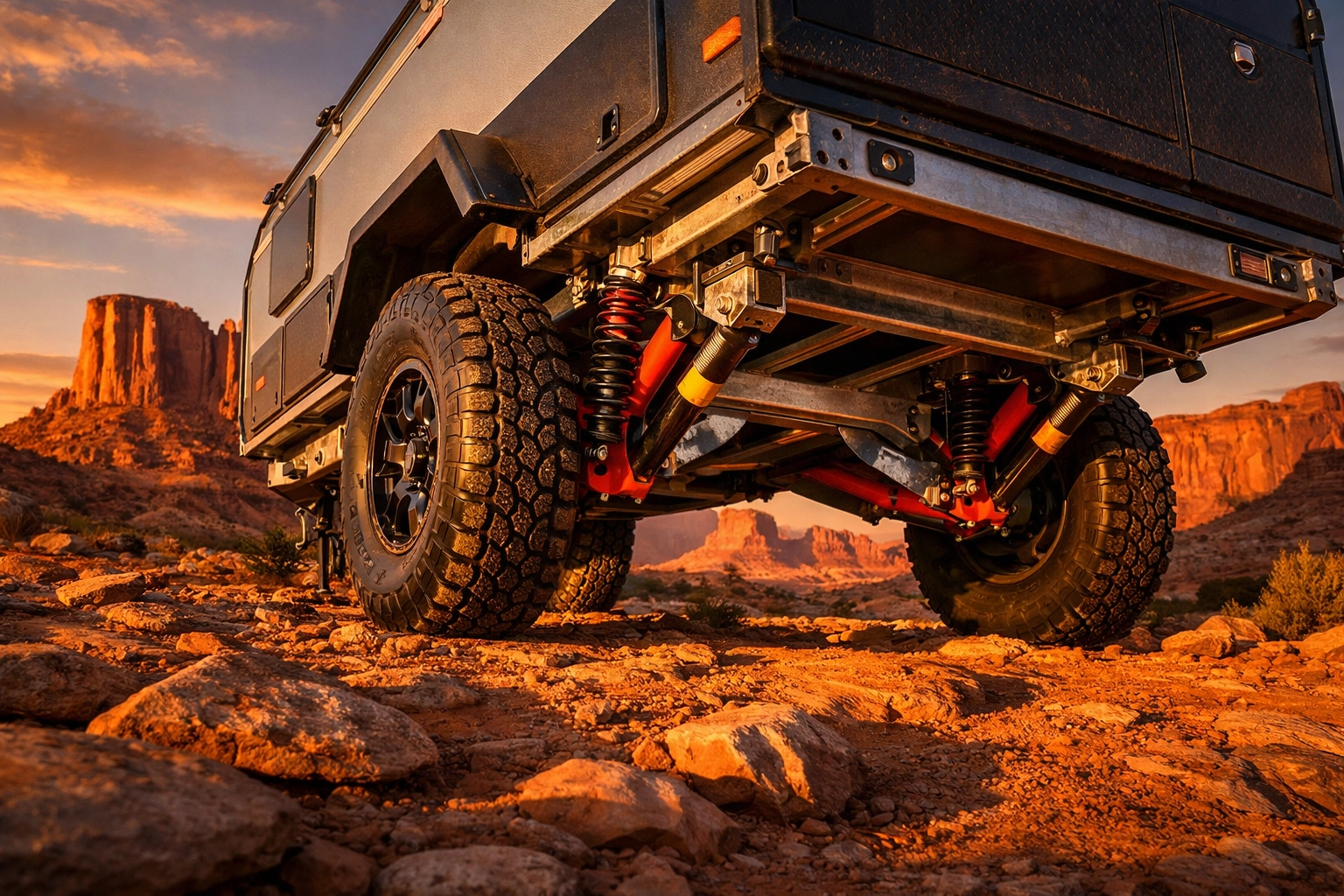
Independent Suspension Systems: This is where BlackSeries has set the industry standard. Independent suspension allows each wheel to move independently, maintaining tire contact with uneven terrain while protecting the chassis from torsional stress. Traditional leaf-spring setups? They’re fine for pavement. For serious rock crawling or desert washes, you need coil-over shocks with adjustable damping.
Structural Reinforcement: Heavy-duty tires are only part of the equation. The frame must be hot-dipped galvanized steel (or better) to resist corrosion and flex without cracking. Aluminum construction saves weight, but steel wins for impact resistance in extreme conditions.
Common Misconceptions
Width and Length Matter More Than You Think: A massive 30 foot RV weight, often exceeding 8,000–10,000 pounds, limits your trail options drastically. Yes, you get more luxury, but you’re restricted to wider forest roads and established campgrounds. A lighter 18 ft camper weight (around 3,500–4,500 pounds) opens up tight switchbacks and technical trails that larger rigs can’t touch.
Ground Clearance Doesn’t Equal Universal Capability: A lifted truck camper with 18 inches of clearance still can’t navigate boulder fields if the approach angle is terrible or the wheelbase is too long. True off-road geometry requires careful balance of clearance, breakover angle, and departure angle.
Top 5 Best RVs for Rough Terrain in 2026
After evaluating dozens of 2026 models, these five stand out for their engineering, real-world performance, and ability to handle extreme environments without catastrophic failure.
1. BlackSeries HQ21
If you’re looking for the ultimate balance of space and capability, the HQ21 is the benchmark. At 21 feet, it offers separate sleeping areas, upgraded appliances, and premium finishes while maintaining serious off-road credentials. The galvanized chassis and independent suspension system can handle anything from Moab’s slickrock to the Alaska Highway’s frost heaves.
Key Strengths:
- 100-gallon fresh water capacity for 3-week off-grid stays
- Upgraded solar systems with lithium battery banks
- 24 ft camper weight range (approximately 5,200 pounds dry) provides stability without sacrificing towability
Best For: Full-time adventurers and extended trips requiring both comfort and capability. Learn more about luxury off-road features.
2. 2026 BEAST MODE XO Off-Road Camper Van
The XO dominates the AWD camper van category in 2026. Built on a reinforced chassis with heavy-duty suspension, this van-based camper excels in environments where length matters: tight desert trails, alpine switchbacks, and snow-covered forest roads.
Key Strengths:
- AWD drivetrain with locking differentials
- Compact 16 ft camper weight equivalent (around 7,500 pounds) for maneuverability
- Integrated recovery points and skid plates
Best For: Solo travelers or couples who prioritize mobility over interior space. Desert exploration and mountain access roads.
3. 2026 Forest River Vengeance Rogue Armored 25L
This is the tank of the off-road trailer world. The Rogue Armored series features a reinforced chassis designed to absorb impacts that would bend a standard frame. The upgraded electrical system includes massive lithium banks capable of running high-draw appliances for days without recharging.
Key Strengths:
- Armored underbelly protection against rock strikes
- 30 foot rv weight considerations: at 25 feet, it weighs around 7,800 pounds, requiring a heavy-duty tow vehicle
- Extreme weather insulation for year-round use
Best For: Families who need space and don’t mind the towing requirements. Rocky terrain specialists.

4. 2026 Thor Motor Coach Rize 4×4
The Rize 4×4 is purpose-built for desert and rocky mountain terrain. With factory-installed 4WD, high ground clearance, and a compact footprint, it’s the go-to choice for boondockers who want to access places that scare other RV owners.
Key Strengths:
- Factory 4×4 drivetrain (rare in the Class C category)
- Average weight of camper in its class: approximately 12,500 pounds
- Solar-ready with expandable lithium systems
Best For: Desert rats and mountain climbers who need both living space and serious go-anywhere capability.
5. 2026 Airstream Basecamp 20X
Don’t let the Airstream badge fool you: the Basecamp 20X is a legitimate off-roader. The lightweight aluminum construction and aerodynamic design make it easier to tow (average travel trailer weights run 3,200 pounds), while the reinforced frame and upgraded suspension handle rough roads better than you’d expect from an Airstream.
Key Strengths:
- Lightweight construction improves fuel economy and towing safety
- Aerodynamic shell reduces wind resistance on mountain passes
- All-weather design with four-season insulation
Best For: Couples prioritizing fuel efficiency and style without sacrificing off-road access. Check out more off-road options.
How BlackSeries HQ Models Compare
While the above rigs are impressive, the BlackSeries HQ line offers superior suspension durability thanks to military-grade independent systems and hot-dipped galvanization. Where other manufacturers use bolt-on lift kits, BlackSeries engineers from scratch for articulation and longevity. If you’re planning multi-year expeditions, the HQ12, HQ15, HQ17, HQ19, and HQ21 models deserve serious consideration.
How to Choose the Best RV for Rough Terrain
Selecting the right off-road RV isn’t about picking the most expensive option: it’s about matching your specific needs with the right engineering compromises.
Selection Criteria
Weight Logistics Are Critical: Here’s the reality check most dealers won’t give you. A 30-foot camper weight (8,000–10,000 pounds) offers luxury, but it also requires a 3/4-ton or 1-ton truck with payload capacity to spare. Overload your tow vehicle, and you’re risking transmission failure, brake fade, and loss of control on steep descents.
For tight, technical trails, consider a 16 ft camper weight or 18 ft camper weight option (3,000–4,500 pounds). These lighter rigs open up routes that heavier trailers simply can’t access due to width restrictions, weight limits on forest service bridges, or sheer physics on steep climbs.
Suspension Systems: Independent suspension beats leaf springs for articulation and longevity. Look for adjustable shocks that let you tune damping for different terrain: soft for desert whoops, firm for rock crawling.
Climate Adaptability: If you’re camping year-round, insulation and climate control become as important as ground clearance. The average weight of camper insulation adds 200–400 pounds but makes the difference between comfort and misery in 15°F mountain mornings or 105°F desert afternoons.
Budget vs. Purpose
Luxury Overland Rigs ($80,000–$150,000+): Models like the BlackSeries HQ21 or Forest River Rogue Armored offer premium finishes, massive solar arrays, and lithium systems capable of weeks off-grid. You’re paying for engineering and long-term durability.
Compact Trail Warriors ($40,000–$70,000): The Airstream Basecamp 20X and mid-range off-road teardrops prioritize mobility over space. Perfect for weekend warriors who value access over amenities.
DIY vs. Factory: Building your own off-road trailer can save money upfront but often lacks the warranty support and engineering validation of factory rigs. Unless you’re experienced with fabrication and have access to professional welding and galvanizing, stick with proven manufacturers.
Preparing Your RV for Rough Terrain Travel
Even the best off-road travel trailer will fail if you don’t maintain it properly. Here’s the checklist that keeps you moving instead of stranded.
Pre-Trip Inspection
Suspension and Chassis:
- Inspect shock absorbers for leaks or damage
- Check all frame welds and galvanization for cracks
- Verify torque specs on suspension bolts (vibration loosens hardware over time)
Tire and Wheel Setup:
- Run appropriate pressure for terrain (lower for sand, higher for rocks)
- Inspect tire tread depth and sidewall condition
- Carry two spare tires (one spare isn’t enough in remote areas)
Electrical Redundancy:
- Test lithium battery bank capacity under load
- Verify solar panel output and charging systems
- Ensure backup generator is serviced and fueled
Water and Sealing:
- Check all roof seals and window gaskets
- Test water pump and filtration systems
- Verify wastewater tank integrity and venting
Emergency Equipment
The difference between an inconvenience and a life-threatening situation often comes down to having the right recovery gear:
- Recovery Kit: Tow straps (not chains), shackles, recovery boards (MaxTrax or similar)
- Tools: Hydraulic jack, tire repair kit, basic hand tools, zip ties, duct tape
- Communication: Satellite communicator (Garmin inReach or similar), offline maps
- First Aid: Comprehensive medical kit including trauma supplies
Learn more about trailer maintenance.
Where to Take Your Off-Road RV in 2026
Now that you’re equipped, where should you point your rig? These destinations offer the perfect combination of accessibility, beauty, and challenge.
American Southwest Desert
Arizona and Nevada: The Sonoran Desert and Mojave Desert offer endless dirt roads, dry washes, and dispersed camping on BLM land. Highlights include the Arizona Peace Trail, Nevada’s Valley of Fire area, and countless unnamed two-tracks that lead to stunning sunrise vistas.
Skill Level: Beginner to intermediate. Sand driving requires lower tire pressure and momentum, but most routes are forgiving.
Rocky Mountains
Colorado and Utah: High-altitude passes, alpine meadows, and technical rock trails define this region. Engineer Pass, Imogene Pass, and the trails around Moab test both vehicle and driver. Expect narrow shelf roads, steep grades, and breathtaking exposure.
Skill Level: Intermediate to expert. Snow lingers into July at elevation, and afternoon thunderstorms are common.
BLM and National Forest Lands
California and Oregon: The eastern sides of these states hide incredible dispersed camping opportunities. From the volcanic tablelands near Mammoth Lakes to the high desert of Eastern Oregon, you’ll find solitude and scenery without the crowds of national parks.
Skill Level: Variable. Many forest roads are graded and suitable for beginners, while off-shoot trails offer expert-level challenges.
Extreme Challenge Routes
For those with the skills and equipment, tackle these bucket-list destinations:
- The White Rim Trail, Utah: 100+ miles of exposed slickrock shelf road circling Canyonlands
- The Rubicon Trail, California: The gold standard for rock crawling, requires winch and serious armor
- Alaska Highway Remote Sections: Frost heaves, gravel, and isolation define this ultimate northern adventure
Explore more extreme terrain options.
FAQ
What is the best RV for rough terrain?
The best rough-terrain RV depends on your priorities. For maximum capability with luxury, the BlackSeries HQ21 offers industry-leading suspension and off-grid systems. For compact maneuverability, the Airstream Basecamp 20X or BEAST MODE XO deliver lighter weight and easier towing. If you need space and armor, the Forest River Vengeance Rogue Armored 25L withstands extreme abuse.
Can I use an RV for camping on rough roads?
Absolutely, but only if it’s designed for it. Standard travel trailers lack the ground clearance, suspension articulation, and structural reinforcement needed for rough roads. Look for models with independent suspension, galvanized frames, and minimum 12-inch ground clearance. Attempting rough roads in a conventional RV risks frame damage, axle failure, and expensive repairs.
Are 4×4 RVs better than regular RVs for off-road use?
4×4 drivetrain helps, but it’s not the whole story. A 4×4 motorhome with poor approach angles and low clearance will still beach on obstacles. For trailers, the tow vehicle’s 4×4 matters more than the trailer itself. Focus on suspension, clearance, and weight distribution first: then add 4×4 capability to your tow vehicle for optimal performance.
How do I prepare my RV for rugged terrain?
Start with a thorough suspension and chassis inspection, checking for loose bolts, worn shocks, and frame cracks. Upgrade to lithium batteries with solar for electrical redundancy. Reduce interior weight by removing non-essential items: every pound matters on steep climbs. Practice recovery techniques in a controlled environment before attempting remote trails, and always travel with communication equipment and recovery gear.
How long can I camp off-grid in a rough terrain RV?
With proper setup, 2–3 weeks is realistic. The BlackSeries HQ21’s 100-gallon water capacity and upgraded solar systems enable 21-day stays. Smaller rigs with 30-gallon tanks may need resupply every 5–7 days. The limiting factor is usually fresh water and waste tank capacity, not electrical power: lithium and solar have essentially solved the power problem for 2026 models.
The wilderness doesn’t care about your Instagram feed or your financing terms. It rewards preparation, capability, and respect for the environment. Choose your off-road RV based on engineering reality, not marketing hype, and you’ll spend more time exploring and less time waiting for a tow truck.
Whether you’re navigating Utah’s red rock country or Alaska’s Dalton Highway, the right rough-terrain RV transforms inaccessible dreams into achievable adventures. Start with the models above, match your tow vehicle to the trailer weight, and get out there( 2026’s wildest destinations are waiting.)

