Off-road capability refers to the specialized engineering, heavy-duty suspension, reinforced chassis, high ground clearance, and off-grid power systems, that allows an RV or travel trailer to safely navigate rough terrain and remote locations far beyond paved campgrounds. In 2026, true off-road capability means the difference between crowded hookup sites and having an entire wilderness to yourself.
There’s a moment every RV owner experiences. You’re scrolling through photos of incredible campsites, remote mountain overlooks, secluded desert vistas, pristine lakeshores miles from the nearest road. Then reality hits: your standard travel trailer can barely handle a gravel parking lot without rattling your dishes into oblivion.
That gap between where you want to camp and where your rig can actually go? That’s exactly what off-road capability is designed to close. And in 2026, as more adventurers seek escape from overcrowded campgrounds, understanding what makes an RV truly off-road capable has never been more important.
What Is Off-Road Capability?
Off-road capability isn’t just a marketing buzzword slapped on any trailer with aggressive-looking tires. It’s a comprehensive engineering approach that addresses every system, suspension, frame, ground clearance, power, and construction, to handle terrain that would destroy a conventional travel trailer.
So, what makes an RV off-road capable? At its core, it’s about three things:
- Structural integrity to absorb punishment from uneven terrain
- Ground clearance and articulation to navigate obstacles without damage
- Self-sufficiency to camp where there are no hookups, services, or cell towers
The average travel trailer weights around 5,200 pounds are built with cost efficiency in mind, thin walls, basic leaf-spring suspension, and minimal ground clearance. They’re designed for smooth highways and level campground pads. Take one down a rocky Forest Service road, and you’ll quickly discover its limitations through cracked frames, blown shocks, and a very bad day.
A true off-road travel trailer flips this equation. Every component is selected and reinforced for the worst-case scenario, not the average one.
What Makes an RV Truly Off-Road Capable?
Let’s break down the six essential systems that separate weekend warriors from true expedition-grade rigs. Understanding these components helps you evaluate any trailer’s real RV off-road capability, not just its marketing claims.
Heavy-Duty Independent Suspension
Standard trailers use basic leaf-spring suspension that transfers every bump, rock, and pothole directly into the cabin (and your spine). Independent suspension systems, like the Cruisemaster setup found on premium off-road rigs, allow each wheel to react independently to terrain changes.
This matters because when one wheel drops into a rut, the other maintains contact and stability. The result? Smoother towing, less stress on your trailer’s frame, and gear that stays on the shelves instead of the floor.
Learn more about off-road chassis and suspension systems and why they’re the foundation of true capability.
All-Terrain Tires
Factory tires on standard trailers prioritize highway efficiency and low cost. Off-road tires feature aggressive tread patterns, reinforced sidewalls, and construction designed for gravel, mud, sand, and rocky trails.
The right tires also affect your towing vehicle’s workload. Properly matched all-terrain tires reduce rolling resistance on rough surfaces while providing the grip needed for steep grades and loose terrain.
High Ground Clearance
Ground clearance is measured from the lowest point of your trailer to the ground, and it’s often the first thing to fail on rough roads. Standard trailers might offer 10-12 inches of clearance. For serious off-road capability, a minimum of 14 inches is recommended, with 16-20 inches preferred for technical terrain.
High clearance isn’t just about avoiding rocks. It’s about approach angles (how steep a hill you can climb without the front dragging), departure angles (descending without scraping), and breakover angles (cresting a hill without high-centering).
Explore why high ground clearance design is non-negotiable for wilderness access.
Reinforced Chassis
The chassis is your trailer’s skeleton. Standard trailers use stamped steel frames adequate for highway use. Off-road trailers require all-welded, fully boxed steel frames that distribute stress across the entire structure rather than concentrating it at weak points.
This reinforcement adds weight but dramatically extends lifespan and prevents the frame cracks that sideline lesser trailers after just a few rough trips.
Off-Grid Power Systems
True off-road capability means camping where there are no electrical hookups, sometimes for weeks at a time. Modern off-road trailers in 2026 integrate substantial solar arrays (400-900 watts is common), lithium battery banks, and intelligent power management systems.
These systems power everything from air conditioning to refrigeration without generators, enabling silent, sustainable camping in sensitive wilderness areas. Discover how off-grid utility design and power solutions enable true self-sufficiency.
Durable Exterior Build
The trail throws everything at your trailer, rocks, branches, sand, and weather extremes. Off-road trailers feature composite panels, protective diamond plate armor, reinforced storage compartments, and sealed construction that prevents dust and water intrusion.
This isn’t about aesthetics. It’s about arriving at camp with functioning systems instead of a repair list. See how body construction and protection differs between standard and expedition-grade trailers.

RV Off-Road Capability vs Standard Trailers
Understanding the difference between marketing claims and actual engineering helps you make informed decisions. Here’s how off-road capable RVs compare to standard travel trailers:
The price difference reflects these engineering investments. But consider this: one failed axle on a remote trail can cost more in towing and repairs than the premium for a properly built rig.
Off-Road Camper Capability – Why It Matters in 2026
The camping landscape has shifted dramatically. National Park campgrounds now book months in advance. Popular boondocking spots that were secrets five years ago are overcrowded. The 2026 reality is simple: off-road camper capability directly translates to access.
Here’s where capability matters most:
- Dispersed camping on public lands: BLM and National Forest roads often deteriorate quickly beyond the first mile. Capability determines how far from the crowds you can go.
- Remote National Parks: Many parks have backcountry camping areas accessible only via unmaintained roads. Think Big Bend’s primitive sites or Death Valley’s remote canyons.
- Seasonal access: Spring snowmelt and monsoon seasons turn standard roads into obstacle courses. Capable rigs extend your camping season.
- Emergency flexibility: When wildfires, floods, or other events close primary routes, capable rigs can use alternate access, sometimes the only way in or out.
The 2026 trend toward “overlanding” isn’t just aesthetic. It’s a practical response to an overcrowded outdoor recreation landscape. Those with capable rigs simply have more options.
Best Off-Road Travel Trailer Features
When evaluating best off-road travel trailer features, look beyond the spec sheet to these specific components:
- Cruisemaster XT Coil Suspension: The gold standard for off-road trailers, offering independent wheel travel and self-leveling capability
- Dual Shock Absorbers Per Wheel: Controls rebound and prevents bottoming out on severe impacts
- Heavy-Duty Articulating Hitch: Allows independent movement between tow vehicle and trailer, preventing frame stress
- High-Capacity Fresh Water Tanks: 50+ gallons enables extended boondocking without resupply
- Integrated Solar Systems: 400+ watts of rooftop solar with lithium battery storage
- Reinforced Roof Racks: Support recovery gear, kayaks, and additional equipment
- Dust-Sealed Construction: Keeps interior livable even on the dustiest trails
- External Storage Access: Reach gear without entering the trailer after a muddy day
The 18 ft camper weight category often hits the sweet spot, large enough for comfortable extended trips, compact enough for tight trail maneuvering.
How BlackSeries Delivers Industry-Leading Off-Road Capability
BlackSeries trailers originated from Australian engineering, a country where “off-road” means hundreds of miles of outback tracks, not a bumpy campground entrance. This heritage shows in every design decision.
What sets BlackSeries apart:
- Cruisemaster XT suspension comes standard, not as an expensive upgrade
- All-welded galvanized steel frames resist corrosion and fatigue
- Composite body construction reduces weight while increasing durability
- Integrated off-grid systems designed as primary power sources, not afterthoughts
Key Models for 2026:
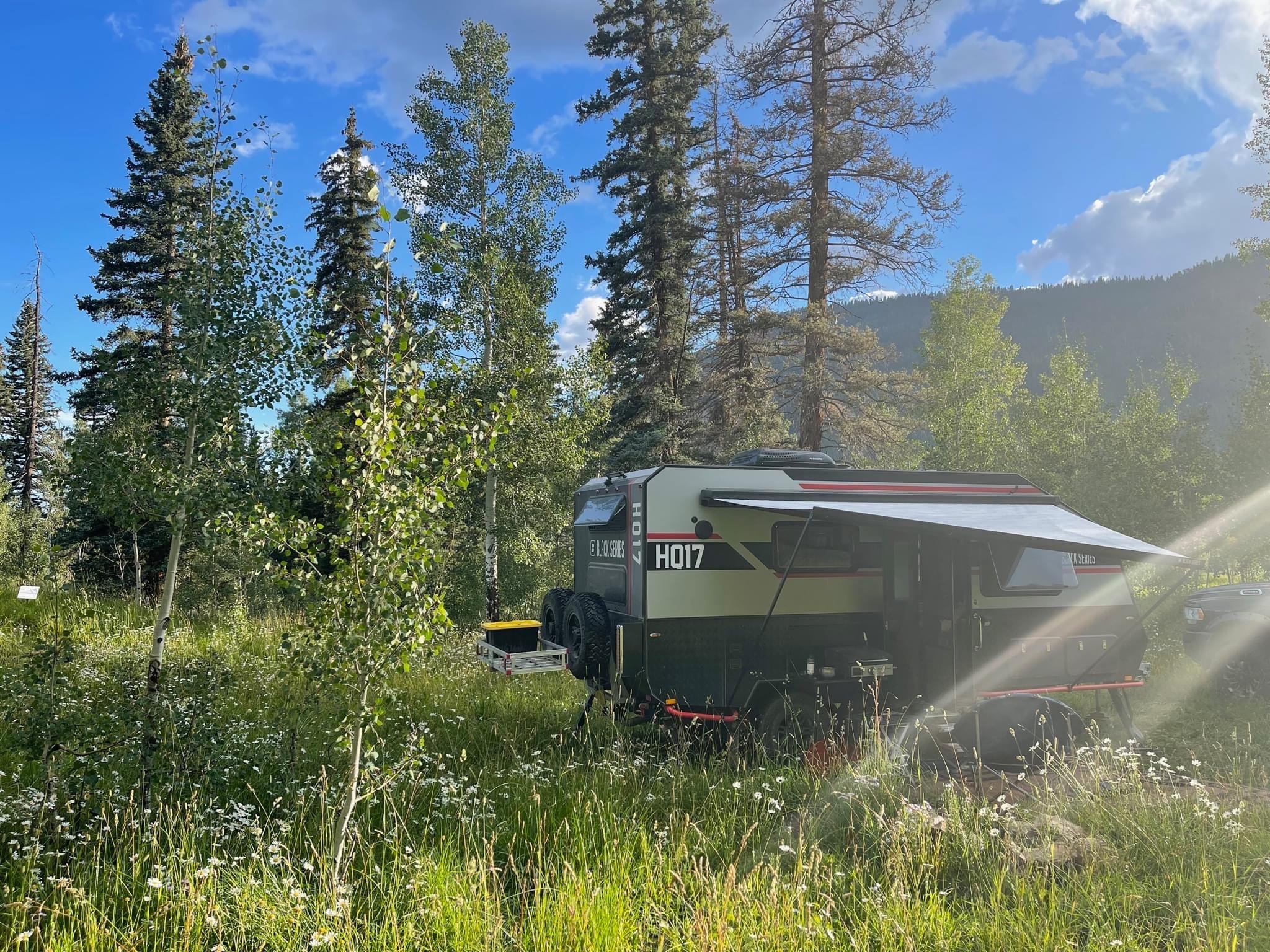
The HQ17 delivers full capability in a compact package, perfect for tight trails and mid-size tow vehicles.
The HQ19 adds interior space while maintaining serious trail credentials.
The HQ21 represents the flagship, maximum comfort and capability for extended expeditions.
The Alpha Series offers streamlined designs for those prioritizing weight savings without sacrificing core off-road capability.
Choosing the Right Off-Road Capable RV
Matching your trailer to your tow vehicle and intended use prevents expensive mistakes. Here’s the framework:
Consider your tow vehicle’s capacity first. A 16 ft camper weight around 3,500-4,000 pounds suits mid-size trucks and SUVs. A 24 ft camper weight pushing 6,500+ pounds requires a full-size truck with adequate payload and towing ratings.
Match capability to your actual destinations. If you’re primarily accessing established Forest Service campgrounds, you might not need maximum ground clearance. If you’re planning technical desert trails or mountain passes, every inch matters.
Factor in the average weight of camper gear you’ll carry. Water, food, recovery equipment, and adventure gear add hundreds of pounds. A 30 foot rv weight fully loaded can exceed towing capacities that seemed adequate on paper.
Think about duration. Weekend trips need less water and power capacity than two-week expeditions. Oversizing systems adds weight and cost; undersizing limits your options.
Real-World Performance Examples
Desert Southwest: BlackSeries owners regularly access remote areas of Utah’s canyon country, Arizona’s Sonoran Desert, and New Mexico’s backcountry via roads that would strand standard trailers. The combination of high clearance, robust suspension, and off-grid capability enables multi-week trips without resupply.
Mountain West: From Colorado’s alpine meadows to Montana’s national forest dispersed camping, the steep grades and rough access roads demand every capability feature. Owners report accessing campsites they previously thought trailer-impossible.
Pacific Coast: California and Oregon’s coastal ranges offer stunning but challenging access. Narrow, winding roads with embedded rocks and seasonal washouts test suspension and clearance continuously.
Off-Road Capability – FAQs
Q1: What does off-road capability mean for an RV?
Off-road capability refers to integrated engineering, suspension, frame, clearance, and power systems, that enables safe travel on unpaved, rough, or remote terrain where standard trailers cannot go.
Q2: Can all travel trailers go off-road?
No. Standard trailers lack the suspension, ground clearance, and structural reinforcement for rough terrain. Attempting off-road travel in an unsuitable trailer risks damage, safety issues, and warranty voidance.
Q3: What features make an RV off-road capable?
Essential features include heavy-duty independent suspension, high ground clearance (14+ inches), reinforced all-welded chassis, all-terrain tires, and comprehensive off-grid power systems.
Q4: Are BlackSeries campers truly off-road capable?
Yes. BlackSeries trailers are engineered from the ground up for off-road use, featuring Cruisemaster suspension, galvanized steel frames, and design heritage from Australia’s demanding outback conditions.
Q5: How do I choose an off-road capable camper?
Start with your tow vehicle’s capacity, then match trailer weight and size to your intended terrain and trip duration. Prioritize suspension quality and ground clearance over interior amenities if access is your primary goal.
Ready to expand your adventure possibilities? Explore the full BlackSeries lineup and discover what true off-road capability means for your 2026 adventures.

