If you’ve ever rolled through a national forest on a dirt access road, windows down, dust kicking up behind you, and thought “I wish I could just stay here“, that’s the pull of off-road trailer travel. It’s not about paved campgrounds with Wi-Fi and coin showers. It’s about towing a rugged, self-sufficient trailer into places most people never see: canyon plateaus, alpine meadows, desert washes, and forest service roads where the only neighbors are the ones with four legs.
Off-road trailer travel is a style of adventure camping where you haul a purpose-built trailer across terrain that would chew up a standard RV in minutes. You’re managing your own power, water, and shelter while exploring landscapes that require real capability, not just clearance, but suspension geometry, dust sealing, and systems designed to go the distance without hookups.
This guide breaks down everything you need to know: what makes a trailer “off-road,” how to plan a trip that doesn’t end with a tow truck, what gear actually matters, and how to pick a rig that matches your ambitions.
What is Off Road Trailer Travel? (Definitions & Terms)
Let’s get the terminology straight, because “off-road,” “overland,” and “backcountry” get thrown around interchangeably, but they’re not quite the same thing.
Off-Road Trailer Travel refers to towing a trailer on unmaintained roads, trails, or terrain that requires higher clearance, reinforced suspension, and rugged construction. Think BLM access roads, forest service tracks, or desert trails, places where you’ll encounter rocks, washboard, sand, or creek crossings.
Overland Travel is a subset focused on long-distance, self-reliant journeys. It’s less about the difficulty of the terrain and more about the duration and remoteness. Overlanding often involves international or multi-state trips where resupply is infrequent and you’re carrying days or weeks of provisions.
Backcountry Camping emphasizes remote, undeveloped locations, places you access via challenging routes. It’s about getting away from crowds and infrastructure, not just driving on dirt.
Now, here are a few terms you’ll see constantly in the off-road trailer world:
Departure Angle: The maximum angle your trailer can leave an incline without the rear dragging. Higher departure angles mean you can handle steeper exits and obstacles without scraping.
Articulating Hitch: A hitch system that allows the trailer to move independently from the tow vehicle in multiple directions. This keeps all four wheels on the ground even when the truck is tilted or traversing uneven terrain, critical for maintaining traction and stability.
Independent Suspension: A suspension system where each wheel moves independently. Unlike solid axles, independent suspension absorbs shocks better on rough terrain and keeps the trailer body more level, reducing stress on the frame and interior.
Dry Weight vs. GVWR: Dry weight is what the trailer weighs empty, no water, gear, propane, or food. GVWR (Gross Vehicle Weight Rating) is the maximum safe loaded weight. The difference between the two is your cargo capacity, and it’s smaller than you think once you add water tanks, batteries, recovery gear, and supplies.
Why Choose Off Road Trailer Travel?
So why drag a trailer into the dirt when you could rent a cabin, sleep in a rooftop tent, or just go full van life?
Because off-road trailers give you something the other options don’t: comfort without compromise. You get the mobility to reach remote locations and the systems to stay there comfortably for days or weeks. Let’s compare:
Standard RV Travel: Designed for campgrounds with hookups. Low clearance, soft suspension, and systems that need frequent recharging. You’re limited to paved or well-maintained gravel roads. Great for state parks, terrible for dispersed camping.
Van Life: Maximum mobility and stealth camping potential. But you’re living, cooking, and sleeping in the same 60 square feet. Limited water capacity, minimal solar, and zero ability to “set up camp” and leave your living space behind while you explore.
Rooftop Tent Camping: Lightweight and adventurous, but no bathroom, no kitchen, no climate control, and you’re setting up and breaking down every single time you want to drive somewhere.
Off-Road Trailers: You tow your full living quarters, bed, kitchen, bathroom, power, water, into places other RVs can’t reach. Then you unhitch, set up camp, and use your truck for day trips, supply runs, or scouting new spots. You’re not sacrificing comfort for capability.
Typical U.S. Use Cases
Desert Southwest (Arizona, Utah, New Mexico): BLM land dominates out here, with endless dirt roads leading to red rock canyons, slot canyons, and mesa-top campsites. Expect extreme temperature swings, limited water sources, and stunning isolation.
Rocky Mountains (Colorado, Wyoming, Montana): High-altitude forest service roads climb above treeline into alpine zones. Washboard roads, steep grades, and sudden weather changes demand trailers with serious suspension and four-season capability.
Pacific Northwest (Oregon, Washington): Rainforests, volcanic landscapes, and coastal access roads. You’ll need robust water sealing, insulation for wet and cold conditions, and systems that handle muddy, slippery trails.
BLM Land and National Forests: These are the backbone of off-road trailer travel in the U.S. The Bureau of Land Management and U.S. Forest Service manage millions of acres open to dispersed camping, often free or low-cost, with no reservations required. You just need to follow Leave No Trace principles and know where motorized access is allowed.
How to Plan Your Off Road Trailer Travel
Planning an off-road trip isn’t like booking a campground. You’re dealing with variables: road conditions, weather, water availability, and whether your rig can actually handle the route you’re eyeing. Here’s how to do it right.
Route Planning: Use BLM and USFS Resources
Start with the Bureau of Land Management (BLM.gov) and U.S. Forest Service (FS.usda.gov) websites. Both agencies publish maps, road status updates, and dispersed camping regulations. Look for:
- Motor Vehicle Use Maps (MVUMs): Show which roads and trails are open to motorized vehicles.
- Road Condition Reports: Updated seasonally or after major weather events.
- Fire Restrictions: Can limit where and when you can camp.
Apps like Gaia GPS, OnX Offroad, and FreeRoam overlay user-submitted campsites, trail ratings, and offline maps, essential when cell service disappears.
Assess Trail Difficulty Honestly: Trails are often rated on a 1-10 scale. If your trailer is new to you, start with easier routes (3-5 range) before tackling technical terrain. A “moderate” trail for a Jeep might be an expensive mistake for a loaded 24-foot trailer.
Tow Vehicle Matching: Know Your Numbers
Your truck’s tow rating is a starting point, not a guarantee. Here’s what actually matters:
Tow Rating vs. Real-World Capability: Manufacturers list maximum tow capacity under ideal conditions, empty truck, flat road, no cargo. In reality, you’re adding passengers, gear, recovery equipment, and fuel. Always leave a 20% buffer between your loaded trailer weight and your truck’s max capacity.
Tongue Weight: Aim for 10-15% of your trailer’s total weight pressing down on the hitch. Too little and the trailer will sway. Too much and you’ll overload the truck’s rear axle, reducing steering control.

Weight Reality Check: The average weight of camper trailers built for highways ranges from 3,000 to 7,000 lbs dry. But off-road trailers are different. A rugged off-road travel trailer in the 16-24 foot range often starts around 3,500-5,500 lbs dry, before you add water, batteries, gear, and armor.
For context, the 16 ft camper weight for an off-road build typically lands around 3,500-4,200 lbs dry, while an 18 ft camper weight climbs to 4,000-4,800 lbs. A 24 ft camper weight for a serious off-road rig can hit 5,500-6,500 lbs dry. And if you’re looking at larger expedition-grade units, the 30 foot rv weight (or 30 ft camper weight / 30-foot camper weight) can exceed 8,000-10,000 lbs dry, significantly heavier than average travel trailer weights due to reinforced frames, independent suspension, and high-capacity off-grid systems.
Why does this matter? Because once you load up with 100 gallons of water (830 lbs), lithium batteries (150-300 lbs), propane (60 lbs), recovery gear, and camping supplies, you can easily add 1,500-2,000 lbs to your dry weight. That “light” 4,500 lb trailer is now pushing 6,500 lbs, and your truck needs to handle it on steep grades and loose surfaces.
Pre-Trip Checklist: Systems and Safety
Before you head out, run through this checklist. Print it, laminate it, keep it in your glove box.
Pro Tip: Test everything before you’re three hours into the backcountry. Run the water pump, fire up the stove, check the lights. It’s way easier to fix a blown fuse at home than on a forest service road at sunset.
The Essential Packing Checklist
You can’t just throw gear in the back and hope for the best. Off-road travel demands organization, redundancy, and a clear understanding of what you actually need vs. what sounds cool.
Trailer Systems (Tools & Spares)
- Spare tire (matching load rating and tread pattern)
- Lug wrench and jack (rated for your trailer’s weight)
- Fuses and wire repair kit
- Spare bulbs for trailer lights
- Tire repair kit and portable compressor
- Axle grease and basic hand tools (wrenches, screwdrivers, pliers)
Recovery Gear
If you’re going off-road, you’re going to get stuck eventually. Be ready.
- Recovery straps (rated for your combined vehicle + trailer weight)
- Traction boards (like MAXTRAX or ARB)
- D-rings or shackles (rated for your truck’s weight)
- Shovel (full-size, not a camping trowel)
- Winch (if your truck is equipped) or kinetic recovery rope
Communication & Navigation
- Offline GPS maps (Gaia GPS, OnX Offroad)
- Satellite messenger (Garmin inReach, Zoleo) for emergencies
- Paper maps as backup
- Weather radio for storm updates
Weather and Terrain-Specific Supplies
Desert: Extra water (beyond your tank capacity), sun shade for the trailer, sand stakes for awnings, electrolyte supplements.
Mountains: Cold-weather clothing, tire chains, extra propane, headlamps with red light mode (for altitude adjustment).
Forests: Insect repellent, bear-safe food storage, rain gear, mud mats for stabilizing the trailer.
What Makes the Best Off Road Trailers for Travel?
Not all trailers marketed as “off-road” are built the same. Some are lightly modified campers with bigger tires. Others are purpose-engineered machines designed to handle thousands of miles of punishment. Here’s what separates the real deal from the pretenders.
Suspension Geometry
Independent suspension is the gold standard for off-road trailers. It allows each wheel to move independently, keeping all four tires in contact with the ground even when traversing boulders, ruts, or steep side slopes. Solid axles, by contrast, force one side up when the other drops, leading to potential frame stress and loss of traction.
Look for long-travel shocks and coil springs or torsion axles. These absorb impacts better than leaf springs, which are common on highway trailers but harsh on rough terrain.
Low Center of Gravity
A low center of gravity reduces rollover risk on side slopes and keeps the trailer stable during sharp turns or sudden stops. This means placing heavy components, batteries, water tanks, chassis structure, as low as possible in the frame.
High-end adventure trailers typically mount batteries and tanks between the frame rails, not above them.
Dust and Water Sealing
Off-road travel kicks up dust, and a single rainstorm can turn a trail into a mud bath. Your trailer needs sealed entry points: doors with compression gaskets, hatches with multi-point locks, and pass-throughs for wiring and plumbing that won’t let dust or water infiltrate.
Check for aluminum or composite siding (not wood framing, which rots when exposed to moisture). Quality trailers use welded aluminum frames and marine-grade fasteners.
Long-Term Durability
Think about the forces at work: constant vibration, thermal expansion, UV exposure, and repeated stress cycles. Cheap trailers use screws and staples. Serious off-road rigs use bolts, rivets, and welds.
Inspect the frame welds (they should be clean, consistent beads), the door and window seals (no gaps or cracking), and the underbelly protection (should be sealed against road spray and rock impacts).
BlackSeries Design Philosophy
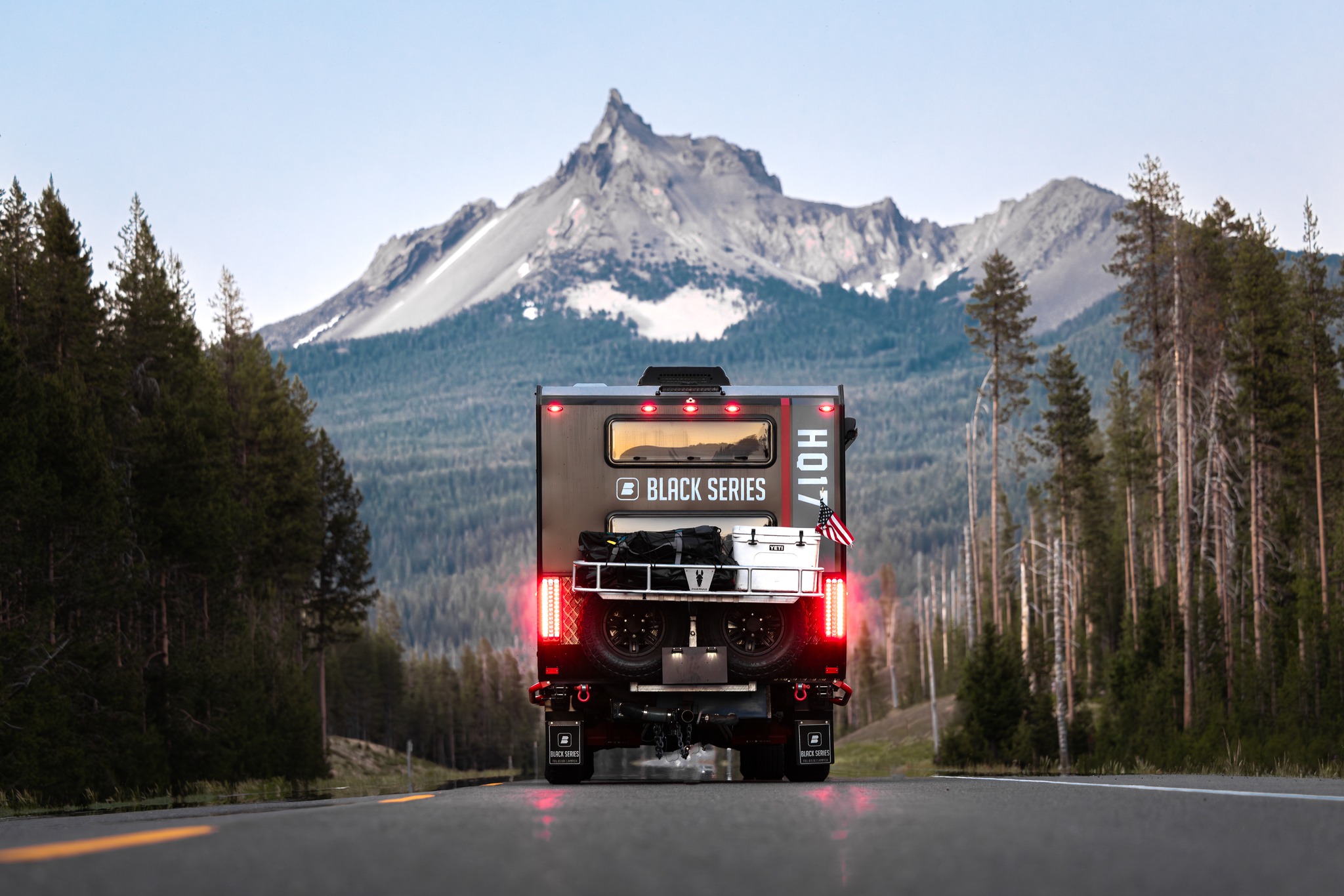
At BlackSeries, we build trailers for people who use them, not just park them at the lake once a year. Our off-road camper trailers are engineered for extended off-grid stays in legitimate backcountry terrain. Independent suspension, oversized lithium power systems, and full-season insulation aren’t add-ons, they’re standard because they’re essential.
Real-World Usage Scenarios
Let’s talk about what off-road trailer travel actually looks like in practice, because the glossy magazine photos don’t show the flat tire at mile marker 47 or the calculation you’re doing in your head about water reserves.
Common Mileage Ranges for U.S. Overland Trips
Most off-road trailer trips fall into three categories:
Weekend Exploration (100-300 miles): A Friday departure to a BLM or forest service area, two nights of camping, Sunday return. Typical range: 2-3 days off-grid. You’ll use 30-50 gallons of water, 200-400 amp-hours of battery, and 5-10 lbs of propane.
Week-Long Adventure (300-800 miles): Multi-location trip hitting 3-4 campsites across a region (e.g., Utah’s canyon country or Colorado’s mountain passes). Typical range: 5-7 days off-grid. Water becomes critical, plan on 75-100 gallons depending on usage. You’ll need robust off-grid power systems with solar recharging.
Extended Expedition (1,000+ miles): Multi-week or multi-month journeys covering entire regions or following seasonal routes (e.g., snowbirds heading south, summer alpine tours). You’ll need resupply strategies, backup systems, and trailers designed for continuous use.
Energy Consumption Logic for Multi-Day Off-Grid Stays
Here’s the math that matters:
Daily Power Draw (typical off-grid trailer):
- Lights, water pump, fans: 20-40 Ah
- Refrigerator (compressor-style): 30-50 Ah
- Device charging (phones, laptops): 10-20 Ah
- Total daily draw: 60-110 Ah
If you’re running a lithium power system with 300 Ah capacity, you can theoretically go 2-3 days without solar input. But add in cloudy weather, higher AC usage (summer) or heater runtime (winter), and you’ll want 400-600 Ah for true week-long autonomy.
Water Consumption:
- Drinking and cooking: 1-2 gallons per person per day
- Dishes and hygiene: 3-5 gallons per person per day
- Shower (if equipped): 5-10 gallons per use
For a couple on a 7-day trip, plan on 70-100 gallons minimum. That’s why serious off-road trailers carry 80-120 gallon tanks.
How Extreme Weather Impacts Trailer Structures
Desert Heat: Direct sun heats metal roofs and walls, turning interiors into ovens. Quality trailers use reflective roof coatings and 3+ inches of insulation to keep interiors livable without running the AC constantly.
Winter Cold: Below-freezing temps can freeze water lines, crack tanks, and drain batteries faster (lithium performs poorly below 32°F without heating). Four-season trailers include heated underbellies, insulated tanks, and battery warming systems.
High Winds: Canyon camping and mountain plateaus expose trailers to sustained 30-40 mph winds. Poorly secured awnings, vents, or cargo can become projectiles. Use telescoping stabilizers, storm straps, and always stow loose items.
FAQ: Off Road Trailer Travel
Is off-road trailer travel legal on BLM land?
Yes, but with rules. BLM land allows dispersed camping on most areas, typically with a 14-day stay limit in any one location. You must camp on designated roads or within 300 feet of them (varies by district). Check the local BLM office for fire restrictions, seasonal closures, and motor vehicle use maps. Some wilderness study areas prohibit motorized access entirely.
How far can you travel off-grid with a trailer?
With proper systems, 7-14 days is realistic for a couple. This assumes:
- 100+ gallons of fresh water
- 300-600 Ah lithium battery capacity with solar recharging
- 20-30 lbs of propane for cooking and heating
Your actual range depends on climate, usage habits, and whether you’re running AC, a heater, or power-hungry appliances. In practice, most people resupply every 5-7 days for fresh food and water top-offs.
Do off-road trailers damage trails?
When used responsibly, no. The key is staying on designated roads and avoiding sensitive areas like stream banks, archaeological sites, or marked restoration zones. Modern trailers with independent suspension and proper tire inflation actually have less ground pressure per square inch than many 4×4 trucks. The bigger issue is irresponsible driving: speeding, cutting switchbacks, or driving off-trail: which any vehicle can do.
What size truck is needed for off-road trailer travel?
It depends on your trailer’s loaded weight, but here’s a general guide:
- Half-Ton Trucks (F-150, Ram 1500, Silverado 1500): Can handle trailers up to 7,000-9,000 lbs with proper payload and towing packages. Good for lighter off-road trailers (16-20 ft range).
- 3/4-Ton Trucks (F-250, Ram 2500, Silverado 2500): Handle trailers up to 12,000-15,000 lbs. Ideal for mid-size to larger off-road trailers (20-30 ft) with full systems.
- 1-Ton Trucks (F-350, Ram 3500, Silverado 3500): For serious expedition rigs or trailers approaching the 30 ft rv weight class (8,000-10,000 lbs dry, 10,000-12,000 lbs loaded).
Remember, it’s not just about can you tow it: it’s about can you control it on steep grades, loose surfaces, and emergency braking situations. A truck that maxes out its towing capacity on the highway will struggle in the dirt.
Off-road trailer travel isn’t for everyone. It takes planning, the right equipment, and a willingness to troubleshoot when things don’t go according to plan. But if you want the freedom to camp where the pavement ends: and stay there comfortably: it’s the best way to explore the American backcountry. Whether you’re chasing red rock sunsets in Utah, alpine meadows in Colorado, or coastal rainforests in Washington, the right trailer makes all the difference between an adventure and an ordeal.

