Wind noise in a travel trailer is usually caused by turbulent airflow around the front, roof, and gaps, not by the trailer being “too light” or “too old.”
Understanding the real sources of wind noise can help you diagnose problems quickly and apply effective solutions. Here’s what you need to know:
> 🔑 Key Takeaways:
> – Highway speeds above 60 mph dramatically amplify wind noise
> – Most noise originates from localized turbulence and gap resonance
> – Many issues can be resolved through structural improvements and driving habits
> – BlackSeries recommends addressing aerodynamics at the design stage rather than aftermarket fixes
What Is Wind Noise in a Travel Trailer?
> 📌 Section Summary: Aerodynamic noise occurs when air flowing around your trailer becomes turbulent rather than smooth. Travel trailers experience more wind noise than solo vehicles due to their larger frontal area and boxy design.
Wind noise in travel trailers is technically called aerodynamic noise, the sound produced when airflow around your trailer transitions from smooth (laminar flow) to chaotic (turbulent flow). This transition creates pressure variations, vibrations, and audible disturbances that intensify with speed.
Laminar Flow vs. Turbulent Flow
When air moves smoothly around an object in parallel layers, it’s called laminar flow. This produces minimal noise and resistance. However, when airflow encounters abrupt angles, protrusions, or gaps, it breaks into irregular patterns called turbulent flow. This turbulence creates:
- Pressure oscillations against exterior panels
- Vibration in structural components
- Audible whistling, humming, or buffeting sounds
Why Towing Amplifies the Problem
Travel trailers face significantly more wind noise challenges than solo vehicles for several reasons:
- Larger frontal area – More surface for wind to impact directly
- Boxy profiles – Sharp angles create more flow separation points
- Gap between tow vehicle and trailer – Creates trapped air pockets
- Extended length – More surface area for turbulence to develop
At highway speeds, these factors combine to make wind noise one of the most common complaints among RV owners. The physics are straightforward: wind resistance, and the noise it generates, increases exponentially with speed. This is why understanding and addressing aerodynamic noise matters for every serious RV traveler.
Common Sources of RV Wind Noise While Towing
> 📌 Section Summary: Wind noise typically originates from four key areas: front-end turbulence, roof accessories, gaps and seals, and underbody airflow disruption.
Identifying where noise originates is the first step toward eliminating it. Here are the primary culprits:
1. Front-End Turbulence
The front face of your travel trailer is the first point of contact with oncoming air. Flat, vertical front ends create what engineers call flow separation, air can’t follow the surface smoothly, so it breaks into turbulent eddies.
This turbulence produces:
- Low-frequency rumbling
- Pressure fluctuations felt as vibration
- Increased fuel consumption as your tow vehicle works harder
The gap between your truck and trailer also traps breaking wind, creating additional noise and reducing towing efficiency. Large gaps between the trailer and truck roof can cause wind to become particularly turbulent, resulting in structural movement and popping sounds.
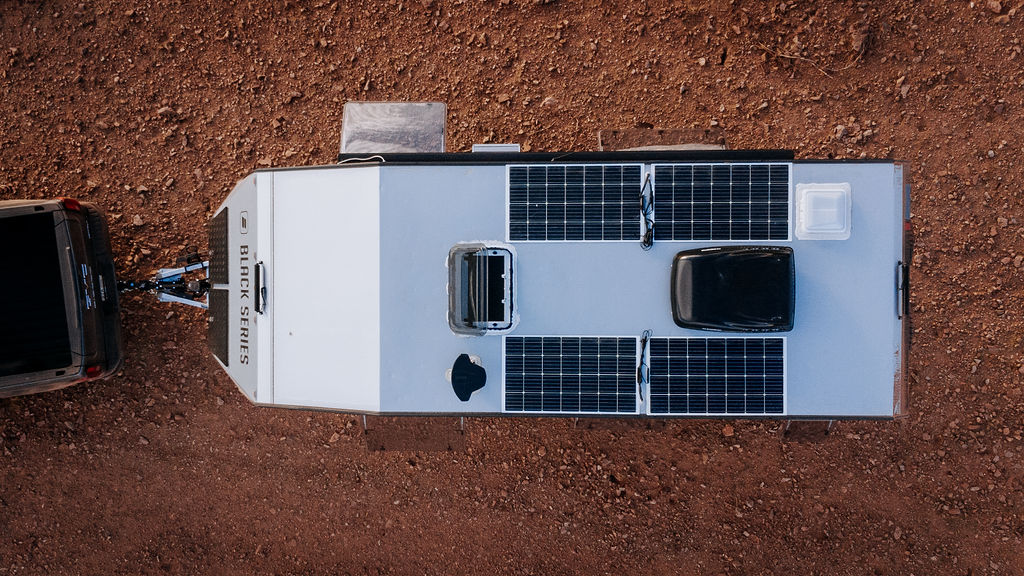
2. Roof Accessories and Mounts
Roof-mounted equipment is a major but often overlooked noise source. Common offenders include:
- Solar panel mounts – Even low-profile panels create airflow disruption
- Roof racks – Cross-bars act as wind catchers
- A/C units – Their boxy profiles generate significant turbulence
- Antennas and satellite dishes – Protrusions create localized whistling
Each accessory adds drag and creates new points where airflow separates from the trailer surface, generating characteristic whistling or humming sounds that intensify at higher speeds.
3. Gaps, Seals, and Panel Edges
Structural gaps are responsible for some of the most irritating wind noises, sharp whistles and high-pitched tones that seem to penetrate everything. Sources include:
- Door and window seals – Deteriorated or improperly fitted weatherstripping
- Panel joints – Factory seams that allow air infiltration
- Slide-out edges – Complex seal systems that can develop gaps
- Compartment doors – External storage with loose seals
These gaps act like musical instruments, with air pressure forcing through narrow openings creating resonant “whistle” tones. Even small gaps can produce surprisingly loud noise at highway speeds.
4. Underbody Airflow
The underside of your trailer is often neglected in noise reduction efforts, but it contributes significantly to overall wind noise. Exposed components create turbulence:
- Frame members and cross-braces
- Holding tanks and plumbing
- Wiring and hose runs
- Unfinished chassis elements
This underbody turbulence creates low-frequency rumbling and contributes to overall cabin noise levels. For comprehensive guidance on optimizing your trailer for challenging conditions, explore our 2025 off-road travel trailer buying guide.
How to Reduce Wind Noise in a Travel Trailer (Step-by-Step)
> 📌 Section Summary: Systematically identify noise locations, seal gaps, reduce roof turbulence, and improve front-end airflow for maximum noise reduction.
Reducing wind noise requires a methodical approach. Follow these steps to diagnose and address problems effectively:
Step 1: Identify the Noise Location
Before applying any fixes, determine where the noise originates:
Speed-based testing:
- Note at what speed noise becomes noticeable (typically 55-60 mph)
- Listen for changes as you accelerate through 65, 70, and 75 mph
- Specific noises often emerge at distinct speed thresholds
Location assessment:
- Have a passenger listen while traveling to identify which area is loudest
- Front/top/side determination guides your repair priority
- Record audio if possible for comparison after fixes
Environmental conditions:
- Test in crosswinds versus headwinds
- Note if noise changes when passing large vehicles
- Weather conditions affect noise characteristics
Step 2: Seal Gaps and Edges
Once you’ve identified problem areas, sealing gaps often provides immediate improvement:
Door and window weatherstripping:
- Inspect all seals for compression, cracking, or gaps
- Replace deteriorated weatherstripping with quality automotive-grade materials
- Ensure proper compression when doors and windows close
Panel joint treatment:
- Apply self-adhesive foam tape to panel edges
- Use silicone sealant for permanent joints
- Check and reseal compartment door edges
Slide-out seals:
- Inspect wiper seals for wear and proper contact
- Clean and lubricate according to manufacturer specifications
- Replace damaged sections promptly
Step 3: Reduce Roof Turbulence
Minimizing rooftop disruption delivers significant noise reduction:
Assess necessity:
- Remove accessories you don’t regularly use
- Consider relocating equipment to lower positions
- Evaluate whether each item justifies its noise contribution
Optimize remaining equipment:
- Add aerodynamic fairings where possible
- Ensure mounts are tight (loose equipment vibrates)
- Choose low-profile alternatives when replacing equipment
Step 4: Improve Front-End Airflow
Addressing front-end turbulence requires either design solutions or aftermarket modifications:
Air deflector installation:
- Add deflectors angled at approximately 15 degrees
- Position to redirect airflow over the trailer roof
- Ensure secure mounting to prevent vibration
Gap management:
- Minimize truck-to-trailer gap where possible
- Consider cab-mounted deflectors on your tow vehicle
- Adjust fifth-wheel height for optimal airflow (if applicable)
For owners tackling challenging terrain where noise control meets durability requirements, our article on boondocking with the HQ21 covers how premium trailers balance multiple performance factors.

Speed and Wind Noise: Why Highway Driving Makes It Worse
> 📌 Section Summary: Wind noise increases exponentially with speed. Reducing cruising speed from 75 mph to 60-65 mph can cut perceived noise by 40% or more.
The relationship between speed and wind noise isn’t linear, it’s exponential. This means small speed increases produce disproportionately large noise increases.
The Physics of Speed-Related Noise
Wind noise intensity follows aerodynamic drag principles:
- Double your speed → approximately quadruple the wind force
- Noise intensity tracks closely with this force increase
- Every 10 mph increase produces noticeably more noise
Real-World Speed Comparisons
Why Slower Is Often Smarter
Experienced RV travelers understand that “slower is actually faster” when you factor in:
- Fuel stops – Higher speeds increase consumption dramatically
- Fatigue – Constant noise increases driver tiredness
- Safety margins – Lower speeds improve emergency response capability
- Comfort – Quieter rides mean happier passengers
Maintaining 60-65 mph provides the optimal balance between travel time and noise/efficiency. This principle applies across all towing scenarios, whether you’re crossing water hazards or cruising interstate highways.
Myths About Wind Noise in Travel Trailers
> 📌 Section Summary: Common misconceptions lead RV owners to pursue ineffective solutions. Understanding the real causes prevents wasted effort and expense.
Myth 1: Wind Noise Means the Trailer Is Too Light
Reality: Trailer weight has minimal direct impact on wind noise. Noise comes from aerodynamic interactions, not mass. A heavy trailer with poor aerodynamics will be just as noisy as a lighter one. What matters is shape, sealing, and surface finish, not pounds on the scale.
Myth 2: Soundproofing Materials Are the Only Solution
Reality: Adding mass-loaded vinyl and acoustic panels treats symptoms, not causes. While interior soundproofing reduces perceived noise, it doesn’t address the source. Effective solutions start with aerodynamic improvements and sealing, soundproofing should be the final layer, not the first response.
Myth 3: All Travel Trailers Are Equally Noisy at Highway Speeds
Reality: Design matters enormously. Trailers engineered with aerodynamic considerations from the start perform dramatically better than those designed purely for interior space or aesthetics. Rounded edges, optimized roof profiles, and integrated accessories all reduce noise at the source.
How BlackSeries Designs RVs with Wind Noise Reduction in Mind
> 📌 Section Summary: BlackSeries addresses aerodynamic noise at the design stage through optimized profiles, reduced flow separation points, and superior construction standards.
At BlackSeries, we approach wind noise as an engineering challenge to solve during design, not a problem to patch afterward.
Aerodynamic Profile Development
Our trailers feature carefully considered exterior contours:
- Rounded front edges reduce initial flow separation
- Optimized height-to-width ratios minimize crosswind sensitivity
- Integrated accessory mounting prevents afterthought-style protrusions
Flow Separation Minimization
Every exterior element undergoes evaluation for aerodynamic impact:
- Roof-mounted equipment uses low-profile designs
- Panel joints are engineered for flush surfaces
- Underbody components are shielded where practical
Construction Integrity Standards
Proper sealing starts with quality construction:
- Premium weatherstripping on all openings
- Precision panel fitting reduces gap resonance
- Structural rigidity prevents flexing-induced noise
Real-World Optimization
BlackSeries trailers are designed for mixed-use scenarios, highway towing one day, off-road adventure the next. This means optimizing for:
- Highway stability and quiet operation
- Off-road durability and ground clearance
- Remote camping capability with full off-grid systems
Explore how these design principles come together in models like the all-new HQ19 or discover the full BlackSeries lineup.
Checklist: Effective Ways to Quiet a Travel Trailer
> 📌 Section Summary: Apply this actionable checklist to systematically reduce wind noise in your travel trailer.
Use this checklist to address wind noise comprehensively:
Speed Management
- Maintain cruising speed between 60-65 mph
- Reduce speed in headwind conditions
- Allow extra travel time rather than pushing speeds
Seal Inspection and Maintenance
- Check door weatherstripping quarterly
- Inspect window seals for compression and gaps
- Examine slide-out wiper seals for wear
- Test compartment door closures for air leaks
Exterior Accessory Audit
- Remove unused roof-mounted equipment
- Tighten all mounting hardware
- Add aerodynamic fairings where practical
- Consider low-profile replacements for noisy accessories
Weight Distribution
- Balance cargo for optimal trailer tracking
- Secure loose items that could shift and cause vibration
- Maintain proper tongue weight percentage
Platform Selection
- Evaluate aerodynamic design when purchasing
- Prioritize integrated accessory mounting
- Choose quality construction with proper sealing standards
FAQ: Wind Noise in Travel Trailers
Q1: Is wind noise normal in a travel trailer?
A: Some wind noise is inevitable in any travel trailer due to their size and shape. However, excessive noise, particularly sharp whistles, loud humming, or conversations-disrupting levels, indicates addressable problems. Most wind noise can be significantly reduced through proper sealing, speed management, and attention to aerodynamics.
Q2: At what speed does wind noise become noticeable?
A: Wind noise typically becomes noticeable around 55-60 mph and increases rapidly beyond 65 mph. The exponential relationship between speed and wind force means each additional 10 mph produces disproportionately more noise. Most RV experts recommend cruising at 60-65 mph for optimal balance between travel time and comfort.
Q3: Do roof accessories increase wind noise?
A: Yes, significantly. Roof-mounted equipment including solar panels, A/C units, antennas, and roof racks all create turbulence and contribute to wind noise. Each accessory adds potential noise sources. Minimizing roof-mounted equipment, choosing low-profile options, and ensuring secure mounting all help reduce accessory-related noise.
Q4: Can better aerodynamics really reduce trailer noise?
A: Absolutely. Aerodynamic design addresses noise at its source rather than attempting to block it afterward. Trailers with rounded edges, optimized profiles, and integrated accessories generate less turbulence and therefore less noise. This is why BlackSeries engineers aerodynamic considerations into every model from the initial design stage, creating trailers that perform quietly whether you’re living the adventure on challenging terrain or cruising the interstate.

