If you’re eyeing a trailer that can handle six months in the backcountry without breaking a sweat, or your back, you’re looking at ultra-premium expedition trailers. These aren’t your average weekend warriors. They’re engineered for extreme, long-duration overlanding in places most people wouldn’t dare tow a camper: remote BLM land, high-altitude mountain passes, and desert expanses where the nearest services are hours away.
Unlike a standard off-road travel trailer, which focuses on handling rough roads with occasional comforts, ultra-premium expedition trailers are designed for continuous, off-grid living regardless of weather. Think monocoque construction, diesel heating systems, and battery banks that could power a small house. If luxury off-road trailers are about enjoying a premium weekend, expedition trailers are about thriving for months without resupply.
What Makes an Expedition Trailer “Ultra-Premium”?
The term “ultra-premium” gets thrown around a lot, but in the expedition world, it’s defined by three core dimensions: structural engineering, self-sufficiency, and living comfort under extreme conditions.
Structural Engineering: We’re talking monocoque or semi-monocoque designs, think aircraft-grade construction where the outer skin shares load-bearing duties with the chassis. This isn’t just welded aluminum over a steel frame. Reinforced chassis with galvanized steel or powder-coated aluminum bodies handle torsional stress from washboard roads without cracking. It’s overbuilt on purpose.
Self-Sufficiency: The electrical, water, and thermal systems aren’t just “nice to have.” A true expedition trailer runs 400–600Ah lithium battery banks paired with 1,000W+ solar arrays. We’re not talking about keeping your phone charged, this is powering induction cooktops, diesel heaters, air conditioning, and water pumps for weeks at a stretch. Water filtration, grey water management, and 50+ gallon freshwater tanks are standard.
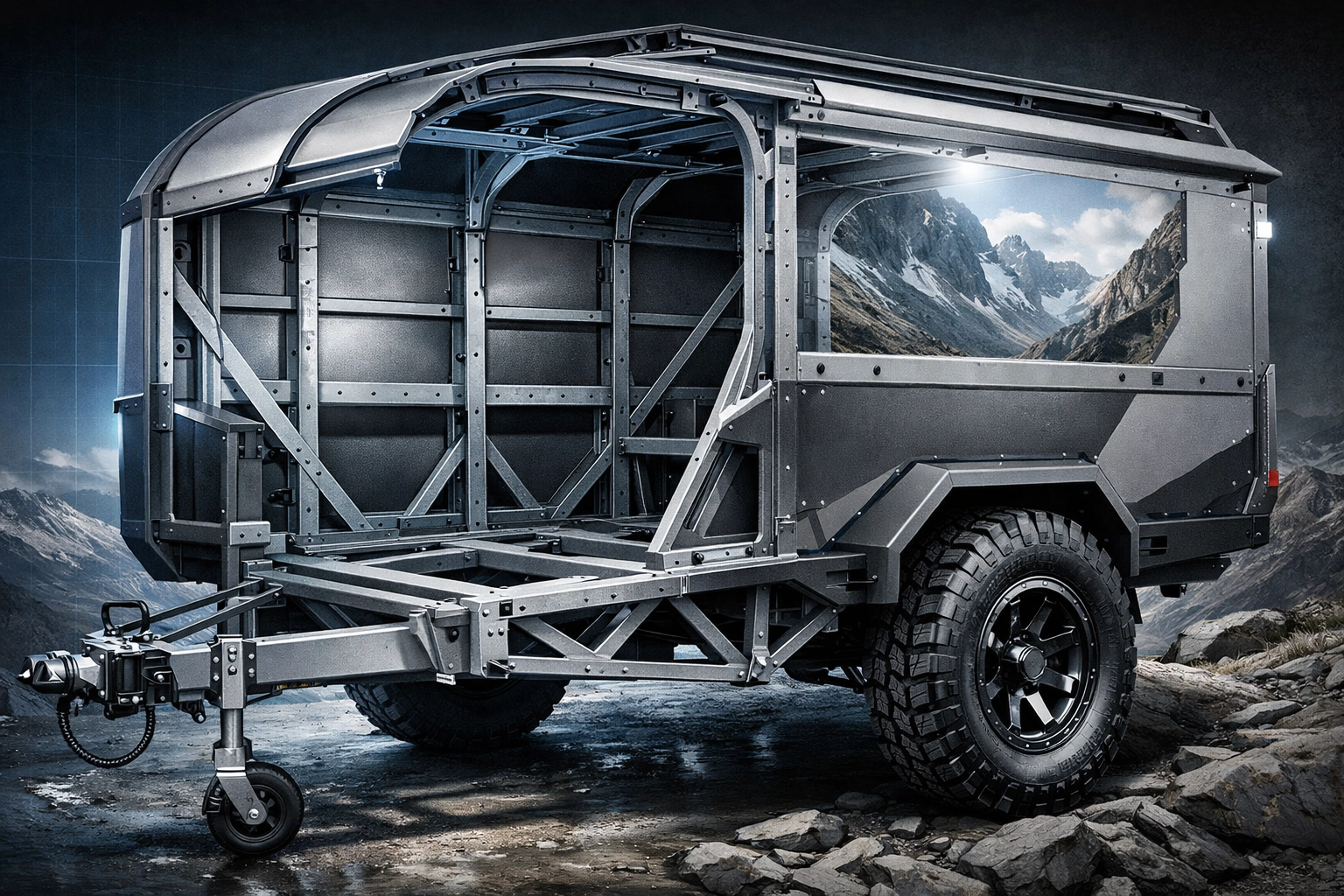
Living Comfort: Here’s the key difference between a luxury off-road trailer and an expedition build. Luxury is about a plush interior for a three-day trip. Expedition comfort means vibration-resistant cabinetry, marine-grade components, memory foam mattresses that don’t compress after 90 nights, and layouts that actually make sense when you’re living in 150 square feet for a month.
The target isn’t “weekend comfort.” It’s “long-term, remote, continuous use.” And that changes everything about material selection, system redundancy, and layout priorities.
Use Cases in the U.S. Market
Who actually needs this level of capability? Remote workers who’ve ditched the lease and spend six months bouncing between Nevada’s BLM land and Colorado’s National Forests. Long-haul overlanders crossing climate zones, from Mojave heat to Montana snow, without returning to civilization for resupply. Retirees who want to boondock in the Southwest during winter and explore Alaska in summer.
The typical routes? Forest Service roads that see maintenance once every three years. Dispersed camping sites 40 miles from pavement. Desert trails where daytime temps hit 115°F and nighttime drops to 40°F. These trailers aren’t designed for KOA hookups, they’re built for places where your cell signal died 20 miles back and the nearest town has a population of 47.
Ultra-Premium Expedition Trailer Features (Deep Dive)
Let’s break down what actually matters when you’re shopping in this category.
Four-Season & Climate Control
Insulation isn’t just about R-value, it’s about thermal bridging, vapor barriers, and maintaining interior temps in extreme conditions. Premium expedition trailers use closed-cell spray foam or rigid foam panels with vapor barriers to handle humidity in wet climates and condensation in cold ones.
Climate control typically includes:
- Diesel or propane furnaces with forced air distribution (Truma Combi systems are common)
- Roof-mounted or split-system air conditioning (think 13,500 BTU+)
- Radiant floor heating in high-end builds
- Insulated window covers and thermal breaks on doors
A proper four-season trailer maintains 70°F inside when it’s 10°F outside, or 110°F outside, without running your battery bank into the ground overnight.

Chassis, Suspension & Load Management
This is where expedition trailers separate from the pack. Independent suspension systems (coil-over or air suspension) provide 8–10 inches of articulation. That means one wheel can drop into a rut while the others stay planted, without twisting the frame or cracking body panels.
Reinforced chassis handle dynamic loads differently than static ones. It’s not just about total weight, it’s about how that weight shifts when you’re crawling over boulders at 3 mph. Torsion-free designs and triangulated subframes distribute stress across multiple points.
Center-of-gravity (CG) control becomes critical in longer trailers. Water tanks mounted low and centered, battery banks positioned over or between axles, and propane/diesel tanks integrated into the chassis help prevent tail-wagging and maintain stability on off-camber sections.
Energy & Water Independence
Here’s where you see the biggest cost jumps. Entry-level expedition setups might run 200Ah lithium with 400W solar. Ultra-premium? Think 600Ah+ Battle Born or Victron lithium banks, 1,000–2,000W solar arrays, and shore power / alternator charging integration.
Power management systems (Victron, REDARC) monitor voltage, charge state, and load distribution in real-time. You’re not guessing whether you can run the AC overnight, you’re watching live data on a control panel.
Water independence means:
- 50–80 gallon freshwater tanks with multiple fill points
- Grey water tanks (40–60 gallons) with level sensors
- Optional water filtration systems (reverse osmosis or UV)
- On-demand hot water heaters (diesel or electric)
- Winterization systems with heated tanks and lines
Interior Ergonomics & Materials
Living in 150–200 square feet for months exposes every design flaw. Expedition trailers use marine-grade latches, solid wood or aluminum cabinetry with positive latches, and drawer systems rated for off-road vibration. Countertops are typically solid surface or quartz, laminate doesn’t hold up.
Sleeping areas use memory foam mattresses with slatted bases for airflow (crucial in humid climates). Storage is modular, think MOLLE panels, gear tracks, and reconfigurable shelving. Windows are double-pane or acrylic with blackout and insect screens.
How to Choose an Ultra-Premium Expedition Trailer
Start with your tow vehicle. This isn’t negotiable. Check your GVWR (Gross Vehicle Weight Rating) and payload capacity, not just towing capacity. Tongue weight on expedition trailers typically runs 12–15% of total weight, and these rigs aren’t light.
Here’s where weight gets real. The average weight of camper trailers in the 20–25 foot range hovers around 5,000–6,000 lbs dry. But expedition builds? You’re looking at 7,000–10,000 lbs dry for a 30 foot rv weight in this category. Even compact models, your 16 ft camper weight or 18 ft camper weight builds, can hit 4,000–5,000 lbs due to reinforced frames, high-capacity tanks, and heavy-duty suspension.
A standard 24 ft camper weight might be 5,500 lbs in a traditional travel trailer. An expedition-spec 24 ft camper weight? Add 1,500–2,000 lbs for structural reinforcement, larger battery banks, and water capacity. The average travel trailer weights don’t apply here, expedition trailers are built like tanks because they need to be.
For a true ultra-premium rig in the 30 ft camper weight or 30 ft rv weight range, you’re easily looking at 10,000+ lbs loaded. That means a 3/4-ton or 1-ton truck minimum, often with upgraded towing packages. Half-ton trucks hit their limits fast, especially when you factor in payload for passengers, gear, and supplies.
Travel Duration Scoring: Rate your typical trips. 7-day trips? You can compromise on tank size and battery capacity. 30–90 day trips? You need full self-sufficiency with redundancy. Be honest about this, it drives every other decision.
Maintenance Accessibility: More systems mean more potential failure points. Can you troubleshoot a Victron inverter or a Truma furnace? Are parts available in the U.S., or are you waiting three weeks for imports? Premium brands offer dealer networks; boutique builders might not.
Resale & Lifecycle Cost: Expedition trailers hold value better than standard RVs, especially well-maintained builds from known manufacturers. Factor in battery replacement every 10–15 years ($3,000–$8,000), suspension servicing, and appliance repairs. A $150,000 trailer that needs $20,000 in repairs over five years still beats a $80,000 trailer that’s falling apart after two.
Ultra-Premium Expedition Trailer Setup Checklist
Before you hit the dirt, walk through this:
Pre-Trip Inspection (every trip):
- Tire pressure and tread depth (adjust for terrain, lower pressure for sand/dirt)
- Lug nuts torqued to spec (re-check after 50 miles)
- Bearing grease and hub temps (infrared thermometer is your friend)
- Battery state of charge and connections
- Water pump operation and tank levels
- Propane/diesel levels and leak checks
Power & Water Readiness:
- Solar panels clean and angled for optimal charging
- Inverter settings configured for appliance loads
- Water tanks filled, grey tank empty
- Freshwater lines flushed and sanitized (if stored)
Recovery & Redundancy Planning:
- Recovery points inspected (front and rear)
- Jack and leveling blocks accessible
- Traction boards mounted externally
- Spare tire (matching trailer tires, not truck spares)
- Basic tool kit and spare fuses/electrical connectors
If you’re new to this level of off-grid capability, check out our guide on off-grid power systems for deeper power management strategies.
Common Misconceptions
“More luxury means less off-road capability”: Not necessarily. The best expedition trailers balance both. Yes, you’re carrying more weight, but properly designed suspension and chassis engineering handle it. The issue isn’t luxury, it’s poor engineering trying to cram luxury into a standard frame.
“Half-ton trucks are enough for a high-spec 30 ft rv weight”: This is where people get into trouble. A loaded 30-foot camper weight expedition trailer can hit 12,000+ lbs. Add tongue weight (1,500–1,800 lbs) and your truck’s payload capacity disappears fast. You need a 3/4-ton minimum, preferably with a diesel engine for torque and range.
“Bigger battery is always better”: Only if your charging system can support it. A 600Ah bank with 400W solar is imbalanced, you’ll never fully charge in winter conditions. Match your battery capacity to your solar array, alternator charging, and realistic usage. Sometimes a 400Ah bank with 1,000W solar outperforms a 600Ah bank with inadequate charging.
Thinking about upgrading your current rig? Check out the latest RV upgrade deals or explore trade-in options to make the leap to expedition-grade capability.
FAQ
What defines an ultra-premium expedition trailer?
Ultra-premium expedition trailers combine reinforced structural engineering (monocoque or semi-monocoque chassis), extreme self-sufficiency (600Ah+ lithium, 1,000W+ solar, large water capacity), and long-term living comfort (four-season insulation, marine-grade components). They’re designed for months-long off-grid use, not weekend trips.
Are four-season expedition trailers heavier?
Yes, significantly. Four-season insulation, diesel heaters, reinforced frames, and high-capacity battery banks add substantial weight. A four-season expedition trailer in the 24–30 foot range typically weighs 2,000–3,000 lbs more than a comparable three-season standard trailer. This impacts towing requirements and requires a properly rated vehicle.
Is an expedition trailer suitable for full-time living?
Absolutely, but with caveats. Expedition trailers excel at off-grid, dispersed camping for extended periods. They’re not designed for stationary RV park living: their value is in mobility and self-sufficiency. For full-time living that involves regular movement and remote locations, they’re ideal. For stationary living, a traditional fifth-wheel or Class A might offer more space and amenities.
Can I tow an expedition trailer with my current truck?
Check three numbers: your truck’s GVWR, towing capacity, and payload capacity. Expedition trailers often require 3/4-ton or 1-ton trucks due to tongue weight and total loaded weight. A 30 ft rv weight expedition trailer can easily exceed 12,000 lbs loaded, which puts tongue weight around 1,800 lbs: eating into your truck’s payload fast. Don’t guess on this: underspec’d towing is dangerous and illegal in many states.
What’s the maintenance cost for ultra-premium expedition systems?
Budget $2,000–$5,000 annually for preventive maintenance: suspension servicing, bearing repacks, appliance checks, and battery system monitoring. Major components like lithium batteries ($3,000–$8,000) need replacement every 10–15 years. Diesel heaters and water pumps may need service every 2–3 years. Compare this to standard trailers ($500–$1,500 annually), but factor in that expedition systems are built for reliability and longevity.
For more insights on maintaining your off-road camper trailer or understanding why off-road RVs are worth the investment, explore our full guide library.

