Trailer sway is the dangerous side-to-side movement of towed RVs, especially hazardous on American highways with crosswinds and high speeds. Proper weight distribution, speed control, and sway prevention equipment can eliminate this deadly towing risk entirely.
What Is Trailer Sway?
Trailer sway, also known as fishtailing, occurs when your travel trailer begins oscillating left and right behind your tow vehicle in an uncontrolled pendulum motion. This dangerous phenomenon transforms what should be a smooth towing experience into a potential catastrophe within seconds.
The physical mechanics behind trailer sway involve the trailer’s center of gravity acting as a pivot point. When external forces, whether from wind, road conditions, or vehicle dynamics, cause the trailer to move sideways, momentum builds with each oscillation. Without intervention, these movements amplify until the trailer overwhelms the tow vehicle’s control.
Common manifestations include noticeable left-right swaying motions visible in mirrors, steering wheel vibrations or pulling, decreased braking effectiveness, and in severe cases, complete loss of directional control. The larger your off-road travel trailer, the greater the physics working against you, longer wheelbase trailers generate more leverage, while heavier units carry more destructive momentum during sway events.
Understanding that sway risk increases exponentially with trailer size helps explain why proper prevention becomes critical. A 16 ft camper weight averaging 3,500 pounds presents manageable sway risks, while a 30-foot camper weight reaching 8,000-10,000 pounds can generate forces exceeding most drivers’ ability to recover control.
What Causes Trailer Sway?
Improper Weight Distribution
Weight distribution represents the most controllable cause of trailer sway. The industry standard tongue weight should measure 10-15% of your trailer’s total loaded weight, this downward pressure at the hitch ball creates stability by preventing the trailer from acting like a loose pendulum.
When cargo shifts toward the rear or sides, several problems compound. Insufficient tongue weight allows the trailer to pivot more freely around the hitch point. An 18 ft camper weight of 4,500 pounds requires 450-675 pounds of tongue weight for stability, but poorly distributed cargo can reduce this to dangerous levels below 300 pounds.
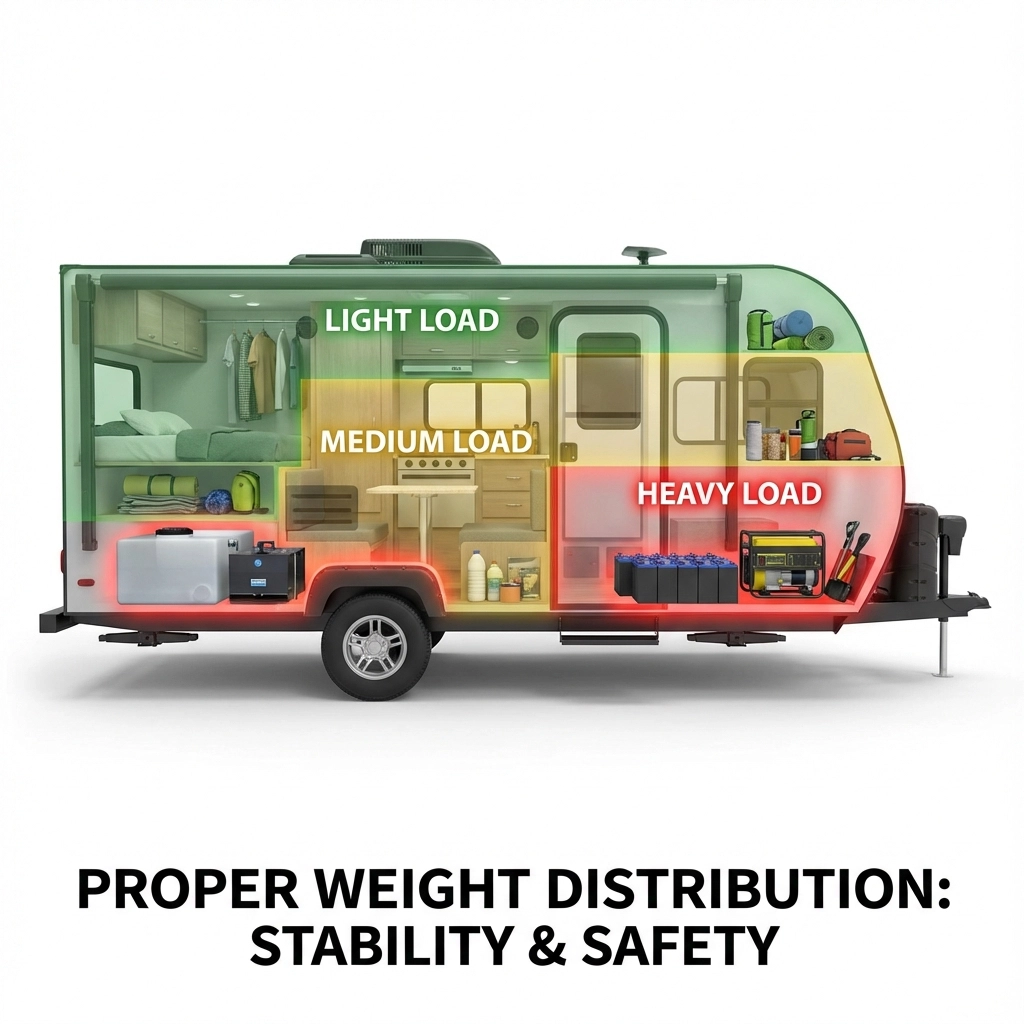
Additionally, high center-of-gravity loading amplifies sway forces. Heavy items stored in overhead cabinets or on the trailer roof create a top-heavy condition that multiplies every external disturbance. Smart loading involves placing dense items low and forward, ideally ahead of the trailer’s axles, while keeping the overall weight distribution balanced side-to-side.
For comprehensive guidance on proper trailer setup and weight management, refer to our detailed travel trailer setup guide, which covers loading strategies for different trailer configurations.
Driving Speed & Wind Conditions
American interstate highways present unique challenges for trailer towing, with speed limits reaching 80 mph in western states combined with consistent crosswinds and turbulence from passing commercial vehicles. The aerodynamic forces acting on travel trailers increase exponentially with speed, doubling your highway speed from 40 to 80 mph creates four times the wind pressure.
Crosswinds prove particularly dangerous because they apply continuous lateral force to your trailer’s large side profile. A 24 ft camper weight distribution becomes irrelevant when 30+ mph crosswinds overwhelm your towing setup’s stability margins. Downhill grades compound these risks by adding momentum that makes recovery from sway more difficult.
The phenomenon of “bow wave” from passing semi-trucks creates sudden pressure changes that can trigger sway in properly balanced trailers. As an 80,000-pound truck passes at highway speeds, the air displacement creates a pushing force followed immediately by a vacuum effect, challenging your trailer’s tracking stability.
Vehicle & Trailer Mismatch
Exceeding your tow vehicle’s rated capacity represents false economy that risks catastrophic failure. When evaluating combinations, consider that manufacturer tow ratings assume optimal conditions, level terrain, moderate temperatures, and experienced drivers. Real-world towing in mountainous regions with loaded trailers requires substantial safety margins.
Suspension geometry plays a crucial role often overlooked by inexperienced towers. Short-wheelbase tow vehicles provide less resistance to trailer-induced forces, while inadequate rear suspension allows excessive trailer tongue weight to lift the front axle, reducing steering control and braking effectiveness.
The relationship between average travel trailer weights and tow vehicle capability requires careful analysis. A half-ton truck rated for 8,000 pounds might struggle with a 30 ft rv weight approaching that limit, especially when accounting for cargo, passengers, and tongue weight that reduces available payload. Understanding these relationships helps avoid dangerous mismatches that contribute to sway incidents.
For specific guidance on matching trailers to half-ton vehicles, our half-ton towable campers guide provides detailed compatibility information.
How to Stop Trailer Sway While Driving
When trailer sway begins, your immediate response determines whether you regain control or experience a potentially fatal accident. These steps form a proven sequence that professional drivers and transportation safety experts recommend:
✓ DO NOT apply brakes immediately – Braking transfers weight forward, reducing rear tire traction and potentially worsening sway
✓ Maintain firm steering wheel grip – Keep steady pressure without overcorrecting or fighting the sway motions
✓ Gradually release accelerator – Reducing speed slowly allows aerodynamic forces to diminish without sudden weight transfer
✓ Apply slight forward pressure – Gently accelerating can help pull the trailer straight by increasing tongue weight temporarily
✓ Activate manual trailer brakes – If equipped with electric trailer brake controller, apply trailer brakes independently to slow the trailer without affecting tow vehicle
✓ Find safe stopping location – Once sway subsides, exit highway safely to inspect your setup and redistribute weight if necessary
This checklist approach proves most effective because each step addresses specific physics contributing to sway without triggering secondary problems. The key lies in gradual responses rather than sudden inputs that might amplify the oscillations.
Best Way to Prevent Trailer Sway Before Towing
Correct Loading Checklist
Proper cargo distribution eliminates the primary cause of trailer sway before it begins. Professional tower’s approach loading systematically, understanding that every item’s placement affects stability.
Heavy Items Forward: Place generators, water tanks, tools, and dense supplies ahead of the trailer’s axles. This loading pattern increases tongue weight naturally while lowering the center of gravity.
Secure All Cargo: Loose items become projectiles during sway events, shifting weight unpredictably. Use appropriate tie-downs, cargo nets, and storage compartments designed for travel conditions.
Balance Side-to-Side: Avoid concentrating weight on one side, which creates imbalanced tracking and uneven tire wear. Distribute items evenly or place heavier items on the trailer centerline.
Monitor Weight Limits: Track both individual axle weights and gross trailer weight. Even proper distribution fails if you exceed structural capacity or tow vehicle ratings.
Use Proper Hitch & Suspension Setup
Weight distribution hitches transform dangerous towing situations into controlled experiences by redistributing tongue weight across all vehicle axles. These systems prove essential when trailer weight exceeds 50% of your tow vehicle’s weight or when rear suspension sagging occurs.

Electronic sway control systems provide automatic intervention when sensors detect oscillation patterns. These systems apply individual trailer brakes to counteract sway forces, offering protection even when other prevention methods fail. While initially expensive at $400-500, electronic sway control justifies the investment for heavy or valuable trailers.
BlackSeries engineering philosophy emphasizes suspension design that minimizes sway potential through lower center-of-gravity construction and optimized weight distribution. Our best off-road camper trailers incorporate features specifically designed to maintain stability across varying terrain conditions, from highway speeds to challenging off-road environments.
Friction sway bars provide economical sway reduction for lighter trailers, using mechanical resistance to dampen oscillations. While requiring removal during backing maneuvers, these devices offer substantial improvement for trailers under 6,000 pounds.
Tire Pressure & Maintenance
Proper tire pressure management affects both safety and fuel economy significantly. Under-inflated trailer tires create excessive flex, generating heat that can lead to blowouts while reducing load-carrying capacity. Over-inflation reduces contact patch, decreasing traction and creating harsh ride quality.
Trailer Tires: Check pressure when cold, before travel begins. Most travel trailer tires require 50-80 PSI depending on load rating and manufacturer specifications. ST (Special Trailer) tires require different pressure requirements than passenger vehicle tires due to construction differences.
Tow Vehicle Tires: Increased tongue weight and trailer loading affects optimal pressure settings. Many manufacturers recommend increasing rear tire pressure 5-10 PSI when towing, while maintaining standard front pressures for steering response.
Brake system maintenance proves equally critical for sway prevention. Electric trailer brake controllers require periodic adjustment as brake linings wear, while hydraulic surge brake systems need regular fluid changes and component inspection.
For specialized conditions like sand driving, proper tire pressure becomes even more critical. Our guide on towing trailer in sand tire pressure recovery addresses these unique requirements.
Trailer Sway Control Tips from BlackSeries
BlackSeries approach to sway prevention emphasizes engineering solutions over reactive technologies. Rather than relying solely on aftermarket sway control devices, our design philosophy integrates stability into fundamental trailer architecture.
Our off-road focus demands exceptional stability margins because challenging terrain amplifies every design weakness. Where traditional RV manufacturers prioritize interior space over physics, BlackSeries engineers design from the axles up, optimizing weight distribution and lowering center-of-gravity through strategic component placement.
The real-world testing that validates our designs occurs in Australia’s demanding outback conditions, where trailers encounter extreme crosswinds, rough terrain, and extended high-speed highway travel. These environments reveal stability characteristics that suburban testing cannot replicate.
Key design elements include strategic battery placement low and forward, freshwater tank positioning ahead of axles, and structural reinforcement that maintains loaded weight distribution. Our affordable off-road campers demonstrate that proper engineering need not compromise value.
For extended off-grid camping where weight distribution changes as supplies are consumed, BlackSeries trailers maintain stability margins throughout the camping cycle. This consideration proves crucial for boondocking trailers that carry substantial water, food, and fuel supplies.
Real-World Data & Safety Statistics
National Highway Traffic Safety Administration (NHTSA) data reveals trailer-related accidents account for approximately 50,000 incidents annually in the United States, with speed-related and sway-induced crashes comprising nearly 35% of these events. The fatality rate for trailer sway accidents increases dramatically above 55 mph, supporting speed reduction as primary prevention.
Research conducted by the University of Michigan Transportation Research Institute found that electronic sway control systems reduce sway-related incidents by 87% compared to unequipped trailers. However, these systems cannot overcome fundamental problems like severe weight imbalance or excessive speed.
Insurance industry analysis shows that trailers exceeding 30-foot camper weight thresholds experience sway-related claims at twice the rate of shorter units, primarily due to increased aerodynamic surface area and leverage forces. This data supports the physics-based arguments for enhanced sway prevention measures on larger trailers.
Wind tunnel testing demonstrates that crosswind forces begin affecting trailer stability at relatively low speeds, as little as 25 mph crosswinds can trigger sway in improperly loaded trailers traveling highway speeds. This research emphasizes the importance of prevention over reaction when towing conditions become challenging.
FAQ – Prevent Trailer Sway While Towing
What speed causes trailer sway?
Trailer sway can begin at any speed above 35 mph when triggered by external forces, but becomes most dangerous at highway speeds above 55 mph. The specific speed threshold depends on trailer weight, length, wind conditions, and loading. Heavier trailers like those with 30 ft rv weight require more force to initiate sway but carry more destructive momentum once oscillation begins.
Can trailer sway flip a vehicle?
Yes, severe trailer sway can cause jackknife situations that flip both the trailer and tow vehicle. Large trailers with poor weight distribution can generate enough lateral force to overwhelm even heavy-duty trucks. This risk increases significantly when tow vehicle weight is less than 1.5 times the loaded trailer weight.
Do sway control hitches really work?
Weight distribution hitches with integrated sway control significantly reduce sway tendency by redistributing tongue weight and dampening oscillations. Electronic sway control systems prove most effective, automatically applying trailer brakes when sensors detect sway patterns. However, no system can overcome fundamental problems like severe overloading or extreme speed.
Is trailer sway more common with long trailers?
Yes, longer trailers experience sway more frequently and severely due to increased leverage and aerodynamic surface area. A 30-foot camper weight creates substantially more leverage around the hitch point compared to shorter units, while the larger side profile catches more wind. This physics reality makes proper prevention techniques essential for longer trailers.
How much tongue weight is ideal?
Optimal tongue weight measures 10-15% of loaded trailer weight, providing stability without overloading the tow vehicle’s rear suspension. For example, a trailer with average weight of camper at 6,000 pounds requires 600-900 pounds of tongue weight. Too little tongue weight allows dangerous trailer pivot, while excessive tongue weight reduces steering control and front-wheel traction.

