The off-grid revolution has reached a tipping point in 2026. More Americans than ever are ditching crowded RV parks for remote BLM land, national forests, and desert trails. But here’s the thing: not every rig can handle what’s out there. If you’re serious about accessing places where cell service disappears and the nearest pavement is 40 miles back, you need an off road trailer camper built for the task.
This guide breaks down everything you need to know: from what actually makes a trailer “off-road capable” to how to choose the right model, set it up for weeks of self-sufficiency, and maintain it for the long haul. Whether you’re eyeing your first adventure rig or upgrading from a standard RV, here’s what you need to master extreme adventure travel in 2026.
What Are Off Road Trailer Campers?
An off road trailer camper isn’t just a regular camper with bigger tires slapped on. It’s a purpose-built mobile basecamp engineered to handle technical terrain, extended boondocking, and the kind of environmental abuse that would leave a standard RV in pieces.
Think of it as the difference between a sedan and a rally car. Sure, both have four wheels and an engine, but one is built for grocery runs while the other is designed to survive gravel, mud, and washboard roads at speed.
The Core Definition
At its core, an off road trailer camper combines:
- High ground clearance (typically 14+ inches) to clear rocks, logs, and deep ruts
- Independent suspension systems with dual shocks that absorb impacts without rattling your gear to pieces
- Reinforced chassis and body construction using galvanized steel or aluminum frames
- Off-road tires (often 15-16 inch) designed for traction on loose surfaces
- Self-sufficiency systems including solar, lithium batteries, and extended water capacity
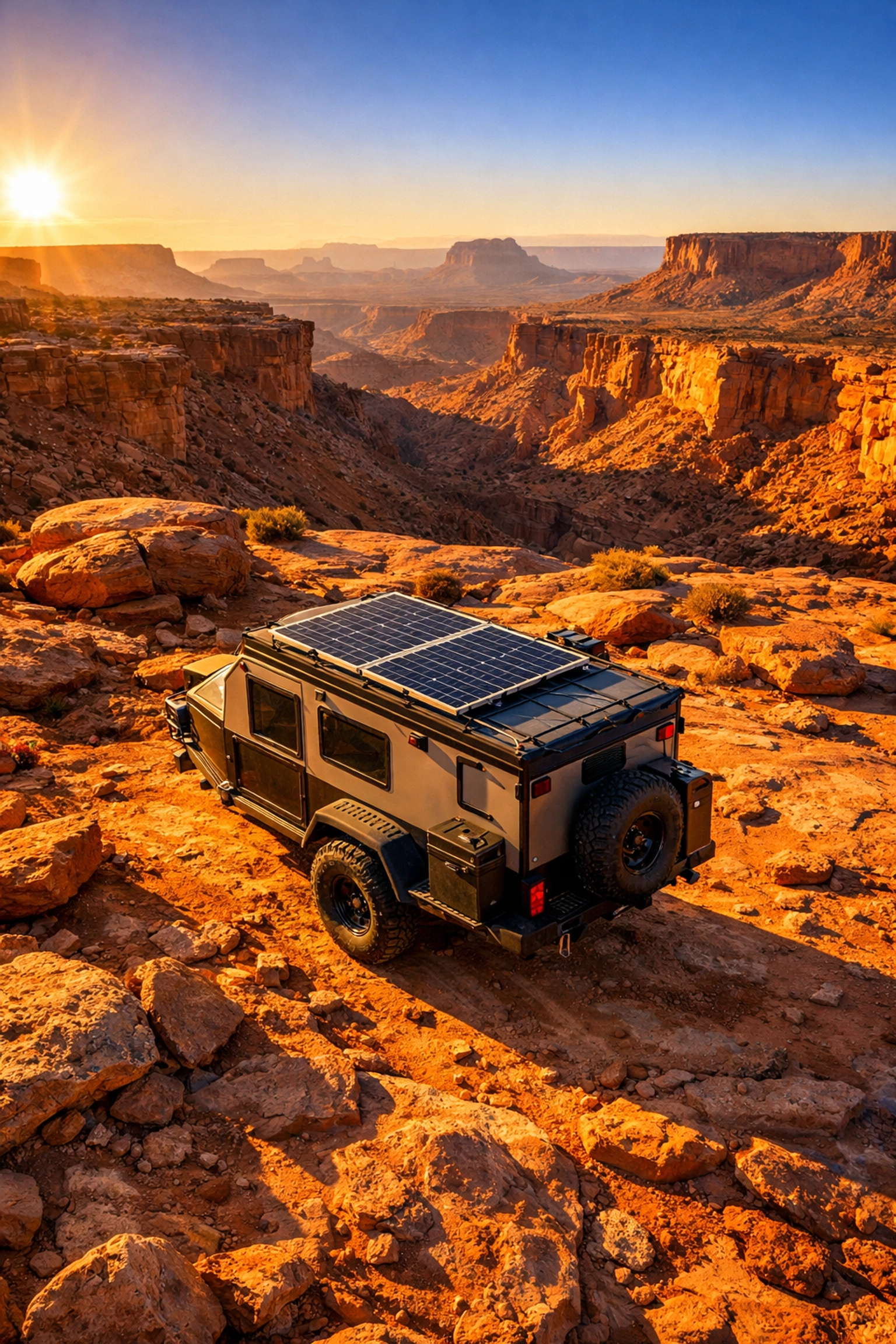
The result? A rig that can follow you down forest roads, across desert washes, and into high-alpine meadows that traditional RVs can’t reach. If you’re new to understanding the distinction, check out our deep dive on off-road RV trailer campers for rough terrain.
How It Compares to Other Options
Let’s be clear about what you’re giving up and gaining compared to alternatives:
Traditional RVs: These are built for paved roads and established campgrounds. They offer maximum interior space and amenities but crumble on anything rougher than a gravel road. Low clearance, tandem axles with linked suspension, and fragile underbellies make them non-starters for true backcountry access.
Roof Top Tents: Ultra-portable and affordable, but you’re basically car camping with a mattress. No bathroom, no kitchen, no protection from weather, and zero storage for extended trips. Great for weekend warriors, not serious adventurers.
Off-Road Trailers: This is where off road trailer campers live. They sacrifice some interior space compared to traditional RVs but gain the capability to reach remote destinations and sustain weeks off-grid. It’s the sweet spot for adventurers who want real amenities without being chained to campground hookups.
Key Features That Matter
Not all “off-road” marketing is created equal. Here’s what actually makes a trailer capable:
Independent Suspension: Each wheel responds to terrain independently, keeping the chassis level and protecting your interior from destructive vibration. Dual-shock systems (like those on BlackSeries models) double down on impact absorption.
Ground Clearance: Anything under 12 inches will high-center on moderate trails. Look for 14-16 inches for serious backcountry access.
Breakover Angle: The sharper the angle between wheels, the steeper the terrain you can navigate without scraping the undercarriage.
Frame Construction: Galvanized steel resists rust in wet climates; aluminum is lighter for smaller tow vehicles. Both beat wood-framed construction, which swells and rots over time.
Tire Package: Aggressive tread, reinforced sidewalls, and proper sizing (typically 15-16 inch wheels) for lower tire pressure on soft surfaces.
For a complete breakdown of what separates real off-road capability from marketing hype, read our guide on off-road campers built for remote camping.
How to Choose the Best Off Road Trailer Camper
Choosing the right off road trailer camper comes down to matching capability, capacity, and comfort to your actual needs: not just your aspirations. Here’s how to cut through the noise.
Towing Vehicle Matching: The Non-Negotiable Reality
Your truck determines your trailer. Period. Ignoring this leads to white-knuckle towing, accelerated wear, and potential safety disasters on mountain grades or loose surfaces.
Mid-Sized Trucks and SUVs (Tacoma, Colorado, 4Runner, Jeep Gladiator): These typically max out around 6,000-7,500 lbs towing capacity. You’re looking at 12-18 foot trailers with a 16 ft camper weight or 18 ft camper weight staying under 5,000 lbs loaded. Models like the BlackSeries HQ12 (3,000 lbs dry) or HQ17 (4,200 lbs dry) are ideal matches.
Half-Ton Trucks (F-150, Silverado 1500, Ram 1500): With 8,000-12,000 lbs towing capacity (depending on configuration), you can handle 18-24 foot trailers. A 24 ft camper weight typically runs 6,000-7,500 lbs loaded: still manageable but pushing limits on steep grades.
Heavy-Duty Trucks (F-250, Silverado 2500, Ram 2500): These beasts handle anything you throw at them, including 24-30 foot trailers. The 30 foot rv weight (or 30 ft rv weight) can exceed 10,000 lbs loaded, but a properly equipped HD truck laughs it off. However, at this size, you sacrifice trail maneuverability.
Pro tip: Focus on tongue weight (10-15% of trailer weight) and ensure your truck’s payload capacity can handle it plus passengers and gear. A trailer with a 30 ft camper weight might require 1,200-1,500 lbs tongue weight: pushing or exceeding many half-ton payload limits.

Suspension, Clearance, and Real Off-Road Capability
Don’t trust marketing photos of trailers parked on scenic dirt roads. Here’s what to verify:
Independent Suspension: This is mandatory. Torsion axles or independent coil-spring systems allow each wheel to articulate without transferring force through the chassis.
Ground Clearance: Measure from the lowest point (usually the frame or tank) to the ground. True off-road trailers offer 14+ inches. Anything less will scrape on moderate trails.
Tire Size and Quality: Factory tires on many “off-road” trailers are highway tires in disguise. Look for Load Range E all-terrain or mud-terrain tires with reinforced sidewalls.
Breakover and Departure Angles: Short overhangs front and rear prevent dragging on steep inclines or declines.
For technical insights on suspension systems, check out our article on off-road trailer RVs and why they’re the best adventure option.
Interior Configuration and Comfort
Once capability is locked in, consider livability. An off road trailer camper that can reach epic destinations but makes you miserable inside defeats the purpose.
Sleeping Capacity: Be realistic. Advertised sleeping capacity includes converting dining areas into beds: great for kids, miserable for adults long-term. If you’re a couple, a queen bed is non-negotiable. Families need dedicated bunk space.
Kitchen Setup: Outdoor kitchens are game-changers for off-grid living, keeping cooking smells and heat outside. Look for slide-out designs with built-in stoves, storage, and prep surfaces.
Bathroom and Shower: Cassette toilets are standard on compact models; larger trailers offer wet baths or separate shower/toilet compartments. External shower connections are clutch for rinsing off after dusty trails or letting dogs clean up before entering.
Storage: Underbed storage, front pass-through compartments, and exterior cargo racks determine how much gear you can bring. Don’t underestimate this: you’ll need recovery gear, tools, water jugs, and recreational equipment.
Budget and Maintenance Costs
Here’s the truth: off road trailer campers cost more upfront than standard models due to reinforced construction and premium components. Entry-level models start around $30,000; mid-range offerings (like BlackSeries HQ17-HQ19) run $50,000-$80,000; flagship models exceed $100,000.
But consider long-term value:
- Resale Value: Quality off-road trailers hold value better than mass-market RVs.
- Maintenance: Better construction means fewer repairs. Galvanized frames don’t rust. Lithium batteries last 5-10 years vs. 2-3 for lead-acid.
- Access Value: You’re paying for the ability to camp for free on BLM land and national forests rather than $50-100/night RV parks.
Average travel trailer weights and construction quality directly impact longevity. Mass-produced trailers using wood framing and entry-level components might save money upfront but cost more over a decade of use.
For model-specific guidance, explore our 2025 off-road travel trailer buying guide (updated principles still apply for 2026 purchases).
Off Road Trailer Camper Setup for Maximum Comfort
Getting your off road trailer camper dialed for extended off-grid living requires systems integration, not just bolting on accessories. Here’s what separates weekend warriors from serious boondockers.
Power Systems: The 2026 Lithium Standard
By 2026, lithium power systems have become the de facto standard for off-road trailers: and for good reason. Compared to lead-acid batteries, lithium offers 3,000-5,000 charge cycles (vs. 300-500), weighs 60% less, and provides usable capacity down to 20% discharge without damage.
Solar Arrays: Entry-level setups start at 200-400W; serious off-gridders run 600-800W panels. This powers 12V refrigerators, LED lights, water pumps, and charges devices during daylight hours while replenishing battery banks.
Battery Capacity: A 200Ah lithium bank is entry-level; 400Ah handles couples comfortably; 600Ah+ supports families or heavy AC use. BlackSeries models come lithium-ready with smart controllers that prevent overcharge and optimize solar input.
Inverters: A 2,000W+ pure sine wave inverter lets you run laptops, cameras, and small appliances. Skip modified sine wave inverters: they damage electronics over time.
Backup Power: Consider a generator for extended cloudy periods or high-demand situations. Modern inverter generators (like Honda EU2200i) are quiet and efficient.
Water and Waste Management
Water capacity separates short trips from extended expeditions. Standard RVs carry 30-40 gallons fresh water; serious off-road trailers offer 60-100+ gallons.
Freshwater Storage: Larger tanks mean longer stays between refills. Pair with inline filtration for sourcing from streams or lakes (in compliance with local regulations).
Greywater Tanks: Size matters for boondocking. A 60-gallon greywater capacity supports 5-7 days of comfortable living (showers, dishes, washing) before needing to dump.
Blackwater Solutions: Cassette toilets offer portability but require frequent emptying. Standard holding tanks provide more capacity but need dump stations or portable macerator systems.
Hot Water: Tankless on-demand heaters save weight and provide endless hot water on propane. External shower connections are clutch for post-adventure cleanup.
Climate Control and Insulation
2026 models emphasize four-season capability, making shoulder-season and winter camping viable.
Insulation: Look for spray foam insulation (vs. fiberglass batting) in walls, floors, and ceilings. Double-pane windows reduce heat loss dramatically.
Heating: Diesel or propane furnaces with ducted heat distribution keep the entire trailer warm. Truma systems are industry standard.
Cooling: Roof-mounted AC units work when powered by shore power or robust solar/battery setups. Fantastic Fan vents with thermostats provide passive cooling in mild weather.
Heated Underbelly: Protects tanks and plumbing from freezing in sub-zero temperatures, extending your camping season into true winter.
Kitchen and Cooking Solutions
Outdoor kitchens are the 2026 standard for off-road trailers, and for good reason: they keep heat, smells, and mess outside while maximizing interior living space.
Slide-Out Designs: Look for spring-assisted or hydraulic slides that deploy easily. Built-in two-burner stoves, storage compartments, and prep surfaces turn the exterior into a full cooking station.
Refrigeration: 12V compressor fridges (60-90L capacity) are non-negotiable. They run efficiently on solar/battery power and maintain temperature reliably in extreme heat.
Storage: Drawer systems with positive latches prevent spills during transit. Dedicated spice racks, utensil holders, and pantry space keep cooking gear organized.
Safety and Recovery Equipment
No matter how capable your rig, eventually you’ll need recovery gear or emergency equipment.
Recovery Essentials: Traction boards (Maxtrax), recovery straps (20-30 ft), D-rings or soft shackles, folding shovel, tire deflation/inflation tools, tire repair kit.
Emergency Supplies: First aid kit (expedition-grade), fire extinguisher (ABC-rated, mounted accessibly), emergency blanket, repair tools, duct tape and zip ties.
Communication: Satellite communicator (Garmin inReach or similar) for true backcountry. Don’t rely on cell coverage.
Navigation: Offline mapping apps (Gaia GPS, onX Offroad) with downloaded regional maps. Paper backup maps for areas you frequent.
For more on off-road travel trailers built for adventure, we’ve got a comprehensive resource covering system integration.
Where to Take Your Off Road Trailer Camper
Once you’ve got the right rig and dialed systems, the question becomes: where to point it? Here are the best destinations and how to choose routes that match your capability and goals.
BLM Land: America’s Free Camping Frontier
The Bureau of Land Management oversees 245 million acres of public land, much of it open to dispersed camping at no cost. This is where off-road trailer campers truly shine.
Top BLM Regions: Arizona strip country, Utah’s West Desert, Nevada basin ranges, New Mexico high desert, California Mojave and Death Valley periphery.
Rules and Regulations: Most BLM land allows 14-day stays with a 28-day minimum absence before returning. Stay on designated roads (no cross-country travel), pack out all trash, and observe campfire restrictions.
Finding Sites: Use the BLM’s interactive map or apps like FreeRoam or Campendium. Look for established dispersed sites with fire rings: these indicate legal camping areas with decent access.
Water and Resources: BLM land rarely has amenities. Bring all water, plan waste management, and expect zero cell service. This is where your off-grid systems prove their worth.
National Forests: Scenic Camping with More Regulation
National Forests offer 193 million acres with established campgrounds and dispersed camping opportunities. They’re generally more regulated than BLM land but provide better amenities and more scenic settings.
Prime Destinations: Colorado’s San Juan National Forest, California’s Sierra Nevada forests, Washington’s Gifford Pinchot, Montana’s Flathead National Forest.
Dispersed Camping Rules: Similar to BLM (14-day limits), but roads and camping areas are more clearly defined. Forest Service roads are numbered: download motor vehicle use maps (MVUMs) showing legal routes.
Considerations: Forest roads vary wildly in condition. A “maintained” road might mean graded gravel or barely-passable two-track. Call ranger stations for current conditions before committing to remote areas.
Desert and High-Alpine Environments
Off-road trailer campers excel in extreme environments: if properly prepared.
Desert Camping: Southwest deserts (Mojave, Sonoran, Chihuahuan) offer stunning landscapes and mild winter temperatures but brutal summer heat. Run AC only if you have 400W+ solar and 400Ah+ battery capacity, or plan generator use. Carry extra water: dual redundancy is smart in desert environments.
High-Alpine Access: Mountain passes and alpine meadows provide incredible summer camping but close seasonally (typically October through May). Snow, mud, and stream crossings require high clearance and capable tow vehicles. Check road conditions religiously and carry recovery gear.
Seasonal Timing: Desert camping is optimal October through April; alpine areas shine June through September. Shoulder seasons (April-May, September-October) offer solitude but variable weather.
Route Planning and Trail Difficulty
Not all forest roads are created equal. Here’s how to assess whether a route matches your rig’s capability:
Difficulty Ratings: Many apps (Gaia GPS, onX Offroad) rate trails on scales from 1 (graded dirt) to 5 (technical rock crawling). Off-road trailers can handle 1-3 comfortably; avoid 4-5 rated routes even with capable tow vehicles.
Conditions Check: Call ranger stations, check recent trip reports on forums or apps, and scout unfamiliar roads without the trailer first if possible.
Width and Clearance: Some forest roads narrow or have low-hanging branches that clear a truck but clip a trailer. Measure your full rig width and height.
Turnarounds: Always know where you can turn around. Backing a trailer downhill on a narrow shelf road is a nightmare scenario.
How to Maintain Your Off Road Trailer Camper for Long-Term Travel
Proper maintenance separates reliable adventure rigs from expensive headaches. Here’s what to check and when.
Pre-Trip Inspection Checklist
Before every trip: especially extended expeditions: run through this systematic check:
Tires and Wheels: Inspect for cuts, bulges, or embedded debris. Check pressure (typically 45-50 psi cold for E-rated tires, but consult your manual). Verify lug nuts are torqued to spec (typically 90-120 ft-lbs for trailer wheels). Don’t skip this: loose lug nuts are the #1 cause of wheel-off incidents. For a detailed guide, see our article on off-road trailer maintenance and tire pressure setup.
Suspension and Bearings: Visually inspect suspension components for cracks or damage. Grab each wheel and rock it: excessive play indicates worn bearings. Repack bearings annually or every 12,000 miles.
Lights and Electrical: Test all running lights, brake lights, and turn signals. Check battery terminals for corrosion. Verify solar panels are clean and connections tight.
Propane System: Inspect hoses for cracks. Test connections with soapy water (bubbles indicate leaks). Ensure regulator and shut-off valves function properly.
Interior Securement: Open every cabinet, drawer, and storage area. Ensure latches work and nothing will fly around during transit.
On-Road Monitoring
While towing, stay vigilant for developing issues:
Tire Pressure Monitoring: Use a TPMS (Tire Pressure Monitoring System) to watch all trailer tires in real time. Rapid pressure loss indicates puncture or seal failure.
Mirror Checks: Glance at your trailer every few minutes. Look for unusual bouncing, sway, or visible damage.
Brake Controller: Ensure trailer brakes engage smoothly without grabbing or over-braking.
Post-Trip Maintenance
After every trip: especially dusty or muddy adventures: perform these tasks:
Exterior Wash: Remove dirt, dust, and road grime that trap moisture and accelerate corrosion. Use RV-specific soap (dish soap strips wax).
Undercarriage Inspection: Look for damage, leaks, or loose components. Hose off mud and debris.
Seal and Caulk Check: Inspect roof seams, window seals, and exterior penetrations. Water intrusion is the #1 killer of RVs and trailers: catch issues early.
Tank Flush: Drain and flush freshwater tanks. Sanitize with bleach solution (1/4 cup per 15 gallons water) twice annually. Dump and rinse blackwater tanks thoroughly.
Seasonal and Annual Maintenance
Some tasks only need periodic attention:
Bearing Repack: Annually or every 12,000 miles, repack wheel bearings with marine-grade grease. This prevents catastrophic bearing failure on remote roads.
Axle and Suspension Service: Inspect shock absorbers for leaks. Check mounting bolts and bushings for wear. Replace shocks every 50,000 miles or if performance degrades.
Propane Tank Recertification: Most tanks require recertification every 10-12 years. Check the collar date stamp.
Appliance Maintenance: Service furnace and water heater annually. Clean refrigerator coils. Inspect AC unit and clean or replace filters.
Battery Maintenance: Lithium batteries require minimal maintenance, but check terminals and verify charge/discharge cycles aren’t showing degradation. Lead-acid batteries need water level checks and equalization charges.
Winterization and Storage
If you’re not camping in freezing conditions, winterize your water system:
- Drain all tanks (fresh, grey, black)
- Bypass water heater and drain it separately
- Pump RV antifreeze (non-toxic, propylene glycol-based) through all faucets and shower
- Pour antifreeze into all drain traps and toilet
Store your trailer under cover if possible. If outdoor storage is necessary, use a quality breathable cover (avoid tarps that trap moisture). Keep tires out of direct sunlight and consider tire covers.
FAQ
What makes an off road trailer camper different from a regular RV?
The core differences come down to construction and capability. Off road trailer campers feature independent suspension systems (vs. leaf springs on linked axles), higher ground clearance (14+ inches vs. 8-10 inches), reinforced chassis using galvanized steel or aluminum, and off-road tires designed for traction on loose surfaces. They also typically include self-sufficiency systems: larger solar arrays, lithium batteries, and increased water capacity: that allow extended boondocking without hookups. Regular RVs prioritize interior space and amenities but sacrifice the structural integrity and suspension articulation needed for rough terrain.
How long can I camp off-grid with an off road trailer camper?
With proper setup, 2-3 weeks is realistic for most couples. This assumes: 400W+ solar panels paired with 300-400Ah lithium batteries for power; 80-100 gallon freshwater capacity (with conservative use); and 60+ gallon greywater tanks. Your limiting factors are typically water (both supply and waste capacity) and food storage. Some full-timers in well-equipped rigs like the BlackSeries HQ21 have reported 3-4 week stretches without resupply by carefully managing resources and utilizing natural water sources (properly filtered). Families or those using AC extensively will see shorter durations: typically 7-10 days before needing to dump tanks or replenish water.
Are off road trailer campers suitable for all types of terrain?
No trailer is truly suitable for all terrain, but quality off-road models handle most situations recreational adventurers encounter. They excel on: maintained forest roads, two-track trails, desert washes, moderate rock obstacles, and shallow water crossings. They struggle with: technical rock crawling (rated 4-5 difficulty), deep mud that requires aggressive articulation, narrow single-track trails barely wide enough for a vehicle, and any situation requiring reversing downhill for extended distances. The key limitation is often access rather than capability: some trails are simply too narrow, steep, or technical for a trailer regardless of build quality. Always scout unfamiliar routes and know your turnaround options before committing to remote areas with a trailer in tow.
What features should I look for in an off road trailer camper?
Prioritize these features in order: (1) Independent suspension with dual shocks per wheel for impact absorption; (2) Ground clearance of 14+ inches measured to the lowest point (frame or tanks); (3) Lithium power system with 300Ah+ capacity and 400W+ solar; (4) Water capacity of 60+ gallons fresh and 50+ gallons grey for extended stays; (5) Robust frame construction using galvanized steel or aluminum (avoid wood framing); (6) Quality tires in Load Range E with aggressive tread; (7) Thoughtful interior layout with adequate storage, comfortable sleeping, and functional kitchen; (8) Exterior access to utilities (shore power, water fill, dump valves) without entering trailer. Optional but valuable: outdoor kitchen, external shower, heated underbelly for four-season use, and solar pre-wiring for easy expansion. Don’t be swayed by luxury interior finishes at the expense of core capability: you can always upgrade cushions, but you can’t retrofit proper suspension or ground clearance easily.
Ready to start your off-grid adventure? Explore the BlackSeries lineup of off-road travel trailers or dive into our comprehensive guides on trailer selection and adventure planning. The backcountry is waiting; and with the right rig, there’s nothing holding you back.

