What Is a Weight Distribution Hitch?
A weight distribution hitch is a towing system that uses spring bars (round or trunnion) to lever some of the tongue weight forward to the tow vehicle’s front axle and back to the trailer axles. Unlike a standard ball mount that concentrates load on the rear suspension, a WDH restores balance across the entire combination.
How it improves safety and control:
- Rear sag: Spring bar leverage reduces rear squat, restoring proper ride height.
- Steering control: Reloading the front axle improves tire contact and steering feel.
- Braking stability: Balanced axle loads help maintain shorter, more predictable stops and reduce trailer sway initiation.
WDH vs. standard trailer hitch:
- Standard receiver + ball mount: Simple connection, no load transfer.
- WDH: Adds spring bars, chains or L-brackets, and an adjustable head that actively redistributes weight.
Keyword context:
- If you’re towing near the average weight of camper setups or common average travel trailer weights, a WDH can be the difference between a floaty, light-steering feel and a confident, level ride. For off-road travel trailer use, the right WDH enhances control without sacrificing articulation.
For fundamentals on safe towing, see our RV towing guide.
Do You Need a Weight Distribution Hitch?
Start with two numbers: trailer GVWR and tongue weight (TW).
- Typical TW target: 10–15% of actual trailer weight.
- If TW causes more than ~1–2 inches of rear sag or a noticeable rise at the front fenders/headlights, you likely need a WDH.
Practical thresholds (guidelines; always check your owner’s manual):
- SUVs and crossovers: WDH is commonly recommended once TW exceeds ~400–500 lb or when towing near the vehicle’s max rating.
- Half-ton pickups (150/1500): WDH is typically recommended above ~600–750 lb TW or when towing close to max tow capacity.
- Three-quarter/one-ton pickups: More margin, but a WDH still improves braking feel and steering when TW is high.
Standards and policy context:
- SAE J2807 underpins how automakers rate tow capacity; many brands require a WDH to achieve the full published rating.
- There’s no single federal law mandating WDH for recreational towing, but several states and many manufacturers set requirements or recommendations at specific weights. Always verify your vehicle and hitch manuals, and local regulations.
Data and real-world perspective:
- Independent testing shows that unloading the front axle can increase emergency stopping distances significantly and dull steering response; reloading the front axle with a WDH mitigates both.
- A 30 foot RV weight varies widely by floorplan and build; many 30-foot travel trailers are roughly 7,000–9,000 lb dry and exceed 9,000–10,000+ lb loaded. That puts TW squarely in WDH territory.
BlackSeries use cases:
- Our off-road travel trailers are built for remote tracks and long-haul travel. Models like the HQ19 and HQ21 often operate with loaded TW in the WDH range; a correctly tuned system keeps the suspension geometry working as designed over choppy washboards and mountain passes.
To find your exact TW, use our step-by-step tongue weight calculation guide. For sway control strategies, see preventing trailer sway while towing.
Tools & Parts You Need Before Installation (Checklist)
Tools:
- Torque wrench (up to 250–350 ft-lb per your hitch spec)
- Socket set (SAE/metric) and breaker bar
- Measuring tape (at least 25 ft) and marker/tape
- 2–4 ft level
- Safety glasses and work gloves
- Wheel chocks and a bottle jack (optional but helpful)
WDH components:
- Shank and adjustable hitch head (with the correct hitch ball size/rating)
- Spring bars (rated to your loaded TW)
- Chains or L-brackets with snap-up or clamp hardware
- Spacer washers/pins and all mounting bolts
- Hitch pin and clip
Safety items:
- Safety chains (crossed under the coupler)
- Breakaway cable and tested brake controller
- 7-pin wiring and functioning lights
Note: For aggressive terrain, choose heavy-duty bars (often 1,200–1,600 lb TW ratings) and reinforced heads. Off-road duty cycles are harsher than highway-only use.
How to Hook Up a Weight Distribution Hitch
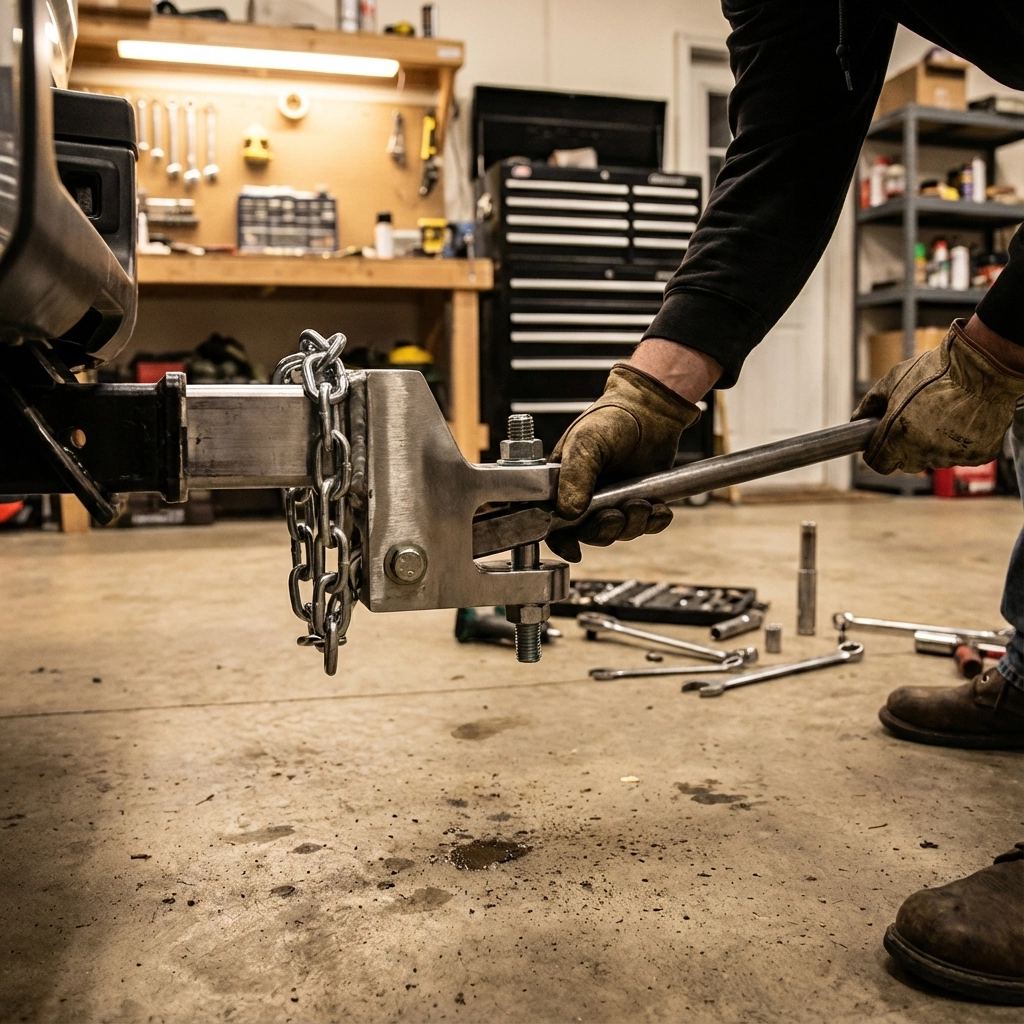
Step 1 – Measure Vehicle Height (Unloaded)
- Park the tow vehicle and trailer on level ground, unloaded.
- Measure ground-to-fender at all four corners and note the trailer coupler height.
- Mark measurement points so you can re-measure consistently later.
Why it matters: These baselines tell you if your WDH tension restores front axle load and reduces rear sag as intended.
Step 2 – Set the Hitch Head Angle
- Insert the shank in “rise” or “drop” to get the ball roughly 1–3 inches above the coupler when unhitched.
- Use spacer washers to set the head tilt. More tilt typically reduces bar leverage; less tilt increases leverage.
- Torque the head bolts to the manufacturer’s spec (often 250–350 ft-lb). Do not guess—use the torque wrench.
Step 3 – Install the Hitch Head on the Shank
- Confirm the correct shank hole positions for your ride height.
- Mount the head at the chosen height and tilt; recheck clearances to bumper and tailgate.
- Verify the hitch ball is the correct diameter and rating for your trailer.
Step 4 – Attach Spring Bars
- Grease the pivot points.
- Install round or trunnion bars per your hitch manual. Ensure they seat fully and articulate smoothly without binding.
- Confirm left and right bars match the correct sides (some bars are handed).
Step 5 – Apply Chain or L-Bracket Tension
- Couple the trailer, lock the coupler, and lower the jack to transfer weight onto the hitch ball.
- Attach chains or set L-brackets. Start conservatively (e.g., at least 5 chain links under tension if using chains).
- Increase tension evenly side-to-side to begin restoring your front ride height. Alternate between sides to keep loads even.
Keyword focus: This is the core “how to hook up a weight distribution hitch” process—precise head tilt, correct spring bar installation, and balanced tension are the keys to stable towing.
Step 6 – Recheck Level & Axle Load
- Re-measure all four fenders. Aim to reduce rear squat and bring the front back near its unloaded height.
- Practical rule: Restore roughly 50–100% of the front-axle load lost when you first hitched. Many aim for 50–75% for daily highway towing.
- If available, use a certified scale (CAT/aggregate yard) to verify axle loads. Adjust head tilt or bar tension as needed.
- Take a short test drive and verify tracking, steering effort, and braking feel. If you notice sway, revisit bar tension and trailer loading.
For a complete pre-trip process, see our travel trailer setup guide.
Proper Weight Distribution Hitch Adjustment Tips
How to judge correct tension:
- Front axle rule: After tensioning, the front fender height should be close to its unloaded measurement. If the front remains high, add tension; if it’s lower than unloaded, you may be over-tensioned.
- Steering and braking feel: Properly adjusted, steering regains weight and precision; hard, choppy ride can indicate over-tension.
Front-axle reload principle (American tuning approach):
- Measure unhitched front axle or fender height.
- Hitch without bars, note the increase (front rises).
- Tension the WDH to bring the front down by at least half of that rise, up to fully restored to the original height, unless your vehicle manual specifies differently.
Highway vs. off-road:
- Highway: Target smooth, level stance and stable steering—slightly firmer tension is fine.
- Off-road: Prioritize articulation and ground clearance. Slightly reduce tension and favor trunnion bars/L-brackets for clearance. Re-tension for pavement.
Monitor changes:
- Seasonal packing, water in tanks, and accessories alter TW. Record your successful settings for “light,” “trip,” and “off-road” loads so you can repeat them.
Common Mistakes to Avoid
- Under/over-torquing hardware: Head bolts, shank bolts, and bracket hardware must meet spec. Loose hardware can fail; over-torquing can damage threads or components.
- Left-right asymmetry: Uneven chain links or bracket positions cause tracking issues and uneven tire wear.
- Wrong frame locations: Always mount brackets on structural frame rails—never thin sheet metal or cosmetic members.
- Skipping re-checks: Re-measure after loading gear, filling water, or adding passengers.
- Using highway parameters off-road: Excessive tension reduces articulation and can increase stress on brackets and bars when crawling uneven tracks.
For advanced terrain tips, see our off-road travel trailers guide and off-road trailer considerations.
Best Weight Distribution Hitch for Heavy & Off-Road Trailers

What to look for in heavy/off-road WDH systems:
- Spring bar capacity that matches your loaded TW (often 1,200–1,600 lb for larger rigs).
- Trunnion-style bars for better ground clearance.
- Reinforced head with large pivot points and serviceable bushings.
- Corrosion-resistant hardware and coatings.
- Integrated or compatible friction sway control.
- Quick-disconnect or easy bar removal for technical trails.
BlackSeries matching logic:
- Start with measured, loaded TW (10–15% of loaded weight). For example, an HQ21 loaded for a long trip may sit near the upper end of average travel trailer weights, making a 1,200–1,400 lb-rated bar common, while leaving margin for water and gear.
- Choose trunnion bars and robust heads to pair with our independent suspension—balanced axle loads let that suspension work as designed on washboards, forest roads, and long highway stretches.
If you’re comparing rigs by size, remember that a 30 foot RV weight can vary dramatically by build. Always size the WDH to real, loaded TW—not brochure dry weight.
For product and setup context, also see our best off-road camper trailers.
FAQ
Do I really need a weight distribution hitch?
Yes if TW is high (typically 10–15% of trailer weight) and you see rear squat, light steering, or you’re towing near your vehicle’s capacity. A WDH restores balance, improves steering and braking, and is required by many manufacturers at higher weights.
Can I hook up a weight distribution hitch by myself?
Yes. With a torque wrench, measuring tape, and careful attention to your hitch manual, most owners can install and adjust a WDH at home. If it’s your first time or you’re towing heavy/off-road, consider a pro check.
How tight should a weight distribution hitch be?
Tighten until the front axle regains roughly 50–100% of the weight it lost when you first hitched. In practice, many aim for 50–75% restoration on pavement. Follow your hitch and vehicle manuals.
Is a weight distribution hitch required by law in the US?
There’s no blanket federal mandate for recreational towing, but some states and many automakers set specific requirements or recommendations above certain weights. Check local rules and your owner’s manual.
Can I tow off-road with a weight distribution hitch?
Yes—use heavy-duty components and reduce tension slightly to maintain articulation. Re-tension for highway travel. Integrated friction sway control is helpful, but avoid binding the system during sharp-articulation obstacles.
For a complete primer before your next trip, review our RV towing guide.
Final Safety Checklist Before You Tow
- Hitch pin secured and coupler locked
- Chains crossed and even; L-brackets/chain tension matched side-to-side
- Breakaway cable clipped to the vehicle (not a chain)
- Lights and brakes tested; controller adjusted to trailer weight
- Short test drive: listen for clunks, confirm straight tracking and stable braking
Proper setup delivers a quieter, more controlled drive—on Interstate miles and rocky backroads alike. BlackSeries trailers are engineered for extreme conditions; a correctly matched and tuned WDH lets you reach those remote camps with confidence.

